Alpsoy Aktan, Utturkar Sagar M, Carter Benjamin C, Dhiman Alisha, Torregrosa-Allen Sandra E, Currie Melanie P, Elzey Bennett D, Dykhuizen Emily C
Department of Medicinal Chemistry and Molecular Pharmacology, Purdue University, West Lafayette, Indiana.
Purdue University Center for Cancer Research, Purdue University, West Lafayette, Indiana.
Cancer Res. 2021 Feb 15;81(4):820-833. doi: 10.1158/0008-5472.CAN-20-1417. Epub 2020 Dec 21.
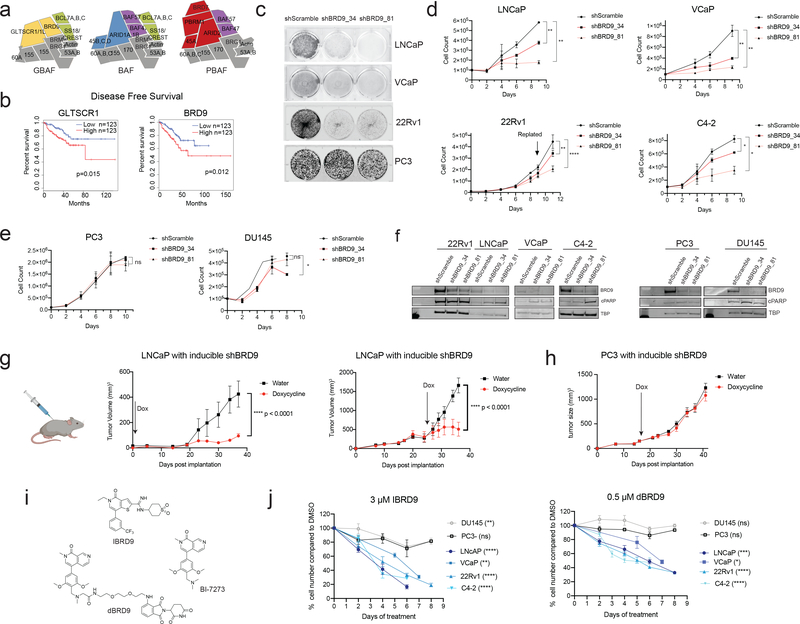
Switch/sucrose-nonfermentable (SWI/SNF) chromatin-remodeling complexes are critical regulators of chromatin dynamics during transcription, DNA replication, and DNA repair. A recently identified SWI/SNF subcomplex termed GLTSCR1/1L-BAF (GBAF; or "noncanonical BAF", ncBAF) uniquely contains bromodomain-containing protein BRD9 and glioma tumor suppressor candidate region 1 (GLTSCR1) or its paralog GLTSCR1-like (GLTSCR1L). Recent studies have identified a unique dependency on GBAF (ncBAF) complexes in synovial sarcoma and malignant rhabdoid tumors, both of which possess aberrations in canonical BAF (cBAF) and Polybromo-BAF (PBAF) complexes. Dependencies on GBAF in malignancies without SWI/SNF aberrations, however, are less defined. Here, we show that GBAF, particularly its BRD9 subunit, is required for the viability of prostate cancer cell lines and for optimal xenograft tumor growth . BRD9 interacts with androgen receptor (AR) and CCCTC-binding factor (CTCF), and modulates AR-dependent gene expression. The GBAF complex exhibits overlapping genome localization and transcriptional targets as bromodomain and extraterminal domain-containing (BET) proteins, which are established AR coregulators. Our results demonstrate that GBAF is critical for coordinating SWI/SNF-BET cooperation and uncover a new druggable target for AR-positive prostate cancers, including those resistant to androgen deprivation or antiandrogen therapies. SIGNIFICANCE: Advanced prostate cancers resistant to androgen receptor antagonists are still susceptible to nontoxic BRD9 inhibitors, making them a promising alternative for halting AR signaling in progressed disease.
开关/蔗糖非发酵型(SWI/SNF)染色质重塑复合物是转录、DNA复制和DNA修复过程中染色质动态变化的关键调节因子。最近鉴定出的一种SWI/SNF亚复合物称为GLTSCR1/1L-BAF(GBAF;或“非经典BAF”,ncBAF),其独特地包含含溴结构域蛋白BRD9和胶质瘤肿瘤抑制候选区域1(GLTSCR1)或其旁系同源物GLTSCR1样蛋白(GLTSCR1L)。最近的研究发现滑膜肉瘤和恶性横纹肌样肿瘤对GBAF(ncBAF)复合物存在独特的依赖性,这两种肿瘤在经典BAF(cBAF)和多溴BAF(PBAF)复合物中均存在畸变。然而,在没有SWI/SNF畸变的恶性肿瘤中,对GBAF的依赖性尚不明确。在这里,我们表明GBAF,特别是其BRD9亚基,是前列腺癌细胞系存活和异种移植肿瘤最佳生长所必需的。BRD9与雄激素受体(AR)和CCCTC结合因子(CTCF)相互作用,并调节AR依赖性基因表达。GBAF复合物与含溴结构域和额外末端结构域(BET)蛋白表现出重叠的基因组定位和转录靶点,而BET蛋白是已确定的AR共调节因子。我们的结果表明,GBAF对于协调SWI/SNF-BET合作至关重要,并揭示了AR阳性前列腺癌的一个新的可药物靶向,包括那些对雄激素剥夺或抗雄激素治疗耐药的癌症。意义:对雄激素受体拮抗剂耐药的晚期前列腺癌仍然对无毒的BRD9抑制剂敏感,这使其成为在进展性疾病中阻断AR信号传导的有前景的替代方案。