Biology and Genetics Section, Department of Neurosciences, Biomedicine and Movement Sciences, University of Verona, Strada Le Grazie 8, 37134, Verona, Italy.
Section of Hematology, Department of Medicine, University of Verona, Policlinico G.B. Rossi, P. L.A. Scuro 10, 37134, Verona, Italy.
Cell Mol Life Sci. 2022 Sep 16;79(10):521. doi: 10.1007/s00018-022-04540-7.
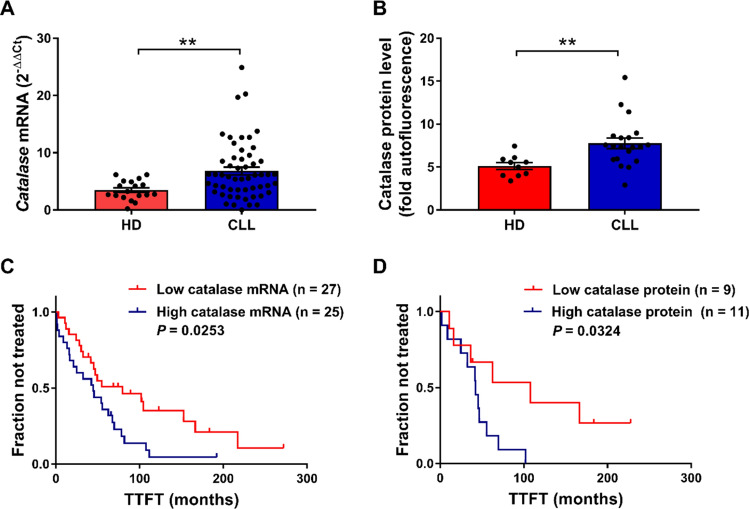
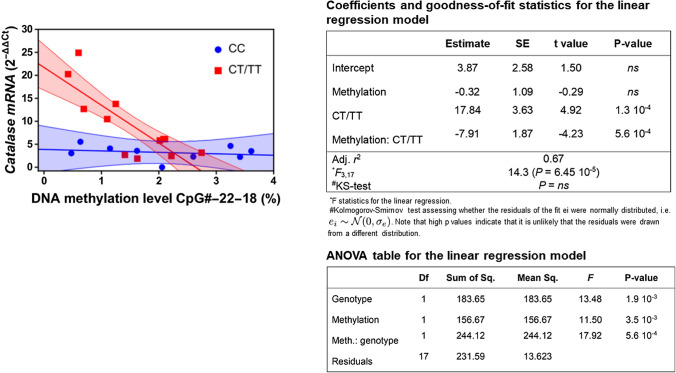
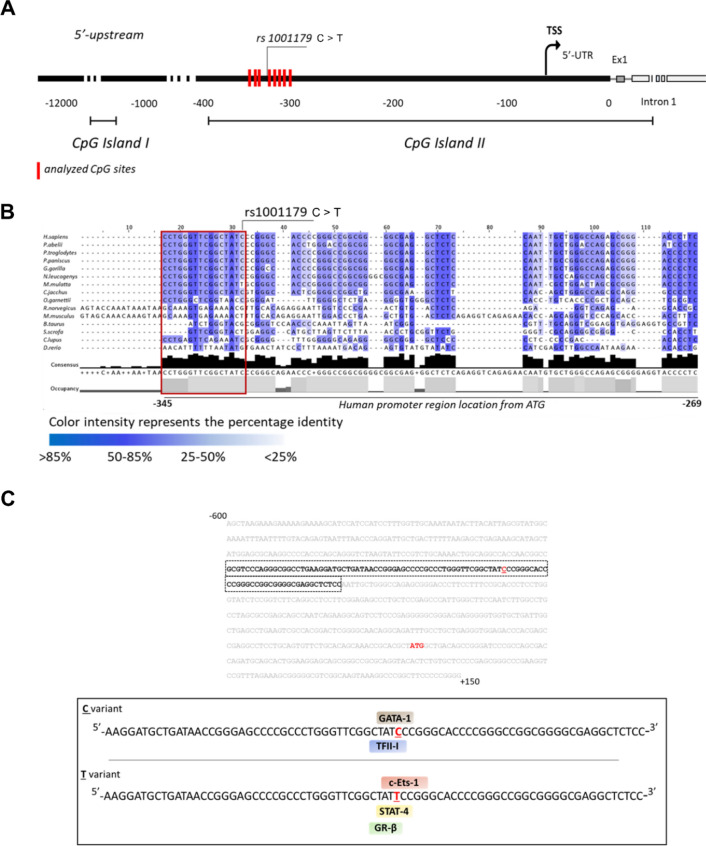
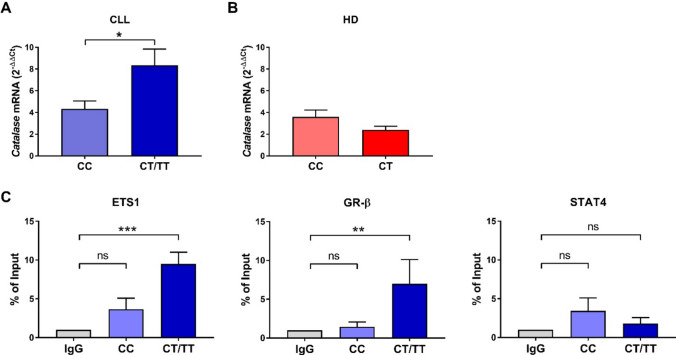
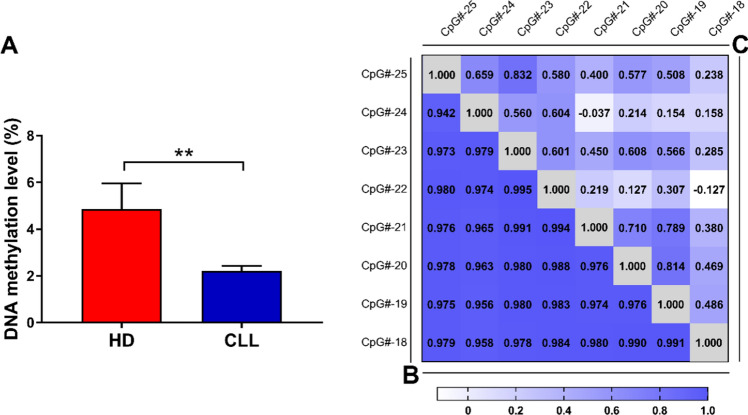
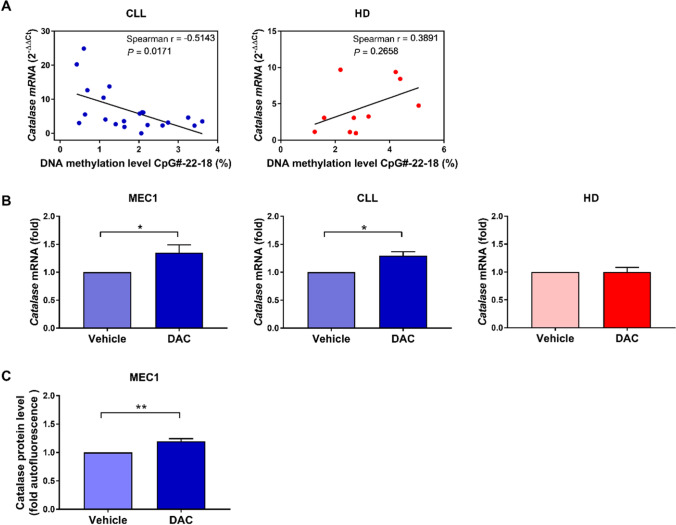
Chronic lymphocytic leukemia (CLL) is an incurable disease characterized by an extremely variable clinical course. We have recently shown that high catalase (CAT) expression identifies patients with an aggressive clinical course. Elucidating mechanisms regulating CAT expression in CLL is preeminent to understand disease mechanisms and develop strategies for improving its clinical management. In this study, we investigated the role of the CAT promoter rs1001179 single nucleotide polymorphism (SNP) and of the CpG Island II methylation encompassing this SNP in the regulation of CAT expression in CLL. Leukemic cells harboring the rs1001179 SNP T allele exhibited a significantly higher CAT expression compared with cells bearing the CC genotype. CAT promoter harboring the T -but not C- allele was accessible to ETS-1 and GR-β transcription factors. Moreover, CLL cells exhibited lower methylation levels than normal B cells, in line with the higher CAT mRNA and protein expressed by CLL in comparison with normal B cells. Methylation levels at specific CpG sites negatively correlated with CAT levels in CLL cells. Inhibition of methyltransferase activity induced a significant increase in CAT levels, thus functionally validating the role of CpG methylation in regulating CAT expression in CLL. Finally, the CT/TT genotypes were associated with lower methylation and higher CAT levels, suggesting that the rs1001179 T allele and CpG methylation may interact in regulating CAT expression in CLL. This study identifies genetic and epigenetic mechanisms underlying differential expression of CAT, which could be of crucial relevance for the development of therapies targeting redox regulatory pathways in CLL.
慢性淋巴细胞白血病(CLL)是一种无法治愈的疾病,其临床过程具有极强的可变性。我们最近发现,CAT 高表达可识别出临床侵袭性高的患者。阐明调控 CLL 中 CAT 表达的机制对于了解疾病机制和开发改善其临床管理的策略至关重要。在这项研究中,我们研究了 CAT 启动子 rs1001179 单核苷酸多态性(SNP)和包含该 SNP 的 CpG 岛 II 甲基化在调控 CLL 中 CAT 表达的作用。与携带 CC 基因型的细胞相比,携带 rs1001179 SNP T 等位基因的白血病细胞表现出明显更高的 CAT 表达。携带 T 等位基因而不是 C 等位基因的 CAT 启动子可被 ETS-1 和 GR-β 转录因子所识别。此外,CLL 细胞的甲基化水平低于正常 B 细胞,这与 CLL 细胞中 CAT mRNA 和蛋白的表达高于正常 B 细胞相一致。CLL 细胞中特定 CpG 位点的甲基化水平与 CAT 水平呈负相关。抑制甲基转移酶活性可显著增加 CAT 水平,从而在功能上验证了 CpG 甲基化在调控 CLL 中 CAT 表达的作用。最后,CT/TT 基因型与较低的甲基化和较高的 CAT 水平相关,提示 rs1001179 T 等位基因和 CpG 甲基化可能在调控 CLL 中 CAT 表达方面存在相互作用。本研究确定了调控 CAT 表达的遗传和表观遗传机制,这对于开发靶向 CLL 氧化还原调节途径的治疗方法可能具有至关重要的意义。