Center for Data and Knowledge Integration for Health (CIDACS), Gonçalo Moniz Institute, Oswaldo Cruz Foundation, Salvador, Bahia, Brazil.
Center for Data and Knowledge Integration for Health (CIDACS), Gonçalo Moniz Institute, Oswaldo Cruz Foundation, Salvador, Bahia, Brazil; Iyaleta Research Association-Research, Science and Humanities, Salvador, Bahia, Brazil.
Lancet Glob Health. 2022 Oct;10(10):e1453-e1462. doi: 10.1016/S2214-109X(22)00333-3.
Racism is a social determinant of health inequities. In Brazil, racial injustices lead to poor outcomes in maternal and child health for Black and Indigenous populations, including greater risks of pregnancy-related complications; decreased access to antenatal, delivery, and postnatal care; and higher childhood mortality rates. In this study, we aimed to estimate inequalities in childhood mortality rates by maternal race and skin colour in a cohort of more than 19 million newborns in Brazil.
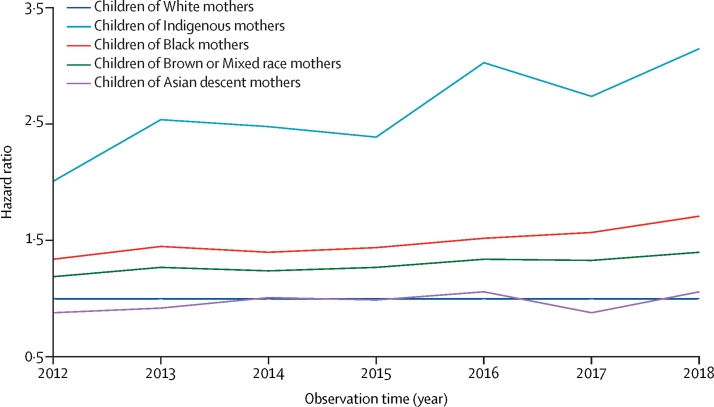
We did a nationwide population-based, retrospective cohort study using linked data on all births and deaths in Brazil between Jan 1, 2012, and Dec 31, 2018. The data consisted of livebirths followed up to age 5 years, death, or Dec 31, 2018. Data for livebirths were extracted from the National Information System for livebirths, SINASC, and for deaths from the Mortality Information System, SIM. The final sample consisted of complete data for all cases regarding maternal race and skin colour, and no inconsistencies were present between date of birth and death after linkage. We fitted Cox proportional hazard regression models to calculate the crude and adjusted hazard ratios (HRs) and 95% CIs for the association between maternal race and skin colour and all-cause and cause-specific younger than age 5 mortality rates, by age subgroups. We calculated the trend of HRs (and 95% CI) by time of observation (calendar year) to indicate trends in inequalities.
From the 20 526 714 livebirths registered in SINASC between Jan 1, 2012, and Dec 31, 2018, 238 436 were linked to death records identified from SIM. After linkage, 1 010 871 records were excluded due to missing data on maternal race or skin colour or inconsistent date of death. 19 515 843 livebirths were classified by mother's race, of which 224 213 died. Compared with children of White mothers, mortality risk for children younger than age 5 years was higher among children of Indigenous (HR 1·98 [95% CI 1·92-2·06]), Black (HR 1·39 [1·36-1·41]), and Brown or Mixed race (HR 1·19 [1·18-1·20]) mothers. The highest hazard ratios were observed during the post-neonatal period (Indigenous, HR 2·78 [95% CI 2·64-2·95], Black, HR 1·54 [1·48-1·59]), and Brown or Mixed race, HR 1·25 [1·23-1·27]) and between the ages of 1 year and 4 years (Indigenous, HR 3·82 [95% CI 3·52-4·15]), Black, HR 1·51 [1·42-1·60], and Brown or Mixed race, HR 1·30 [1·26-1·35]). Children of Indigenous (HR 16·39 [95% CI 12·88-20·85]), Black (HR 2·34 [1·78-3·06]), and Brown or Mixed race mothers (HR 2·05 [1·71-2·45]) had a higher risk of death from malnutrition than did children of White mothers. Similar patterns were observed for death from diarrhoea (Indigenous, HR 14·28 [95% CI 12·25-16·65]; Black, HR 1·72 [1·44-2·05]; and Brown or Mixed race mothers, HR 1·78 [1·61-1·98]) and influenza and pneumonia (Indigenous, HR 6·49 [95% CI 5·78-7·27]; Black, HR 1·78 [1·62-1·96]; and Brown or Mixed race mothers, HR 1·60 [1·51-1·69]).
Substantial ethnoracial inequalities were observed in child mortality in Brazil, especially among the Indigenous and Black populations. These findings demonstrate the importance of regular racial inequality assessments and monitoring. We suggest implementing policies to promote ethnoracial equity to reduce the impact of racism on child health.
MCTI/CNPq/MS/SCTIE/Decit/Bill & Melinda Gates Foundation's Grandes Desafios Brasil, Desenvolvimento Saudável para Todas as Crianças, and Wellcome Trust core support grant awarded to CIDACS-Center for Data and Knowledge Integration for Health.
种族主义是健康不平等的社会决定因素。在巴西,种族不公正导致黑人和土著人群在母婴健康方面的结果较差,包括妊娠并发症风险增加;产前、分娩和产后护理的机会减少;以及儿童死亡率较高。在这项研究中,我们旨在估计巴西一个超过 1900 万新生儿队列中按产妇种族和肤色划分的儿童死亡率的不平等情况。
我们进行了一项全国性的基于人群的回顾性队列研究,使用了巴西 2012 年 1 月 1 日至 2018 年 12 月 31 日期间所有出生和死亡的关联数据。数据包括活产儿,随访至 5 岁、死亡或 2018 年 12 月 31 日。活产儿的数据来自国家活产儿信息系统(SINASC),死亡数据来自死亡率信息系统(SIM)。最终样本包括所有关于产妇种族和肤色的完整数据,并且在链接后没有出生日期和死亡日期之间的不一致。我们使用 Cox 比例风险回归模型来计算粗死亡率和调整后的危险比(HRs)以及全因和特定年龄小于 5 岁的死亡率与产妇种族和肤色之间的关联,按年龄亚组进行分析。我们计算了 HRs(和 95%CI)随时间的趋势(按日历年度),以表明不平等的趋势。
在 SINASC 中,2012 年 1 月 1 日至 2018 年 12 月 31 日期间登记的 20526714 例活产儿中,有 238436 例与 SIM 中确定的死亡记录相关联。链接后,由于母亲种族或肤色数据缺失或死亡日期不一致,排除了 1010871 例记录。按母亲种族对 19515843 例活产儿进行分类,其中 224213 例死亡。与白人母亲的孩子相比,土著(HR 1.98 [95%CI 1.92-2.06])、黑种人(HR 1.39 [1.36-1.41])和棕色或混合种族(HR 1.19 [1.18-1.20])母亲的孩子的 5 岁以下儿童死亡率风险更高。在新生儿后期(土著人,HR 2.78 [95%CI 2.64-2.95],黑人,HR 1.54 [1.48-1.59])和 1 至 4 岁(土著人,HR 3.82 [95%CI 3.52-4.15])和黑种人,HR 1.51 [1.42-1.60])和棕色或混合种族,HR 1.30 [1.26-1.35])观察到最高的危险比。土著(HR 16.39 [95%CI 12.88-20.85])、黑种人(HR 2.34 [1.78-3.06])和棕色或混合种族母亲(HR 2.05 [1.71-2.45])的儿童死于营养不良的风险高于白人母亲的儿童。死于腹泻(土著人,HR 14.28 [95%CI 12.25-16.65];黑人,HR 1.72 [1.44-2.05])和流感和肺炎(土著人,HR 6.49 [95%CI 5.78-7.27];黑人,HR 1.78 [1.62-1.96])的模式也类似,以及棕色或混合种族母亲(HR 1.60 [1.51-1.69])。
巴西儿童死亡率存在显著的民族种族不平等,尤其是在土著和黑人群体中。这些发现表明需要定期评估和监测种族不平等情况。我们建议实施促进民族种族平等的政策,以减少种族主义对儿童健康的影响。
MCTI/CNPq/MS/SCTIE/Decit/Bill & Melinda Gates 基金会的“巴西大挑战”、“所有儿童健康发展”和“韦尔康信托核心支持赠款”授予 CIDACS-健康数据和知识整合中心。