Cancer Research Center, Beijing Chest Hospital, Capital Medical University, Beijing Tuberculosis and Thoracic Tumor Research Institute, Beijing, China.
Department of Thoracic Surgery, Beijing Chest Hospital, Capital Medical University, Beijing Tuberculosis and Thoracic Tumor Research Institute, Beijing, China.
Front Immunol. 2022 Aug 31;13:963051. doi: 10.3389/fimmu.2022.963051. eCollection 2022.
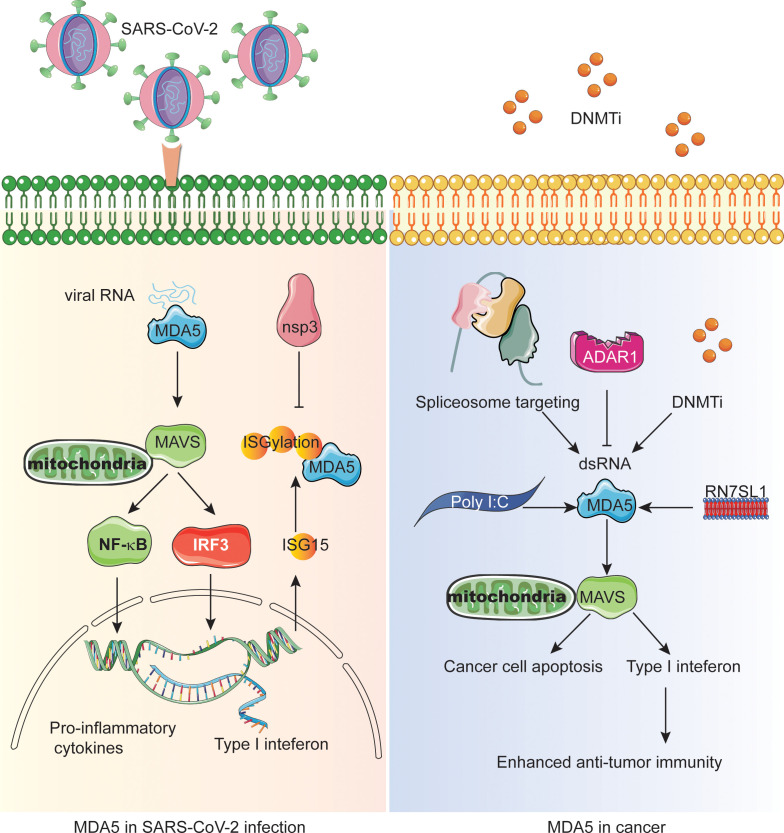
The connections between pattern recognition receptors (PRRs) and pathogen-associated molecular patterns (PAMPs) constitutes the crucial signaling pathways in the innate immune system. Cytoplasmic nucleic acid sensor melanoma differentiation-associated gene 5 (MDA5) serves as an important pattern recognition receptor in the innate immune system by recognizing viral RNA. MDA5 also plays a role in identifying the cytoplasmic RNA from damaged, dead cancer cells or autoimmune diseases. MDA5's recognition of RNA triggers innate immune responses, induces interferon (IFN) response and a series of subsequent signaling pathways to produce immunomodulatory factors and inflammatory cytokines. Here we review the latest progress of MDA5 functions in triggering anti-tumor immunity by sensing cytoplasmic dsRNA, and recognizing SARS-CoV-2 virus infection for antiviral response, in which the virus utilizes multiple ways to evade the host defense mechanism.
模式识别受体(PRRs)与病原体相关分子模式(PAMPs)之间的联系构成了先天免疫系统中的关键信号通路。细胞质核酸传感器黑色素瘤分化相关基因 5(MDA5)作为先天免疫系统中的重要模式识别受体,通过识别病毒 RNA 发挥作用。MDA5 还在识别来自受损、死亡的癌细胞或自身免疫性疾病的细胞质 RNA 方面发挥作用。MDA5 对 RNA 的识别引发先天免疫反应,诱导干扰素(IFN)反应和一系列后续信号通路,产生免疫调节因子和炎症细胞因子。在这里,我们综述了 MDA5 通过感应细胞质 dsRNA 触发抗肿瘤免疫以及识别 SARS-CoV-2 病毒感染以产生抗病毒反应的最新进展,其中病毒利用多种方式逃避宿主防御机制。