Department of Radiation Oncology, Perelman School of Medicine, University of Pennsylvania, Philadelphia, PA, USA; Department of Pathology and Laboratory Medicine, Perelman School of Medicine, University of Pennsylvania, Philadelphia, PA, USA; Abramson Family Cancer Research Institute, Perelman School of Medicine, University of Pennsylvania, Philadelphia, PA, USA; Center for Cellular Immunotherapies, Perelman School of Medicine, University of Pennsylvania, Philadelphia, PA, USA; Mark Foundation Center for Immunotherapy, Immune Signaling, and Radiation, Perelman School of Medicine, University of Pennsylvania, Philadelphia, PA, USA.
Department of Radiation Oncology, Perelman School of Medicine, University of Pennsylvania, Philadelphia, PA, USA; Abramson Family Cancer Research Institute, Perelman School of Medicine, University of Pennsylvania, Philadelphia, PA, USA.
Cell. 2021 Sep 16;184(19):4981-4995.e14. doi: 10.1016/j.cell.2021.08.004. Epub 2021 Aug 30.
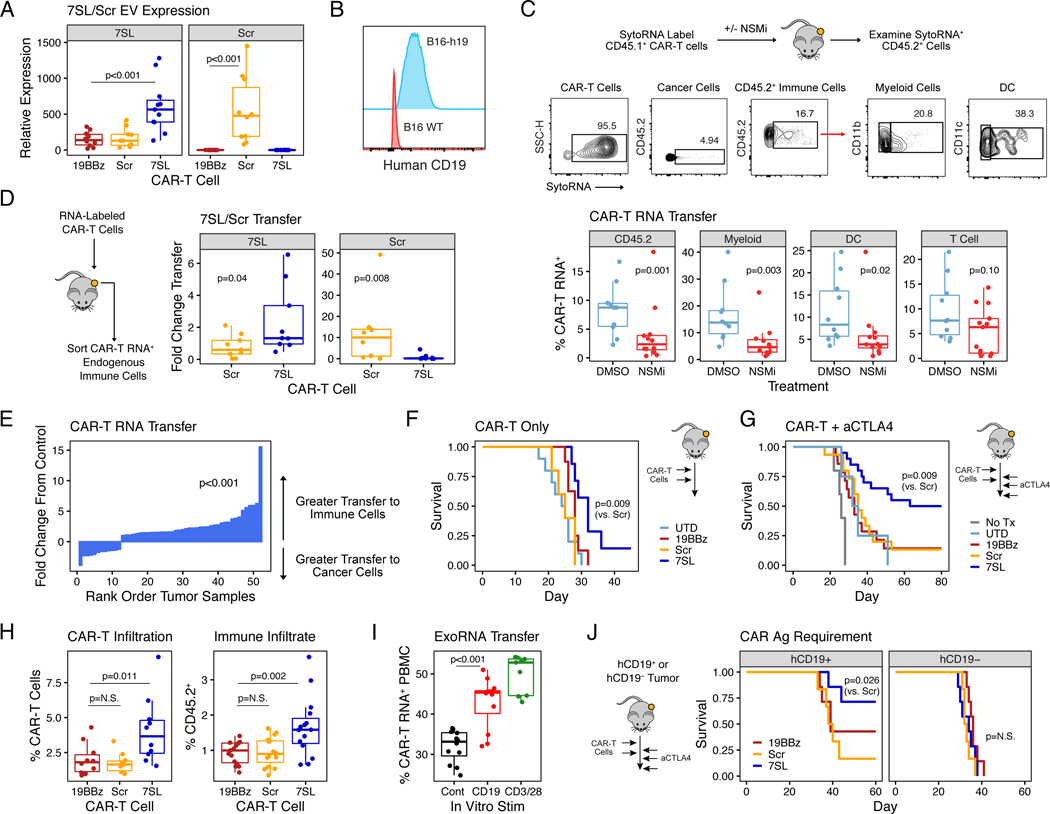
Poor tumor infiltration, development of exhaustion, and antigen insufficiency are common mechanisms that limit chimeric antigen receptor (CAR)-T cell efficacy. Delivery of pattern recognition receptor agonists is one strategy to improve immune function; however, targeting these agonists to immune cells is challenging, and off-target signaling in cancer cells can be detrimental. Here, we engineer CAR-T cells to deliver RN7SL1, an endogenous RNA that activates RIG-I/MDA5 signaling. RN7SL1 promotes expansion and effector-memory differentiation of CAR-T cells. Moreover, RN7SL1 is deployed in extracellular vesicles and selectively transferred to immune cells. Unlike other RNA agonists, transferred RN7SL1 restricts myeloid-derived suppressor cell (MDSC) development, decreases TGFB in myeloid cells, and fosters dendritic cell (DC) subsets with costimulatory features. Consequently, endogenous effector-memory and tumor-specific T cells also expand, allowing rejection of solid tumors with CAR antigen loss. Supported by improved endogenous immunity, CAR-T cells can now co-deploy peptide antigens with RN7SL1 to enhance efficacy, even when heterogenous CAR antigen tumors lack adequate neoantigens.
肿瘤浸润不良、衰竭的发展和抗原不足是限制嵌合抗原受体 (CAR)-T 细胞疗效的常见机制。模式识别受体激动剂的递送是改善免疫功能的一种策略;然而,将这些激动剂靶向免疫细胞具有挑战性,并且癌细胞中的非靶向信号可能有害。在这里,我们设计了 CAR-T 细胞来递送 RN7SL1,一种激活 RIG-I/MDA5 信号的内源性 RNA。RN7SL1 促进 CAR-T 细胞的扩增和效应记忆分化。此外,RN7SL1 被部署在细胞外囊泡中,并选择性地转移到免疫细胞中。与其他 RNA 激动剂不同,转移的 RN7SL1 限制髓样来源的抑制细胞 (MDSC) 的发展,减少髓细胞中的 TGFB,并促进具有共刺激特征的树突状细胞 (DC) 亚群。因此,内源性效应记忆和肿瘤特异性 T 细胞也会扩增,从而允许 CAR 抗原丢失的实体瘤被排斥。在增强的内源性免疫的支持下,CAR-T 细胞现在可以与 RN7SL1 共同部署肽抗原以提高疗效,即使在具有异质性 CAR 抗原的肿瘤中缺乏足够的新抗原时也是如此。