Muraro Antonella, de Silva Debra, Halken Susanne, Worm Margitta, Khaleva Ekaterina, Arasi Stefania, Dunn-Galvin Audrey, Nwaru Bright I, De Jong Nicolette W, Rodríguez Del Río Pablo, Turner Paul J, Smith Pete, Begin Philippe, Angier Elizabeth, Arshad Hasan, Ballmer-Weber Barbara, Beyer Kirsten, Bindslev-Jensen Carsten, Cianferoni Antonella, Demoulin Céline, Deschildre Antoine, Ebisawa Motohiro, Fernandez-Rivas Maria Montserrat, Fiocchi Alessandro, Flokstra-de Blok Bertine, Gerdts Jennifer, Gradman Josefine, Grimshaw Kate, Jones Carla, Lau Susanne, Loh Richard, Alvaro Lozano Montserrat, Makela Mika, Marchisotto Mary Jane, Meyer Rosan, Mills Clare, Nilsson Caroline, Nowak-Wegrzyn Anna, Nurmatov Ulugbek, Pajno Giovanni, Podestà Marcia, Poulsen Lars K, Sampson Hugh A, Sanchez Angel, Schnadt Sabine, Szajewska Hania, Van Ree Ronald, Venter Carina, Vlieg-Boerstra Berber, Warner Amena, Wong Gary, Wood Robert, Zuberbier Torsten, Roberts Graham
Food Allergy Centre, Padua University Hospital, Italy.
The Evidence Centre, UK.
World Allergy Organ J. 2022 Sep 7;15(9):100687. doi: 10.1016/j.waojou.2022.100687. eCollection 2022 Sep.
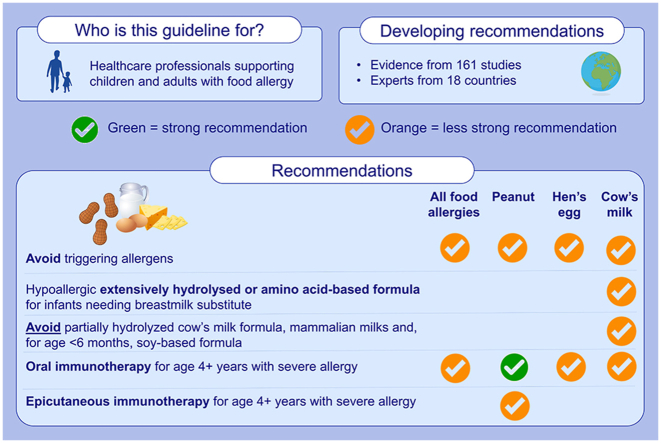
Food allergy affects approximately 2-4% of children and adults. This guideline provides recommendations for managing food allergy from the Global Allergy and Asthma European Network (GALEN). A multidisciplinary international Task Force developed the guideline using the Appraisal of Guidelines for Research and Evaluation (AGREE) II framework and the Grading of Recommendations, Assessment, Development and Evaluations (GRADE) approach. We reviewed the latest available evidence as of April 2021 (161 studies) and created recommendations by balancing benefits, harms, feasibility, and patient and clinician experiences. We suggest that people diagnosed with food allergy avoid triggering allergens (low certainty evidence). We suggest that infants with cow's milk allergy who need a breastmilk alternative use either hypoallergenic extensively hydrolyzed cow's milk formula or an amino acid-based formula (moderate certainty). For selected children with peanut allergy, we recommend oral immunotherapy (high certainty), though epicutaneous immunotherapy might be considered depending on individual preferences and availability (moderate certainty). We suggest considering oral immunotherapy for children with persistent severe hen's egg or cow's milk allergy (moderate certainty). There are significant gaps in evidence about safety and effectiveness of the various strategies. Research is needed to determine the best approaches to education, how to predict the risk of severe reactions, whether immunotherapy is cost-effective and whether biological therapies are effective alone or combined with allergen immunotherapy.
食物过敏影响约2%至4%的儿童和成人。本指南提供了来自全球过敏与哮喘欧洲网络(GALEN)的食物过敏管理建议。一个多学科国际特别工作组使用研究与评价指南评估(AGREE)II框架以及推荐分级、评估、制定与评价(GRADE)方法制定了本指南。我们回顾了截至2021年4月的最新可用证据(161项研究),并通过权衡益处、危害、可行性以及患者和临床医生的经验来制定建议。我们建议被诊断为食物过敏的人避免接触引发过敏的过敏原(证据确定性低)。我们建议需要母乳替代品的牛奶过敏婴儿使用低敏深度水解牛奶配方奶粉或氨基酸基配方奶粉(证据确定性中等)。对于部分花生过敏儿童,我们推荐口服免疫疗法(证据确定性高),不过根据个人偏好和可及性,也可考虑使用经皮免疫疗法(证据确定性中等)。我们建议考虑对持续性严重鸡蛋或牛奶过敏的儿童进行口服免疫疗法(证据确定性中等)。关于各种策略的安全性和有效性,证据存在重大差距。需要开展研究以确定最佳教育方法、如何预测严重反应风险、免疫疗法是否具有成本效益以及生物疗法单独使用或与过敏原免疫疗法联合使用是否有效。