Kang Jiyeon, Cairns John
Department of Health Service Research and Policy, Faculty of Public Health and Policy, London School of Hygiene and Tropical Medicine, 15-17 Tavistock Place, London, WC1H 9SH, UK.
Centre for Cancer Biomarkers (CCBIO), University of Bergen, Bergen, Norway.
Pharmacoecon Open. 2023 Jan;7(1):77-91. doi: 10.1007/s41669-022-00369-9. Epub 2022 Sep 20.
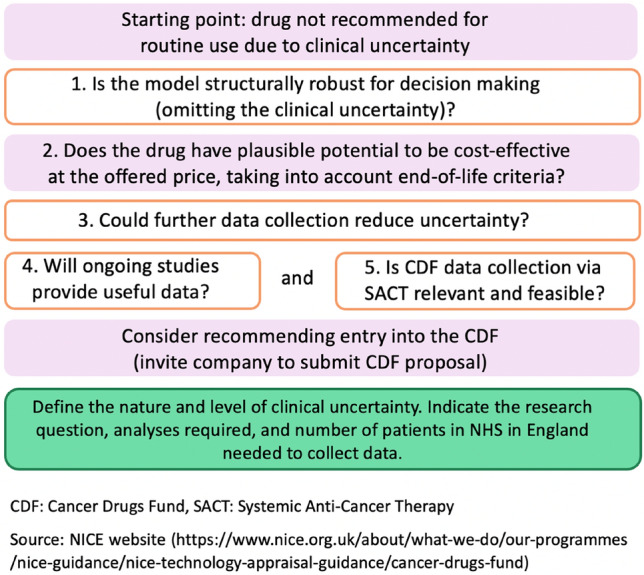
The Cancer Drugs Fund (CDF) in England uses managed access agreements to facilitate additional data collection to address uncertainties identified in the appraisals of new drugs. This study reviews the uncertainties highlighted in the original appraisals where recommendations "to use within the CDF" were made and how additional data were used to address these uncertainties in the CDF review appraisals where final decisions on routine commissioning were made.
The first 24 drugs exiting the 2016 CDF were included in this review. The information about uncertainty and the use of newly collected data were extracted from the original appraisals and the CDF review appraisals. The additional data used in the CDF review appraisals, distinguishing between clinical trial data and real-world data (RWD), were reviewed to assess the extent to which the additional data were able to reduce the original uncertainties.
The recommendation that the drug be routinely commissioned was made in 87.5% of re-appraisals. Uncertainty stemming from immaturity of the survival data in clinical trials was frequently found in appraisals. Later follow-up of clinical trials was used to address this uncertainty, whereas limited use was made of RWD. The Systemic Anti-Cancer Therapy (SACT) dataset is the most frequently used source of RWD. SACT data were mostly used in review appraisals to support the clinical outcomes based on later follow-up of trial participants and to inform modelling of subsequent treatments or treatment duration.
While additionally collected RWD attracted attention when the 2016 CDF was introduced, RWD have not been widely used in CDF review appraisals and (to date) have done little to reduce uncertainty. Experience with these appraisals has highlighted the importance of longer follow-up of clinical trials and the relatively limited role of RWD, in general, and of SACT data in particular.
英国的癌症药物基金(CDF)利用管理式准入协议来促进额外数据的收集,以解决新药评估中发现的不确定性问题。本研究回顾了在最初评估中所强调的不确定性,这些评估做出了“在CDF范围内使用”的建议,以及在CDF审查评估中如何利用额外数据来解决这些不确定性,CDF审查评估做出了关于常规委托的最终决定。
本综述纳入了2016年CDF中首批退出的24种药物。从最初评估和CDF审查评估中提取有关不确定性和新收集数据使用情况的信息。对CDF审查评估中使用的额外数据进行了审查,区分了临床试验数据和真实世界数据(RWD),以评估额外数据能够减少原始不确定性的程度。
在87.5%的重新评估中做出了该药物应常规委托的建议。在评估中经常发现临床试验生存数据不成熟所导致的不确定性。利用临床试验的后期随访来解决这一不确定性,而对真实世界数据的使用有限。全身抗癌治疗(SACT)数据集是最常使用的真实世界数据来源。SACT数据大多用于审查评估,以基于试验参与者的后期随访支持临床结果,并为后续治疗或治疗持续时间的建模提供信息。
虽然在引入2016年CDF时,额外收集的真实世界数据引起了关注,但真实世界数据在CDF审查评估中并未得到广泛应用,并且(迄今为止)在减少不确定性方面作用甚微。这些评估的经验凸显了临床试验更长随访期的重要性,以及一般而言真实世界数据,特别是SACT数据的作用相对有限。