Department of Orthopedics, Union Hospital, Tongji Medical College, Huazhong University of Science and Technology, Wuhan, 430022, China.
Department of Urology, The Second Xiangya Hospital, Central South University, Changsha, Hunan, 410011, China.
Adv Healthc Mater. 2022 Dec;11(23):e2200955. doi: 10.1002/adhm.202200955. Epub 2022 Oct 3.
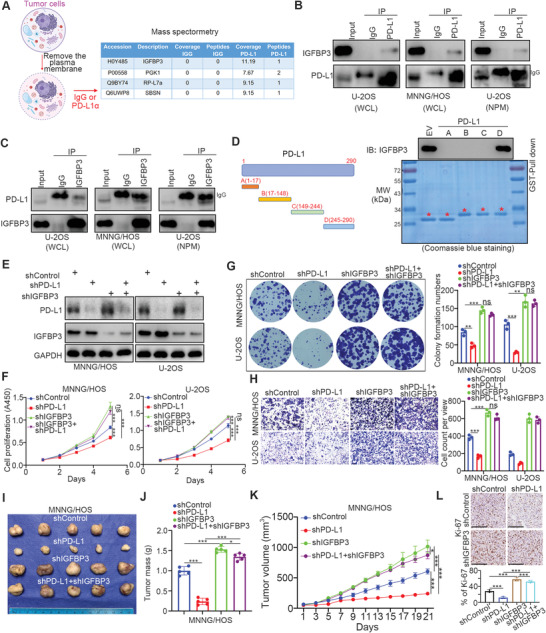
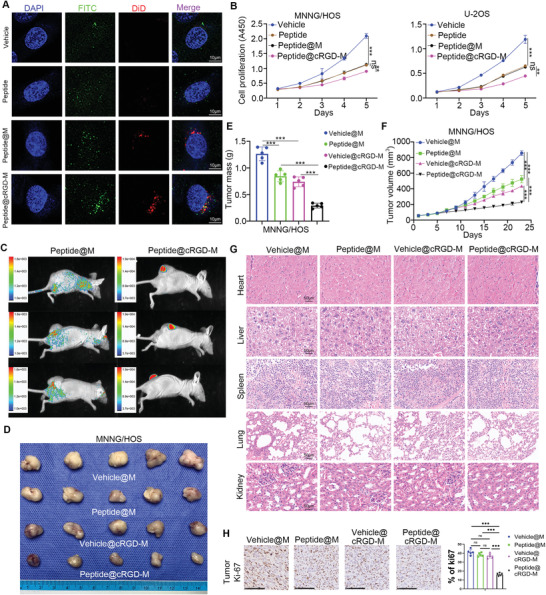
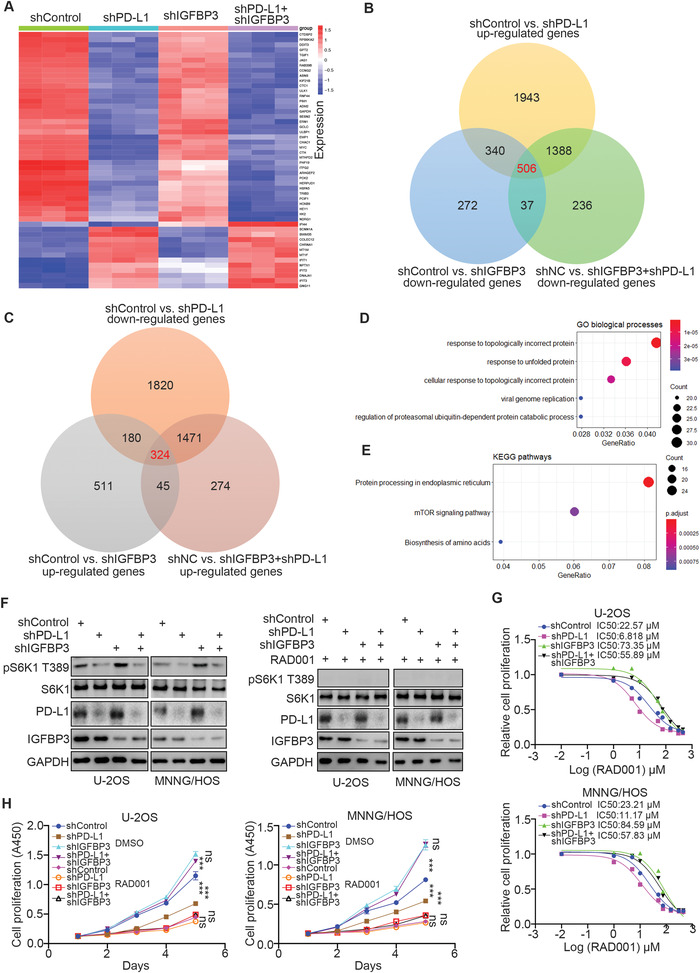
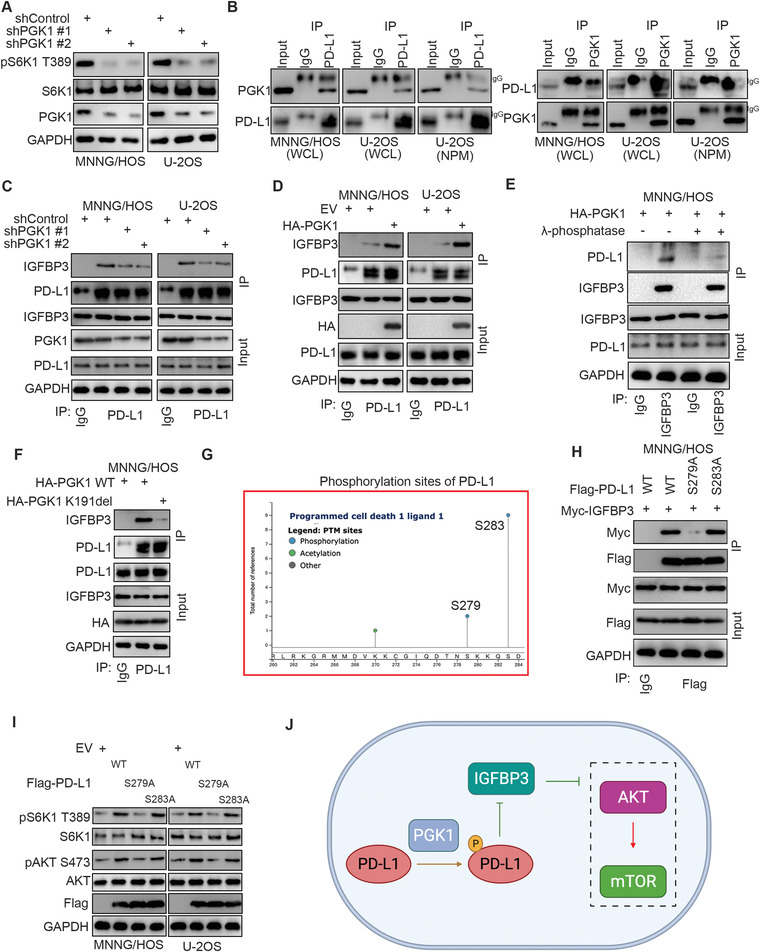
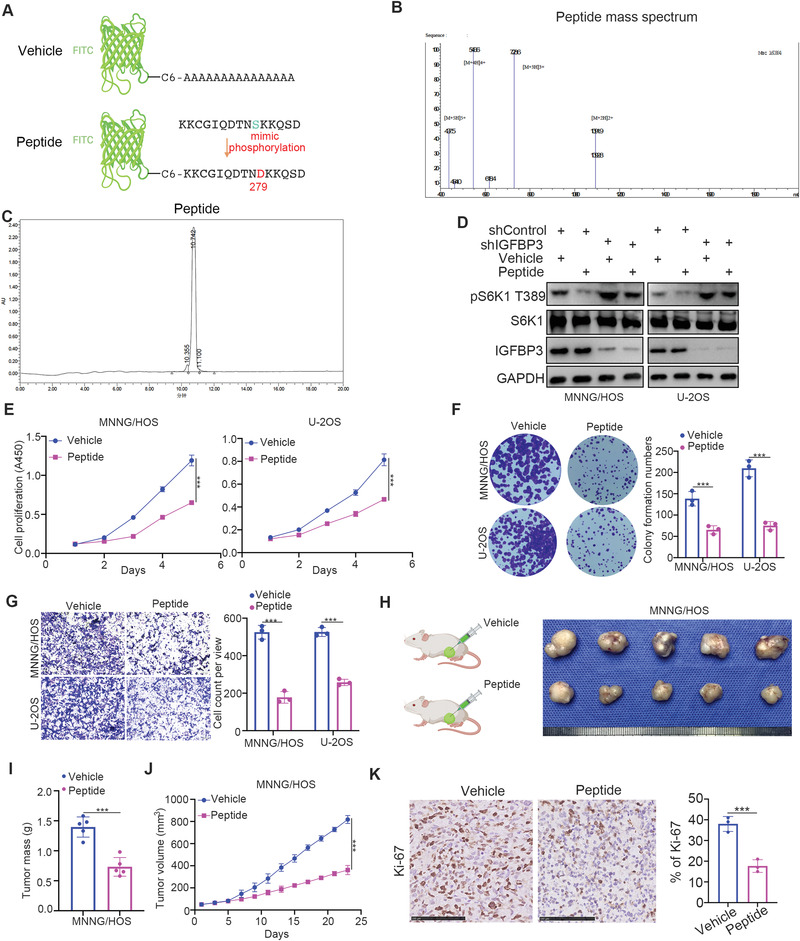
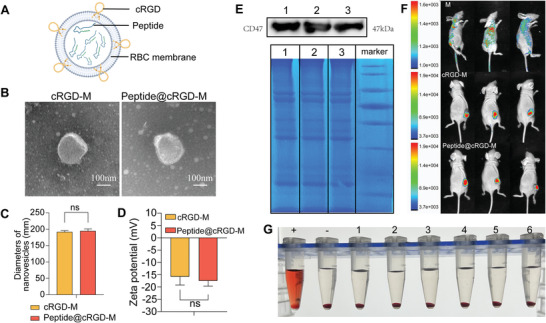
Osteosarcoma is a rare malignant bone-originating tumor that usually occurs in young people. Programmed cell death 1 ligand 1 (PD-L1), an immune checkpoint protein, is highly expressed in osteosarcoma tissues. Several recent studies have indicated that the tumor-related role of PD-L1 in tumors, especially non-plasma membrane (NPM)-localized PD-L1, is not limited to immune regulation in osteosarcoma. Here, mass spectrometry analysis is combined with RNA-seq examination to identify the intracellular binding partners of PD-L1 and elucidate the underlying mechanism of its action. It is found that the NPM-localized PD-L1 interacted with Insulin-like growth factor binding protein-3 (IGFBP3) to promote osteosarcoma tumor growth by activating mTOR signaling. This interaction is enforced after phosphoglyceratekinase1 (PGK1)-mediated PD-L1 phosphorylation. Based on these findings, a phosphorylation-mimicking peptide is designed from PD-L1 and it is encapsulated with a Cyclic RGD (cRGD)-modified red blood cell membrane (RBCM) vesicle (Peptide@cRGD-M). The Peptide@cRGD-M precisely delivers the PD-L1-derived phosphorylation-mimicking peptide into osteosarcoma lesions and significantly promotes its therapeutic effect on the tumor. Therefore, this investigation not only highlights the function of NPM-localized PD-L1, but also uses an engineering approach to synthesize a small molecular peptide capable of inhibiting osteosarcoma growth.
骨肉瘤是一种罕见的起源于骨骼的恶性肿瘤,通常发生在年轻人中。程序性细胞死亡配体 1(PD-L1)是一种免疫检查点蛋白,在骨肉瘤组织中高度表达。最近的几项研究表明,PD-L1 在肿瘤中的肿瘤相关作用,特别是非质膜(NPM)定位的 PD-L1,不仅限于骨肉瘤中的免疫调节。在这里,我们结合质谱分析和 RNA-seq 检查来鉴定 PD-L1 的细胞内结合伙伴,并阐明其作用的潜在机制。结果发现,NPM 定位的 PD-L1 通过激活 mTOR 信号通路与胰岛素样生长因子结合蛋白 3(IGFBP3)相互作用,促进骨肉瘤肿瘤生长。这种相互作用是在磷酸甘油酸激酶 1(PGK1)介导的 PD-L1 磷酸化后增强的。基于这些发现,我们从 PD-L1 设计了一个磷酸化模拟肽,并将其封装在具有 Cyclic RGD(cRGD)修饰的红细胞膜(RBCM)囊泡(Peptide@cRGD-M)中。Peptide@cRGD-M 精确地将 PD-L1 衍生的磷酸化模拟肽递送到骨肉瘤病变部位,并显著促进其对肿瘤的治疗效果。因此,本研究不仅强调了 NPM 定位的 PD-L1 的功能,还利用工程方法合成了一种能够抑制骨肉瘤生长的小分子肽。