Center of Nutrition, Health, and Society (NUTRISS), Institute of Nutrition and Functional Foods (INAF), Laval University, Québec, Quebec, Canada.
Research Center, University Institute of Cardiology and Pneumology of Quebec, Laval University, Québec, Quebec, Canada.
Am J Clin Nutr. 2022 Dec 19;116(6):1748-1758. doi: 10.1093/ajcn/nqac256.
Canada's Food Guide (CFG) was profoundly revised in 2019, but the extent to which adherence to recommendations on healthy food choices reduces the risk of cardiovascular disease (CVD) is unknown.
The aim of this study was to examine how greater adherence to the 2019 CFG's recommendations on healthy food choices influences the risk of incident CVD.
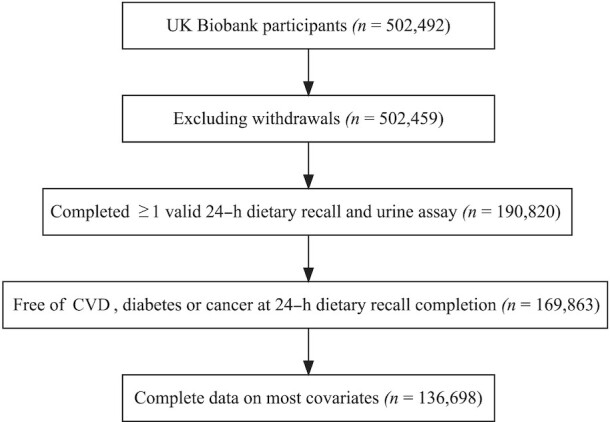
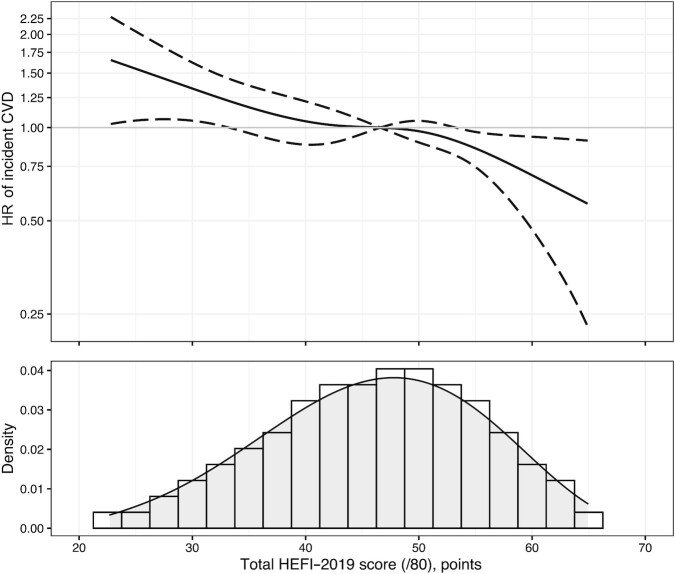
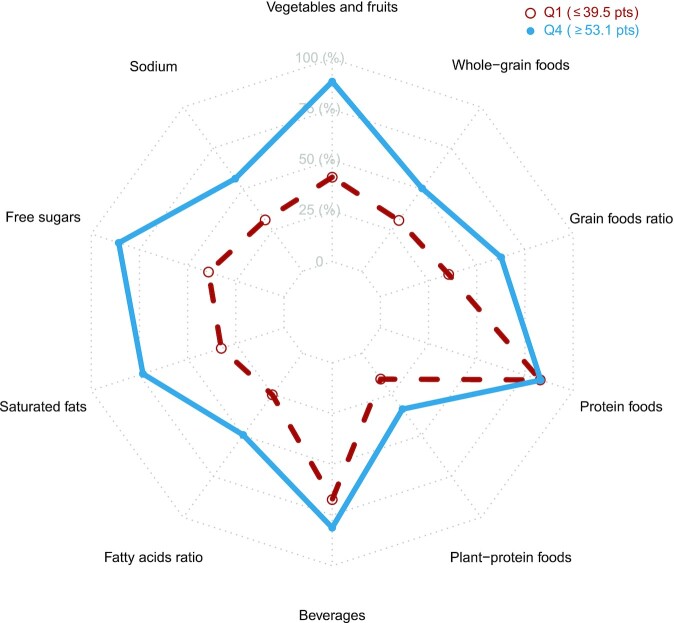
Participants were a sample of adults without history of CVD, diabetes, or cancer from the UK Biobank prospective cohort study. Usual dietary intakes were estimated by modeling data from repeated Web-based 24-h dietary recalls using the National Cancer Institute multivariate method. Adherence to key CFG recommendations on healthy food choices was assessed using the Healthy Eating Food Index (HEFI)-2019, which has a maximum of 80 points. The CVD outcome was a composite of fatal and nonfatal myocardial infarction and ischemic stroke. Cox regression models adjusted via inverse probability weighting were used to estimate CVD risks. Counterfactual models were used to interpret risks of hypothetical changes in the HEFI-2019 score.
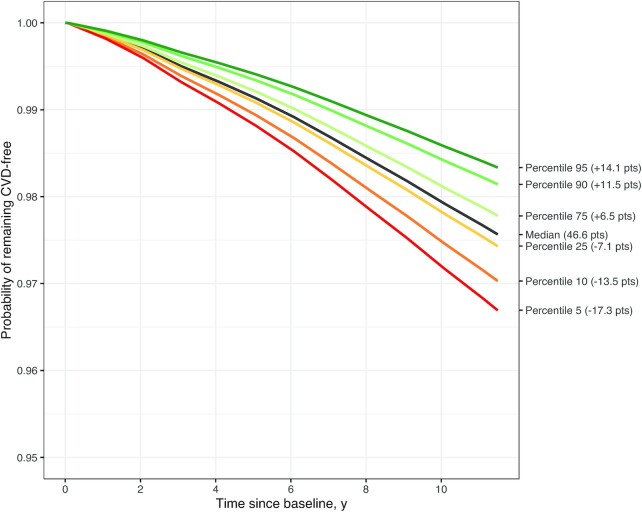
A total of 136,698 participants met the eligibility criteria (55% females; mean age: 57.2 y; range: 40-75 y). During the 11-y follow-up, there were 2843 cases of incident CVD. Compared with no change in the HEFI-2019 score, increasing the HEFI-2019 score of all participants to the 90th percentile of the score distribution (58.1 points) hypothetically reduced the risk of CVD by 24% (RR: 0.76; 95% CI: 0.58, 0.94; absolute risk difference: -0.58%).
These results suggest that greater adherence to the 2019 CFG recommendations on healthy food choices reduces the 11-y risk of CVD in middle-aged and older adults.
加拿大食物指南(CFG)在 2019 年进行了彻底修订,但遵守健康食品选择建议对降低心血管疾病(CVD)风险的程度尚不清楚。
本研究旨在检查对 2019 年 CFG 健康食品选择建议的更高依从性如何影响 CVD 事件的风险。
参与者是来自英国生物银行前瞻性队列研究的无 CVD、糖尿病或癌症病史的成年人样本。使用国家癌症研究所多变量方法对重复的基于网络的 24 小时饮食回忆数据进行建模,以估算习惯性饮食摄入量。使用健康饮食食品指数(HEFI)-2019 评估对健康食品选择的关键 CFG 建议的依从性,其最高得分为 80 分。CVD 结局是致命和非致命性心肌梗死和缺血性中风的综合。通过逆概率加权进行调整的 Cox 回归模型用于估计 CVD 风险。使用反事实模型来解释 HEFI-2019 得分变化的风险。
共有 136698 名符合条件的参与者(55%为女性;平均年龄:57.2 岁;范围:40-75 岁)。在 11 年的随访期间,有 2843 例发生 CVD 事件。与 HEFI-2019 评分无变化相比,所有参与者的 HEFI-2019 评分增加到评分分布的第 90 个百分位数(58.1 分),假设可降低 CVD 风险 24%(RR:0.76;95%CI:0.58,0.94;绝对风险差异:-0.58%)。
这些结果表明,对 2019 年 CFG 健康食品选择建议的更高依从性可降低中老年人群 CVD 的 11 年风险。