Yousif Reber S, Omar Alend M, Ismail Mustafa, Hamouda Waeel O, Alkhafaji Aktham O, Hoz Samer S
Department of Neurosurgery, Emergency Teaching Hospital, Duhok, Iraq.
College of Medicine, University of Baghdad, Baghdad, Iraq.
Surg Neurol Int. 2022 Aug 26;13:388. doi: 10.25259/SNI_350_2022. eCollection 2022.
Nonmissile penetrating traumatic brain injuries (pTBIs) are low-velocity injuries which can be caused by a variety of inflicting tools and represent a rare entity in children. Poor outcome has been attributed with an initial admission Glasgow Coma Scale (GCS) of <5, asymmetrical pupil size, and specific initial computed tomography scan findings including brainstem injury.
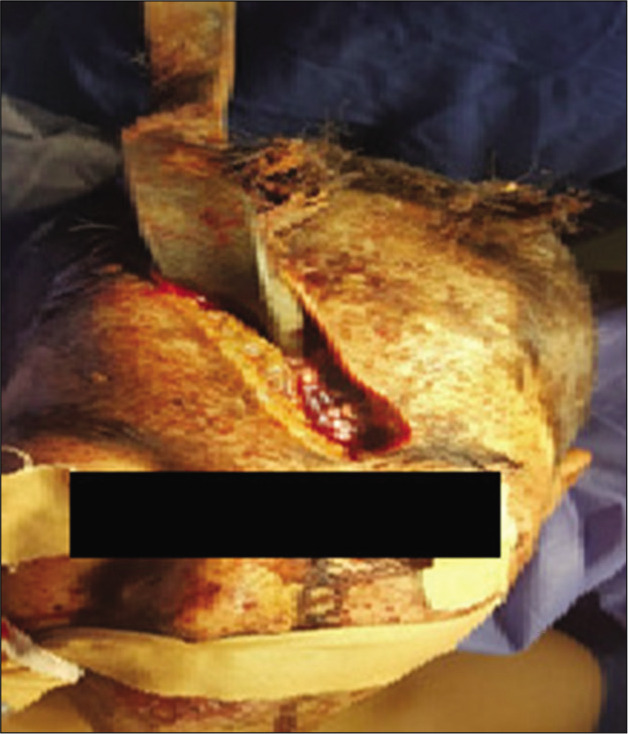
We report a case of an 11-year-old boy who presented to our ER with a GCS of 6 after being assaulted on his head by a 30 cm length metallic tent hook penetrating his forehead reaching down to the central skull base zone.
We demonstrated that following standard recommendations in the management of pTBI which include applying the advanced trauma life support protocol in ER, acquiring the needed preoperative neuroimaging studies, avoiding moving the penetrating object till patient shifted to OR, and finally performing a planned stepwise surgical intervention through craniotomy may yield an excellent functional recovery, especially in children despite an otherwise grave initial presentation and apparently profound brain injury.
非导弹穿透性创伤性脑损伤(pTBI)是低速损伤,可由多种致伤工具造成,在儿童中较为罕见。不良预后与初始入院时格拉斯哥昏迷量表(GCS)评分<5、瞳孔大小不对称以及包括脑干损伤在内的特定初始计算机断层扫描结果有关。
我们报告一例11岁男孩,他被一个30厘米长的金属帐篷钩击中头部,钩子穿透前额直至中央颅底区域,随后以GCS评分为6被送往我们的急诊室。
我们证明,遵循pTBI管理的标准建议,包括在急诊室应用高级创伤生命支持方案、进行所需的术前神经影像学检查、在患者转移至手术室之前避免移动穿透物体,以及最后通过开颅手术进行有计划的逐步手术干预,可能会产生极佳的功能恢复,尤其是对于儿童,尽管初始表现严重且明显存在严重脑损伤。