National Observatory of Athens, Institute for Environmental Research and Sustainable Development, 15236, Athens, Greece.
Int J Biometeorol. 2022 Nov;66(11):2339-2355. doi: 10.1007/s00484-022-02361-8. Epub 2022 Sep 21.
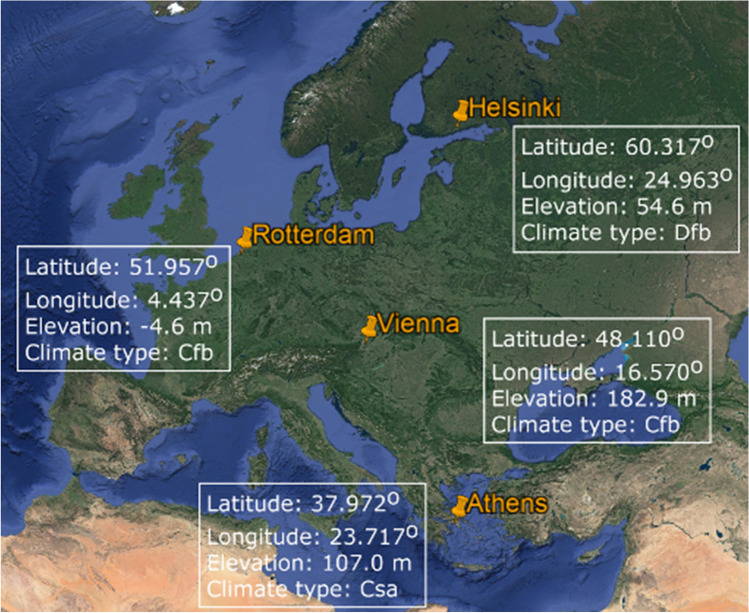
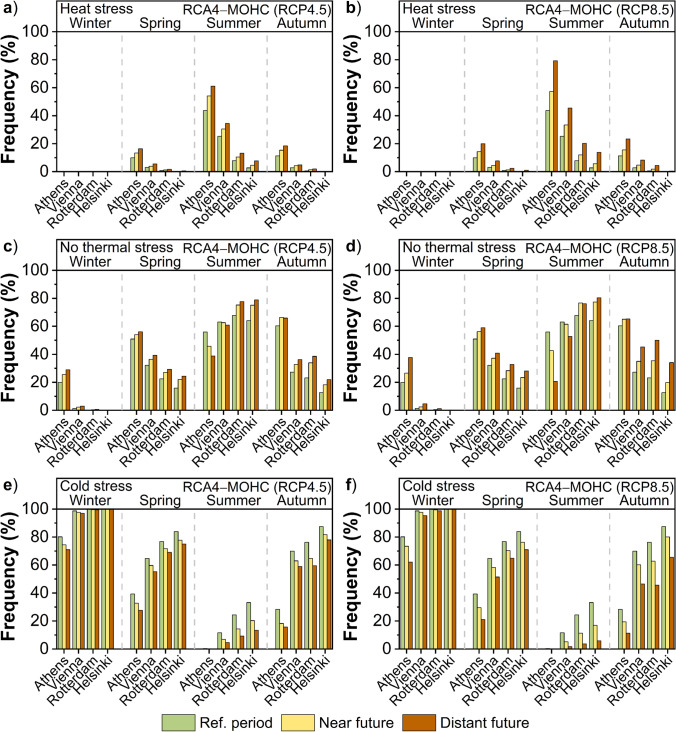
The thermal conditions that prevail in cities pose a number of challenges to urban residents and policy makers related to quality of life, health and welfare as well as to sustainable urban development. However, the changes in thermal stress due to climate change are probably not uniform among cities with different background climates. In this work, a comparative analysis of observed and projected thermal stress (cold stress, heat stress, no thermal stress) across four European cities (Helsinki, Rotterdam, Vienna, and Athens), which are representative of different geographical and climatic regions of the continent, for a recent period (1975 - 2004) and two future periods (2029 - 2058, 2069 - 2098) has been conducted. Applying a rational thermal index (Universal Thermal Climate Index) and considering two models of the EURO-CORDEX experiment (RCA4-MOHC, RCA4-MPI) under two Representative Concentration Pathways (RCP4.5, RCP8.5), the projected future changes in thermal conditions are inspected. The distribution of thermal stress in the current climate varies greatly between the cities, reflecting their climatic and urban heterogeneity. In the future climate, a reduction in the frequency of cold stress is expected across all cities, ranging between - 2.9% and - 16.2%. The projected increase in the frequency of optimal thermal conditions increases with increasing latitude, while the projected increase in the frequency of heat stress (ranging from + 0.2 to + 14.6%) decreases with increasing latitudes. Asymmetrical changes in cold- and heat-related stress between cities were found to affect the annual percentage of optimal (no thermal stress) conditions in future. Although future projections are expected to partly bridge the gap between the less-privileged cities (with respect to annual frequency of optimal thermal conditions) like Helsinki and Rotterdam and the more privileged ones like Athens, the former will still lag behind on an annual basis.
城市中的热环境给城市居民和政策制定者带来了许多挑战,涉及生活质量、健康和福利以及可持续城市发展等方面。然而,由于气候变化,不同背景气候的城市之间的热应力变化可能并不均匀。在这项工作中,对四个欧洲城市(赫尔辛基、鹿特丹、维也纳和雅典)进行了观测和预测的热应力(冷应力、热应力、无热应力)的比较分析,这些城市代表了该大陆不同地理和气候区域,时间范围为近期(1975-2004 年)和两个未来时期(2029-2058 年、2069-2098 年)。应用合理的热指数(通用热气候指数)并考虑 EURO-CORDEX 实验的两个模型(RCA4-MOHC、RCA4-MPI)在两个代表性浓度途径(RCP4.5、RCP8.5)下,检查了未来热条件的变化。当前气候下热应力的分布在城市之间差异很大,反映了它们的气候和城市异质性。在未来的气候中,预计所有城市的冷应力频率都会降低,范围在-2.9%到-16.2%之间。预计最优热条件频率的增加随纬度的增加而增加,而预计热应力频率的增加(范围从+0.2 到+14.6%)随纬度的增加而减少。发现城市之间冷相关和热相关压力的不对称变化会影响未来最优(无热应力)条件的年百分率。尽管未来的预测预计将部分缩小赫尔辛基和鹿特丹等较不富裕的城市(就最优热条件的年频率而言)与更优越的城市(如雅典)之间的差距,但前者仍将在年度基础上落后。