Gaur Anupama, Tiwari Shivam, Kumar Chandan, Maiti Pralay
School of Materials Science and Technology, Indian Institute of Technology (Banaras Hindu University) Varanasi 221005 India
School of Biomedical Engineering, Indian Institute of Technology (Banaras Hindu University) Varanasi 221005 India.
Nanoscale Adv. 2019 Jun 27;1(8):3200-3211. doi: 10.1039/c9na00214f. eCollection 2019 Aug 6.
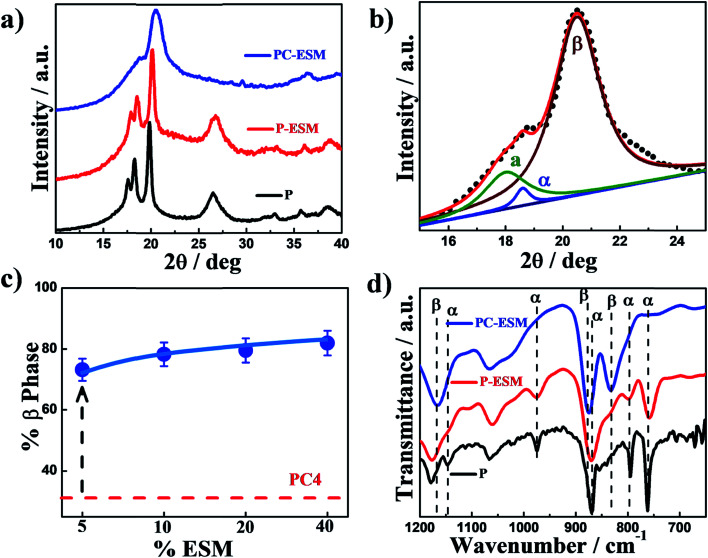
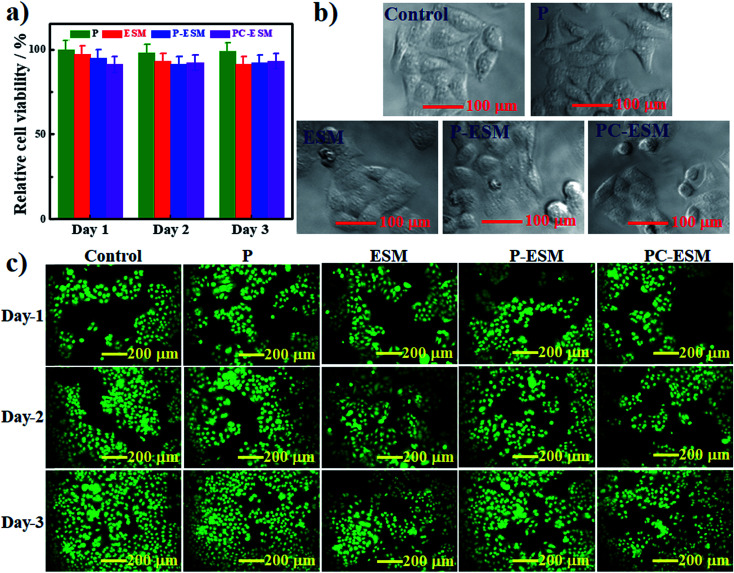
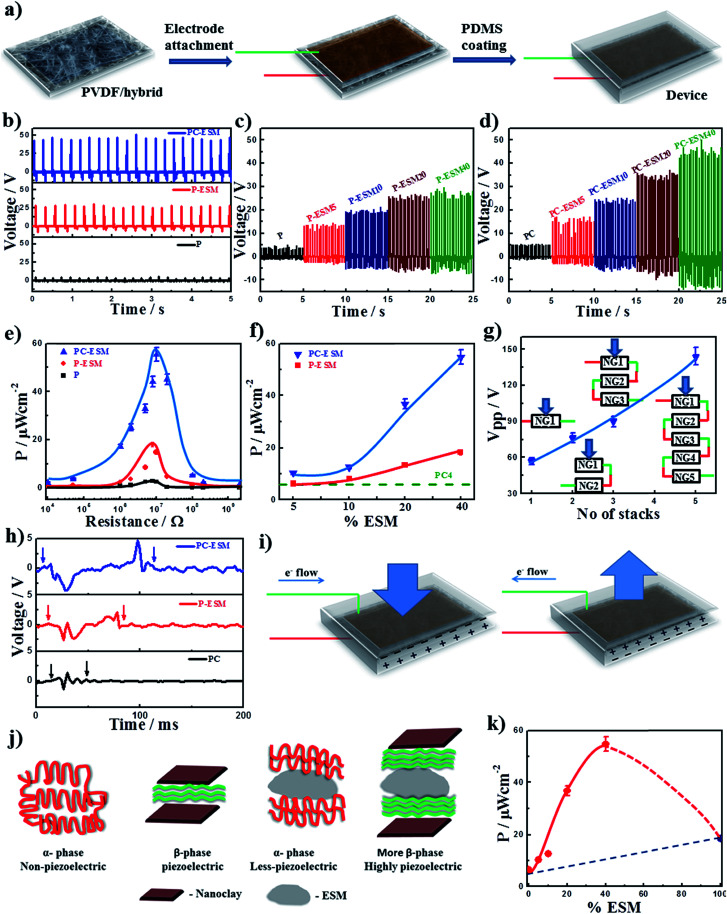
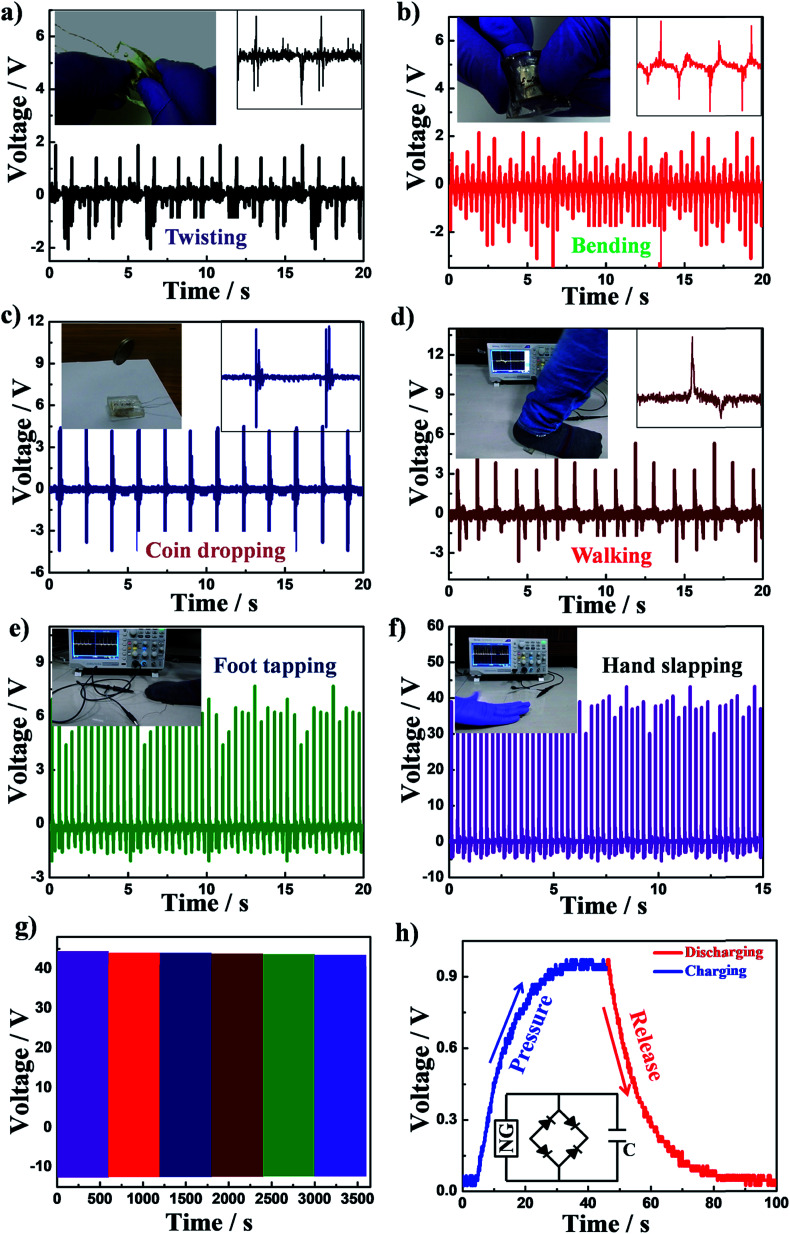
A bio-based piezoelectric egg shell membrane (ESM) is used for energy harvesting applications in the form of two and three-component nanohybrids. A bio-waste piezo-filler in a piezoelectric polymer matrix was designed through an induced β-phase nucleation in the matrix using an organically modified two-dimensional nanoclay. Structural alteration (α to β-phase) in the presence of the nanoparticles was also manifested by morphological changes over spherulite to a needle-like morphology; thus, these nanohybrid materials are suitable for energy harvesting applications. ESM-based nanogenerators were fabricated with local ordering of piezo phases, as revealed atomic force microscopy, leading to the generation of mostly electroactive phases in the whole nanohybrid. The voltage outputs from the optimized device were measured to be ∼56 and 144 V in single and multiple stacks (five), respectively, with corresponding power densities of 55 μW cm and 100 μW cm. The efficiency of the device was verified using a variety of body movements, bending, twisting, walking, and foot tapping, causing mechanical energy dissipation, which eventually transformed into energy storage. The underlying mechanism of high conversion of energy is explained by the synergistically induced piezo-phase in the polymer matrix together with the floppy piezo-filler. The mechanical stability, durability and repeated energy conversion of the hybrid device make it a robust nanogenerator. The biocompatibility of the nanogenerator was verified through cellular studies, demonstrating its appropriate use in powering biomedical devices/implants.
一种基于生物的压电蛋壳膜(ESM)以二元和三元纳米杂化物的形式用于能量收集应用。通过使用有机改性的二维纳米粘土在基质中诱导β相成核,设计了一种压电聚合物基质中的生物废物压电填料。纳米颗粒存在下的结构改变(α相向β相)也通过球晶到针状形态的形态变化表现出来;因此,这些纳米杂化材料适用于能量收集应用。基于ESM的纳米发电机通过压电相的局部有序排列制造,如原子力显微镜所示,导致整个纳米杂化物中产生大部分电活性相。优化后的器件在单叠和多叠(五叠)中的电压输出分别测量为约56 V和144 V,相应的功率密度分别为55 μW/cm²和100 μW/cm²。该器件的效率通过各种身体运动(弯曲、扭转、行走和轻敲脚部)进行验证,这些运动会导致机械能耗散,最终转化为能量存储。聚合物基质中协同诱导的压电相与柔软的压电填料共同解释了能量高转换的潜在机制。混合器件的机械稳定性、耐久性和重复能量转换使其成为一种坚固的纳米发电机。通过细胞研究验证了纳米发电机的生物相容性,证明了其在为生物医学设备/植入物供电方面的适当用途。