de Miranda Jéssica Maria Arouca, Viana Dalyanna Mildred de Oliveira, Dos Santos Anderson Antônio Lima, Costa Áquila Filêmon de Andrade, Dantas Bruno Araújo da Silva, de Miranda Francisco Arnoldo Nunes, Mendes Felismina Rosa Parreira, Torres Gilson de Vasconcelos
Centro de Ciências da Saúde, Federal University of Rio Grande do Norte (UFRN), Avenida Governador Silvio Pedroza, 306, Areia Preta. Ed Portal da Enseada, ap 100, Natal 59014-100, RN, Brazil.
Centro de Ciências da Saúde, Federal University of Rio Grande do Norte (UFRN), Rua Piquia, 7932, Pitimbu, Natal 59067-580, RN, Brazil.
Geriatrics (Basel). 2022 Sep 13;7(5):96. doi: 10.3390/geriatrics7050096.
The interaction of quality of life (QoL) with functionality, nutrition and depression has been studied, but few studies have compared different realities. Our objective was to compare the associations of QoL with impaired functionality, nutritional status and depressive symptoms among older people patients treated in primary health care (PHC) in Brazil and Portugal.
Cross-sectional, comparative study was conducted with primary data from PHC services in Brazil and Portugal with users over 65 years old. Participants' scores were classified as "impaired" and "preserved" for QoL, functional decline, nutrition and depression. We used Pearson's chi-square test, Fisher's exact test and the Mann-Whitney U test.
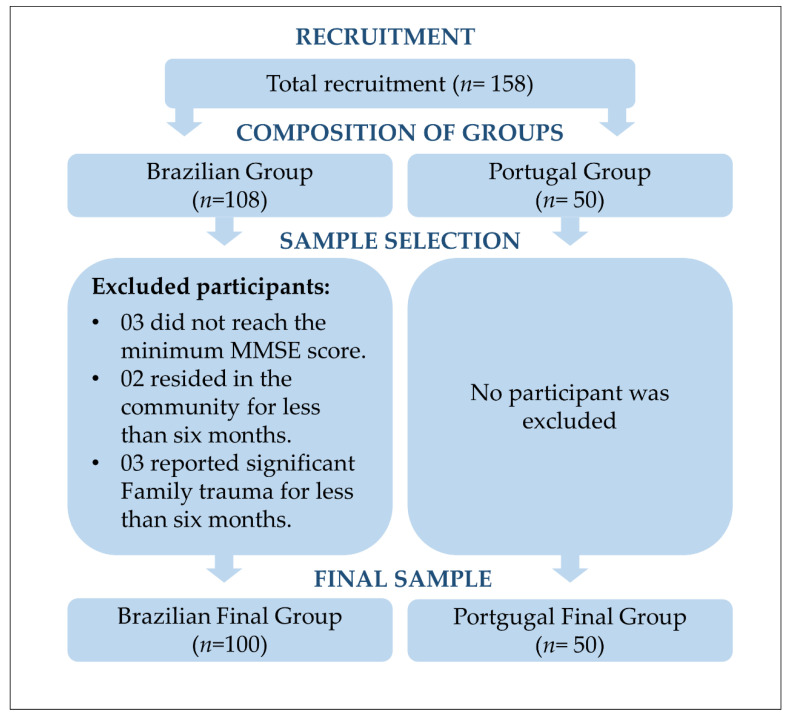
Our sample had a total of 150 PHC users. We found lower QoL scores in Brazil, which were associated with the risk of functional decline for the domains Physical Functioning, General Health Perceptions, Mental Health dimensions and Physical Health. Nutritional impairment in the group from Portugal included the domains of Vitality and Social Role Functioning. For depressive impairment, Portugal showed an association with the domains Mental Health, Vitality and Social Role Functioning.
QoL was associated with functional and nutritional impairment and depressive symptoms, highlighting physical, mental and social characteristics related to the perception of well-being.
生活质量(QoL)与功能、营养和抑郁之间的相互作用已得到研究,但很少有研究比较不同的实际情况。我们的目的是比较巴西和葡萄牙在初级卫生保健(PHC)中接受治疗的老年患者的生活质量与功能受损、营养状况和抑郁症状之间的关联。
对巴西和葡萄牙初级卫生保健服务机构中65岁以上使用者的原始数据进行横断面比较研究。参与者在生活质量、功能下降、营养和抑郁方面的得分被分为“受损”和“保留”。我们使用了Pearson卡方检验、Fisher精确检验和Mann-Whitney U检验。
我们的样本共有150名初级卫生保健使用者。我们发现巴西的生活质量得分较低,这与身体功能、总体健康感知、心理健康维度和身体健康等领域的功能下降风险相关。葡萄牙组的营养损害包括活力和社会角色功能等领域。对于抑郁损害,葡萄牙显示出与心理健康、活力和社会角色功能等领域相关。
生活质量与功能和营养损害以及抑郁症状相关,突出了与幸福感认知相关的身体、心理和社会特征。