Ćirković Ivana, Marković-Denić Ljiljana, Bajčetić Milica, Dragovac Gorana, Đorđević Zorana, Mioljević Vesna, Urošević Danijela, Nikolić Vladimir, Despotović Aleksa, Krtinić Gordana, Rakić Violeta, Janićijević Ivana, Šuljagić Vesna
Faculty of Medicine, University of Belgrade, 11000 Belgrade, Serbia.
Institute of Microbiology and Immunology, 11000 Belgrade, Serbia.
Antibiotics (Basel). 2022 Aug 28;11(9):1161. doi: 10.3390/antibiotics11091161.
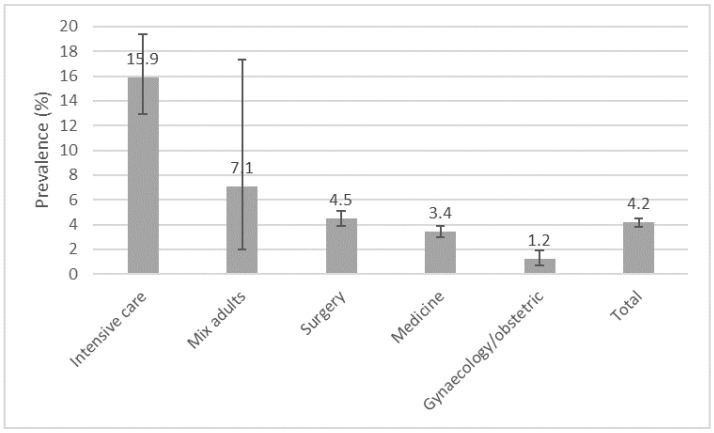
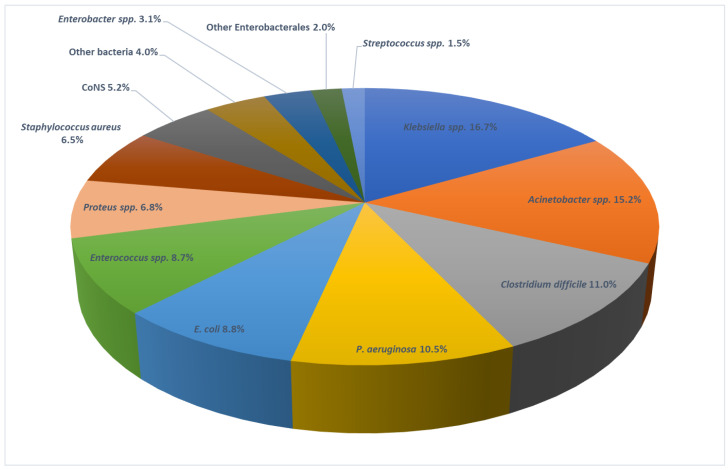
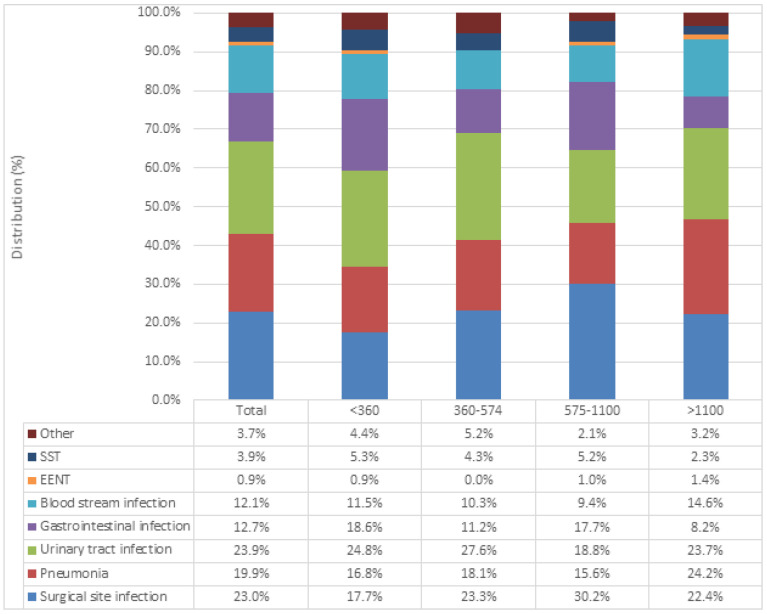
Millions of patients acquire healthcare-associated infections (HAIs) every year, putting them at risk for serious complications and prolonged hospitalization. Point prevalence surveys (PPS), guided by the European Centre for Disease Prevention and Control framework, are one of the primary methods by which countries in the European Union conduct surveillance of HAIs. Serbia, though not in the EU, implemented this approach in its national PPS. The microbiological and antimicrobial resistance (AMR) analyses comprised patients in 61 out of 65 hospitals included in the fourth PPS conducted in November 2017. A total of 515/12,380 (4.2%) of the adult patients included in the PPS had at least one HAI, with intensive care units carrying the highest prevalence of 15.9%. Urinary tract and surgical site infections were the most frequently identified types of HAIs (23.9% and 23.0%, respectively). comprised almost half (47.0%) of all causative agents, most notably spp. (16.7%). AMR was very high for most pathogens-80.5% of nonfermentative Gram-negative bacilli were resistant to carbapenems whereas 62.9% of were resistant to third generation cephalosporins. The calculated AMR index of 61% is one of the highest in Europe. Further efforts are needed to reduce the burden of HAIs in Serbia that carry very high resistance rates to antibiotics currently used in clinical practice.
每年有数百万患者发生医疗保健相关感染(HAIs),这使他们面临严重并发症和住院时间延长的风险。在欧洲疾病预防控制中心框架的指导下,现患率调查(PPS)是欧盟国家对HAIs进行监测的主要方法之一。塞尔维亚虽不在欧盟,但在其全国性现患率调查中采用了这种方法。微生物学和抗菌药物耐药性(AMR)分析涵盖了2017年11月进行的第四次现患率调查中65家医院中的61家医院的患者。在现患率调查纳入的成年患者中,共有515/12380(4.2%)至少发生了一次HAI,重症监护病房的发生率最高,为15.9%。尿路感染和手术部位感染是最常发现的HAI类型(分别为23.9%和23.0%)。 几乎占所有病原体的一半(47.0%),最显著的是 菌属(16.7%)。大多数病原体的AMR非常高——80.5%的非发酵革兰氏阴性杆菌对碳青霉烯类耐药,而62.9%的 对第三代头孢菌素耐药。计算得出的61%的AMR指数是欧洲最高的之一。需要进一步努力减轻塞尔维亚HAIs的负担,这些感染对目前临床实践中使用的抗生素耐药率非常高。