Kang Min-Kyu, Lee Yu-Rim, Song Jeung-Eun, Kweon Young-Oh, Tak Won-Young, Jang Se-Young, Park Jung-Gil, Park Soo-Young
Department of Internal Medicine, College of Medicine, Yeungnam University, Daegu 42415, Korea.
Department of Internal Medicine, School of Medicine, Kyungpook National University, Kyungpook National University Hospital, Daegu 41994, Korea.
Diagnostics (Basel). 2022 Sep 18;12(9):2255. doi: 10.3390/diagnostics12092255.
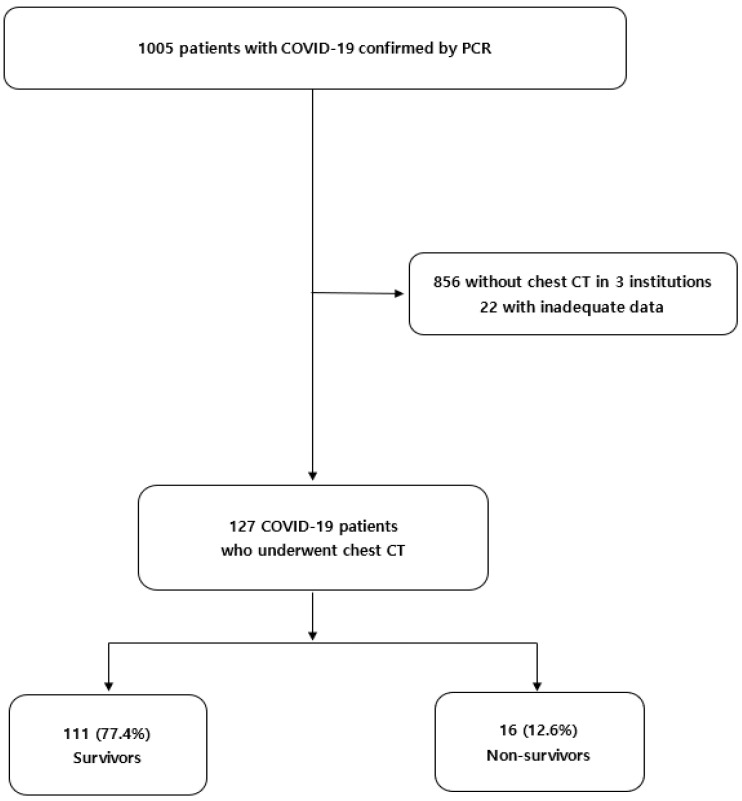
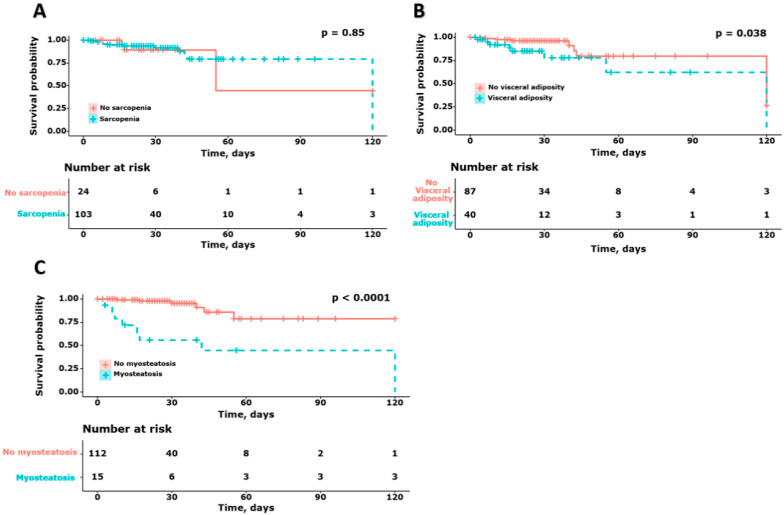
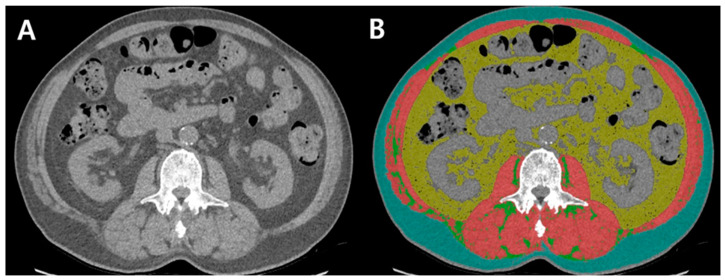
Body composition, including sarcopenia, adipose tissue, and myosteatosis, is associated with unfavorable clinical outcomes in patients with coronavirus disease (COVID-19). However, few studies have identified the impact of body composition, including pre-existing risk factors, on COVID-19 mortality. Therefore, this study aimed to evaluate the effect of body composition, including pre-existing risk factors, on mortality in hospitalized patients with COVID-19. This two-center retrospective study included 127 hospitalized patients with COVID-19 who underwent unenhanced chest computed tomography (CT) between February and April 2020. Using the cross-sectional CT images at the L2 vertebra level, we analyzed the body composition, including skeletal muscle mass, visceral to subcutaneous adipose tissue ratio (VSR), and muscle density using the Hounsfield unit (HU). Of 127 patients with COVID-19, 16 (12.6%) died. Compared with survivors, non-survivors had low muscle density (41.9 vs. 32.2 HU, p < 0.001) and high proportion of myosteatosis (4.5 vs. 62.5%, p < 0.001). Cox regression analyses revealed diabetes (hazard ratio [HR], 3.587), myosteatosis (HR, 3.667), and a high fibrosis-4 index (HR, 1.213) as significant risk factors for mortality in patients with COVID-19. Myosteatosis was associated with mortality in hospitalized patients with COVID-19, independent of pre-existing prognostic factors.
身体组成,包括肌肉减少症、脂肪组织和肌脂肪变性,与冠状病毒病(COVID-19)患者的不良临床结局相关。然而,很少有研究确定包括既往风险因素在内的身体组成对COVID-19死亡率的影响。因此,本研究旨在评估包括既往风险因素在内的身体组成对COVID-19住院患者死亡率的影响。这项双中心回顾性研究纳入了127例2020年2月至4月期间接受胸部非增强计算机断层扫描(CT)的COVID-19住院患者。利用L2椎体水平的横断面CT图像,我们分析了身体组成,包括骨骼肌质量、内脏与皮下脂肪组织比率(VSR)以及使用亨氏单位(HU)测量的肌肉密度。在127例COVID-19患者中,16例(12.6%)死亡。与幸存者相比,非幸存者的肌肉密度较低(41.9 vs. 32.2 HU,p<0.001),肌脂肪变性比例较高(4.5 vs. 62.5%,p<0.001)。Cox回归分析显示,糖尿病(风险比[HR],3.587)、肌脂肪变性(HR,3.667)和高纤维化-4指数(HR,1.213)是COVID-19患者死亡的重要风险因素。肌脂肪变性与COVID-19住院患者的死亡率相关,且独立于既往的预后因素。