Human Nutrition Research Unit, Department of Agricultural, Food, and Nutritional Science, University of Alberta, Edmonton, Alberta, Canada.
Human Nutrition Research Unit, Department of Agricultural, Food, and Nutritional Science, University of Alberta, Edmonton, Alberta, Canada; Department of Medicine, University of Alberta, Edmonton, Alberta, Canada.
Am J Clin Nutr. 2023 Jun;117(6):1288-1305. doi: 10.1016/j.ajcnut.2023.04.003. Epub 2023 Apr 8.
The impact of body composition (BC) abnormalities on COVID-19 outcomes remains to be determined.
We summarized the evidence on BC abnormalities and their relationship with adverse clinical outcomes in patients with COVID-19.
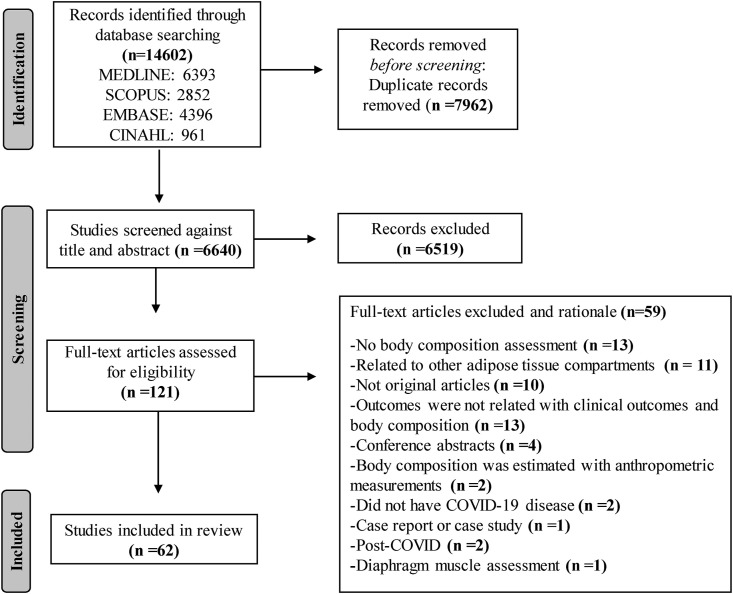
A systematic search was conducted up until 26 September, 2022 for observational studies using BC techniques to quantify skeletal muscle mass (or related compartments), muscle radiodensity or echo intensity, adipose tissue (AT; or related compartments), and phase angle (PhA) in adults with COVID-19. Methodological quality of studies was assessed using the Newcastle-Ottawa Scale. A synthesis without meta-analysis was conducted to summarize the prevalence of BC abnormalities and their significant associations with clinical outcomes.
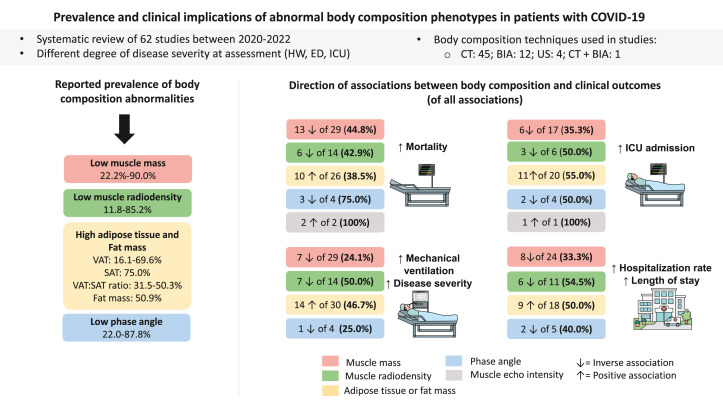
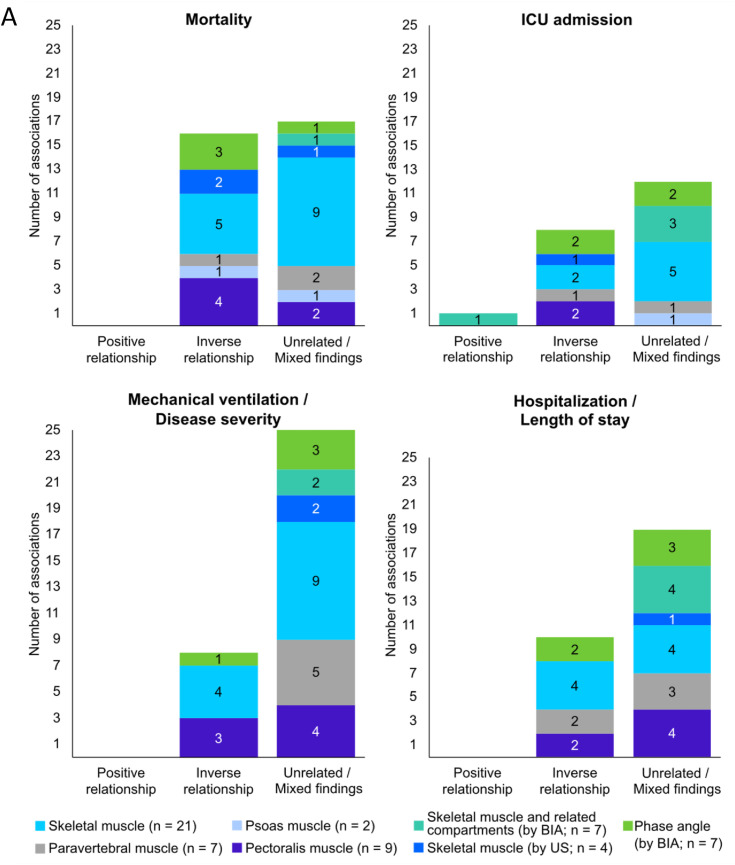
We included 62 studies (69.4% low risk of bias) with 12-1138 participants, except 3 studies with ≤490,301 participants. Using CT and different cutoff values, prevalence ranged approximately from 22% to 90% for low muscle mass, 12% to 85% for low muscle radiodensity, and 16% to 70% for high visceral AT. Using BIA, prevalence of high FM was 51%, and low PhA was 22% to 88%. Mortality was inversely related to PhA (3/4 studies) and positively related to intra- and intermuscular AT (4/5 studies), muscle echo intensity (2/2 studies), and BIA-estimated FM (2/2 studies). Intensive care unit (ICU) admission was positively related to visceral AT (6/7 studies) and total AT (2/3 studies). Disease severity and hospitalization outcomes were positively related to intra- and intermuscular AT (2/2 studies). Inconsistent associations were found for the rest of the BC measures and hospitalization outcomes.
Abnormalities in BC were prevalent in patients with COVID-19. Although conflicting associations were observed among certain BC abnormalities and clinical outcomes, higher muscle echo intensity (reflective of myosteatosis) and lower PhA were more consistently associated with greater mortality risk. Likewise, high intra- and intermuscular AT and visceral AT were associated with mortality and ICU admission, respectively. This trial was registered at PROSPERO as CRD42021283031.
身体成分(BC)异常对 COVID-19 结局的影响仍有待确定。
我们总结了 BC 异常及其与 COVID-19 患者不良临床结局之间关系的证据。
截至 2022 年 9 月 26 日,我们对使用 BC 技术定量测量骨骼肌质量(或相关隔室)、肌肉放射性密度或回声强度、脂肪组织(AT;或相关隔室)和相位角(PhA)的观察性研究进行了系统检索。使用纽卡斯尔-渥太华量表评估研究的方法学质量。我们进行了不进行荟萃分析的综合分析,以总结 BC 异常的患病率及其与临床结局的显著相关性。
我们纳入了 62 项研究(69.4%为低偏倚风险),包含 12-1138 名参与者,除了 3 项研究的参与者≤490301 人。使用 CT 和不同的截断值,低肌肉量的患病率约为 22%-90%,低肌肉放射性密度的患病率为 12%-85%,高内脏 AT 的患病率为 16%-70%。使用 BIA,高 FM 的患病率为 51%,低 PhA 的患病率为 22%-88%。死亡率与 PhA 呈负相关(3/4 项研究),与肌内和肌间 AT(4/5 项研究)、肌肉回声强度(2/2 项研究)和 BIA 估计的 FM(2/2 项研究)呈正相关。重症监护病房(ICU)入院与内脏 AT(6/7 项研究)和总 AT(2/3 项研究)呈正相关。疾病严重程度和住院结局与肌内和肌间 AT(2/2 项研究)呈正相关。对于其余的 BC 测量和住院结局,观察到不一致的相关性。
COVID-19 患者的 BC 异常很常见。尽管某些 BC 异常与临床结局之间存在相互矛盾的关联,但较高的肌肉回声强度(反映肌脂肪增多)和较低的 PhA 与更高的死亡率风险更相关。同样,肌内和肌间 AT 以及内脏 AT 分别与死亡率和 ICU 入院相关。本试验在 PROSPERO 上注册为 CRD42021283031。