Genetic Analysis Department, Laboratory of Racing Chemistry, 1731-2, Tsurutamachi, Utsunomiya 320-0851, Japan.
Department of Veterinary Medicine, Faculty of Applied Biological Sciences, Gifu University, 1-1, Yanagido, Gifu 501-1193, Japan.
Genes (Basel). 2022 Sep 4;13(9):1589. doi: 10.3390/genes13091589.
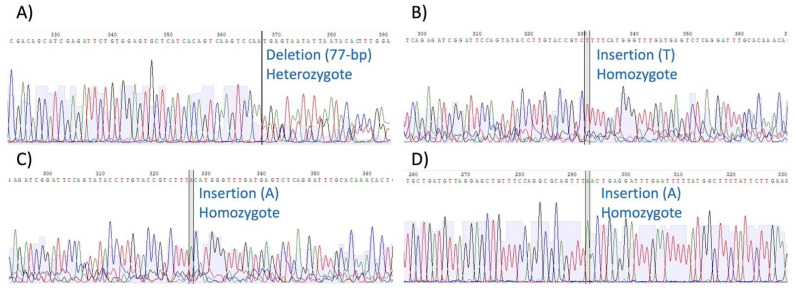
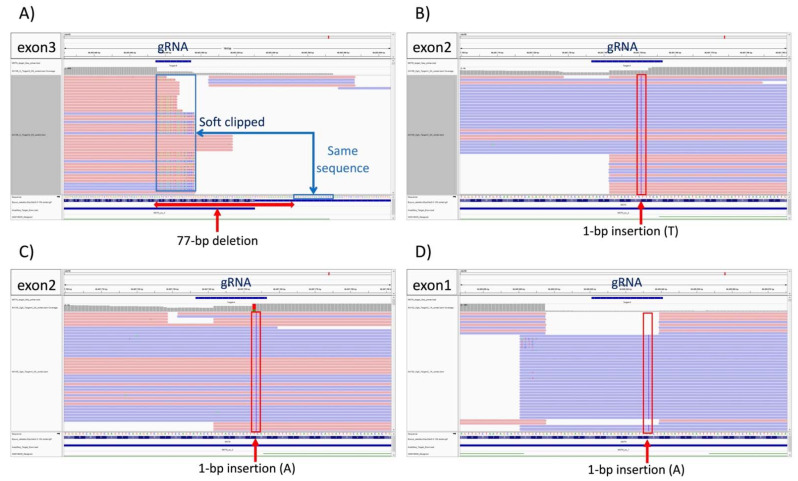
The creation of genetically modified horses is prohibited in horse racing as it falls under the banner of gene doping. In this study, we developed a test to detect gene editing based on amplicon sequencing using next-generation sequencing (NGS). We designed 1012 amplicons to target 52 genes (481 exons) and 147 single-nucleotide variants (SNVs). NGS analyses showed that 97.7% of the targeted exons were sequenced to sufficient coverage (depth > 50) for calling variants. The targets of artificial editing were defined as homozygous alternative (HomoALT) and compound heterozygous alternative (ALT1/ALT2) insertion/deletion (INDEL) mutations in this study. Four models of gene editing (three homoALT with 1-bp insertions, one REF/ALT with 77-bp deletion) were constructed by editing the myostatin gene in horse fibroblasts using CRISPR/Cas9. The edited cells and 101 samples from thoroughbred horses were screened using the developed test, which was capable of identifying the three homoALT cells containing 1-bp insertions. Furthermore, 147 SNVs were investigated for their utility in confirming biological parentage. Of these, 120 SNVs were amenable to consistent and accurate genotyping. Surrogate (nonbiological) dams were excluded by 9.8 SNVs on average, indicating that the 120 SNV could be used to detect foals that have been produced by somatic cloning or embryo transfer, two practices that are prohibited in thoroughbred racing and breeding. These results indicate that gene-editing tests that include variant calling and SNV genotyping are useful to identify genetically modified racehorses.
基因编辑马在赛马中被禁止,因为它属于基因兴奋剂的范畴。在这项研究中,我们开发了一种基于扩增子测序的基因编辑检测方法,使用下一代测序(NGS)。我们设计了 1012 个扩增子来靶向 52 个基因(481 个外显子)和 147 个单核苷酸变异(SNV)。NGS 分析显示,97.7%的靶向外显子测序深度(>50)足以进行变异calling。本研究中,人工编辑的靶标被定义为纯合替代(HomoALT)和复合杂合替代(ALT1/ALT2)插入/缺失(INDEL)突变。通过使用 CRISPR/Cas9 编辑马成纤维细胞中的肌肉生长抑制素基因,构建了四种基因编辑模型(三个 HomoALT 带有 1 个碱基插入,一个 REF/ALT 带有 77 个碱基缺失)。使用开发的检测方法筛选编辑细胞和 101 个纯种马样本,该检测方法能够识别含有 1 个碱基插入的三个 HomoALT 细胞。此外,还研究了 147 个 SNV 用于确认生物亲子关系的效用。其中,120 个 SNV 可进行一致且准确的基因分型。平均有 9.8 个 SNV 可排除替代(非生物)母马,表明这 120 个 SNV 可用于检测通过体细胞克隆或胚胎移植产生的幼驹,这两种做法在纯种赛马和繁殖中是被禁止的。这些结果表明,包括变异calling 和 SNV 基因分型的基因编辑检测对于识别基因修饰的赛马是有用的。