Xu Beizhu, Huang Caihua, Zhang Caojin, Lin Donghai, Wu Weifeng
Department of Cardiology, The First Affiliated Hospital of Guangxi Medical University, Nanning 530021, China.
Research and Communication Center of Exercise and Health, Xiamen University of Technology, Xiamen 361024, China.
Metabolites. 2022 Sep 8;12(9):845. doi: 10.3390/metabo12090845.
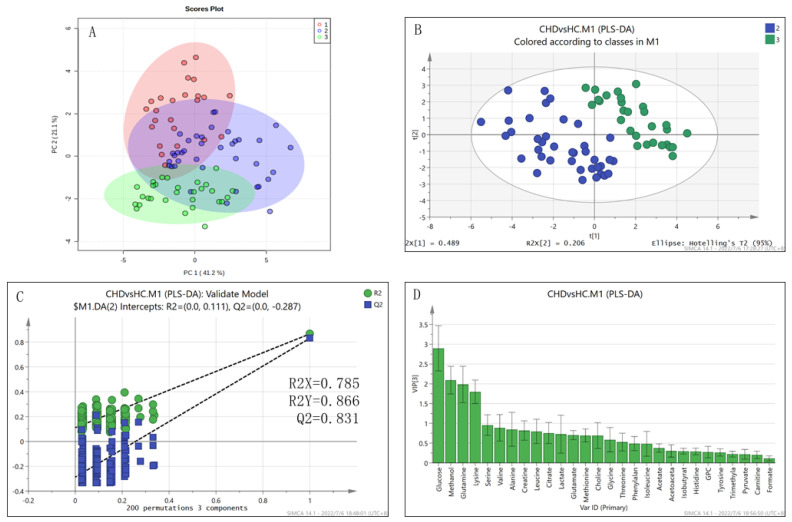
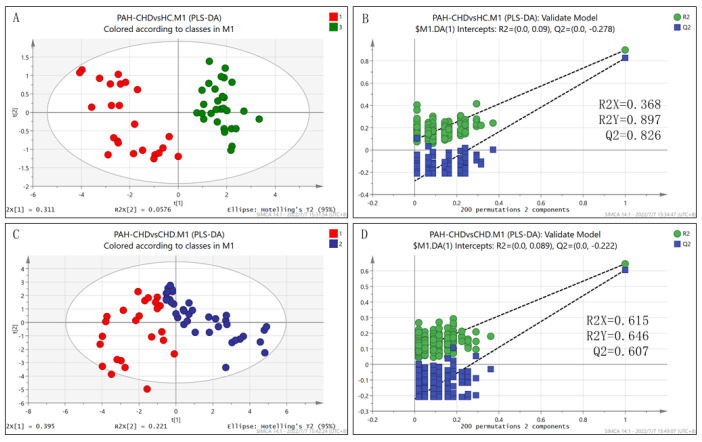
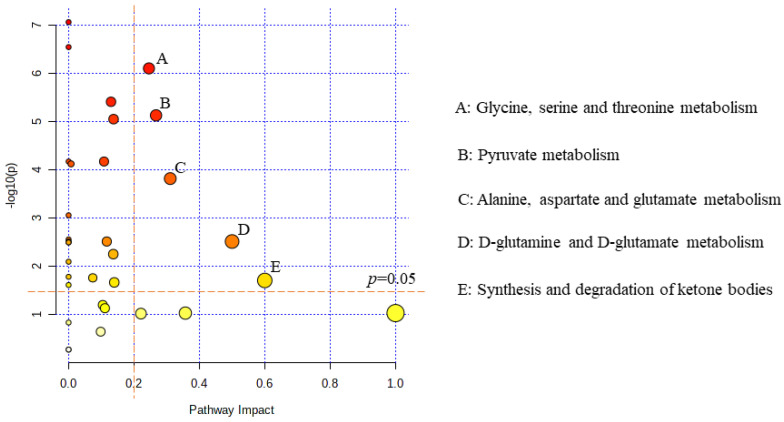
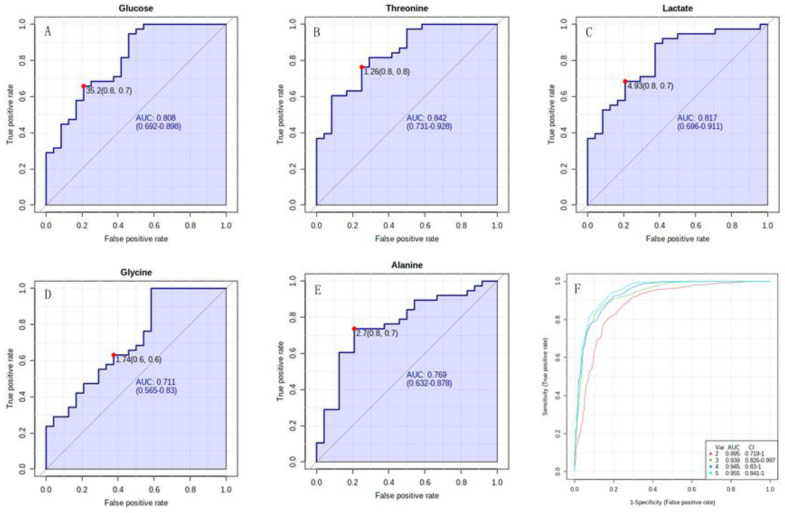
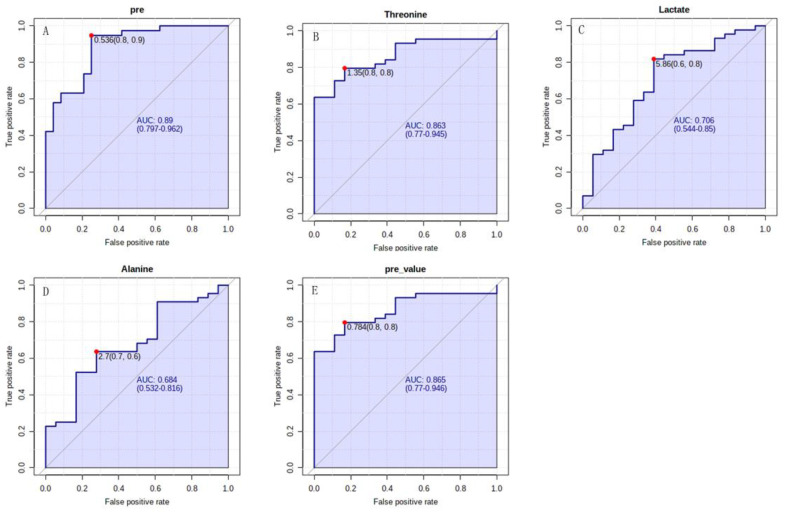
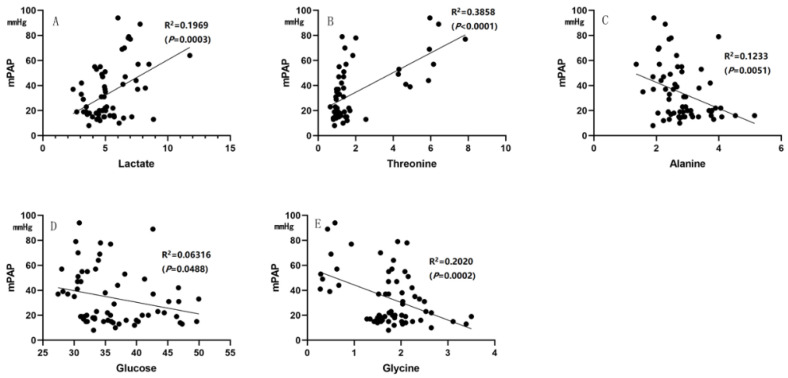
Patients with unrepaired congenital heart disease (CHD) are prone to pulmonary arterial hypertension (PAH). The ovine pulmonary arterial smooth muscle cells exposed to increased pulmonary blood flow (PBF) exhibited hyperproliferation and metabolic alterations, but the metabolic disorders of patients with CHD and associated PAH (PAH-CHD) have not yet been fully understood. Adult CHD patients were prospectively included and divided into the PAH-CHD group ( = 24) and CHD group ( = 38), while healthy adults were included as healthy control (HC) group ( = 29). Plasma from each subject was prepared for nuclear magnetic resonance (NMR) detection. H-NMR spectra were acquired using 850 MHz NMR spectrometer. A total of 28 metabolites were identified from the NMR spectra and their relative concentrations were calculated and analyzed by multivariate and univariate statistical analyses and metabolic pathway analysis. Receiver operating characteristic (ROC) curve analysis and correlation analysis were performed to identify potential biomarkers and assess their roles in clinical assessment. Multivariate statistical analysis showed that the metabolic profile of PAH-CHD was altered relative to CHD or HC, while that of CHD was altered relative to HC. The identified characteristic metabolites were alanine, glucose, glycine, threonine and lactate, and the areas under the ROC curves (AUCs) were 0.769, 0.808, 0.711, 0.842 and 0.817, respectively. Multivariate ROC curve analysis showed AUCs ranging from 0.895 to 0.955 for the combination of these characteristic metabolites. The correlation analysis indicated that lactate and threonine were significantly correlated with mean pulmonary arterial pressure, pulmonary vascular resistance and N-terminal pro-B-type natriuretic peptide. The increased PBF could trigger global metabolic alterations in patients with CHD, which were more severe in patients with PAH-CHD. The characteristic metabolites have the potential to be biomarkers of PAH-CHD, which could be used for its noninvasive diagnosis, severity and prognosis assessment, thereby improving the management of PAH-CHD.
患有未修复先天性心脏病(CHD)的患者易患肺动脉高压(PAH)。暴露于肺血流量(PBF)增加的绵羊肺动脉平滑肌细胞表现出过度增殖和代谢改变,但CHD合并PAH(PAH-CHD)患者的代谢紊乱尚未完全明确。前瞻性纳入成年CHD患者并分为PAH-CHD组(n = 24)和CHD组(n = 38),同时纳入健康成年人作为健康对照组(HC)(n = 29)。制备每个受试者的血浆用于核磁共振(NMR)检测。使用850 MHz NMR光谱仪采集1H-NMR光谱。从NMR光谱中鉴定出总共28种代谢物,并通过多变量和单变量统计分析以及代谢途径分析计算和分析它们的相对浓度。进行受试者工作特征(ROC)曲线分析和相关性分析,以鉴定潜在的生物标志物并评估它们在临床评估中的作用。多变量统计分析表明,PAH-CHD的代谢谱相对于CHD或HC发生了改变,而CHD的代谢谱相对于HC发生了改变。鉴定出的特征性代谢物为丙氨酸、葡萄糖、甘氨酸、苏氨酸和乳酸,ROC曲线下面积(AUC)分别为0.769、0.808、0.711、0.842和0.817。多变量ROC曲线分析显示,这些特征性代谢物组合的AUC范围为0.895至0.955。相关性分析表明,乳酸和苏氨酸与平均肺动脉压、肺血管阻力和N末端B型利钠肽原显著相关。PBF增加可引发CHD患者的整体代谢改变,在PAH-CHD患者中更为严重。这些特征性代谢物有可能成为PAH-CHD的生物标志物,可用于其无创诊断、严重程度和预后评估,从而改善PAH-CHD的管理。