Department of Information and Communication Engineering, Sejong University, Seoul 05006, Korea.
Department of Convergence Engineering for Intelligent Drone, Sejong University, Seoul 05006, Korea.
Sensors (Basel). 2022 Sep 15;22(18):6994. doi: 10.3390/s22186994.
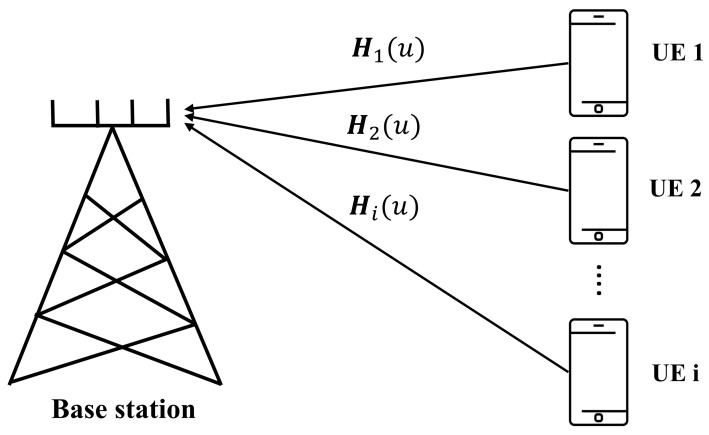
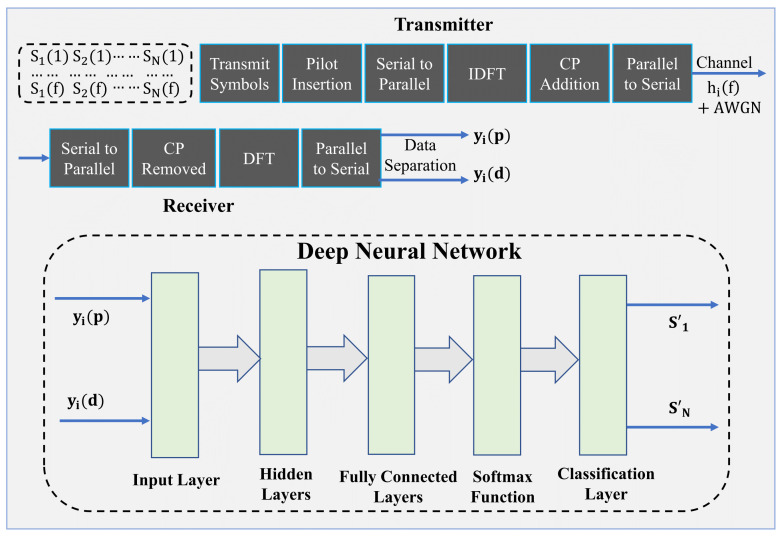
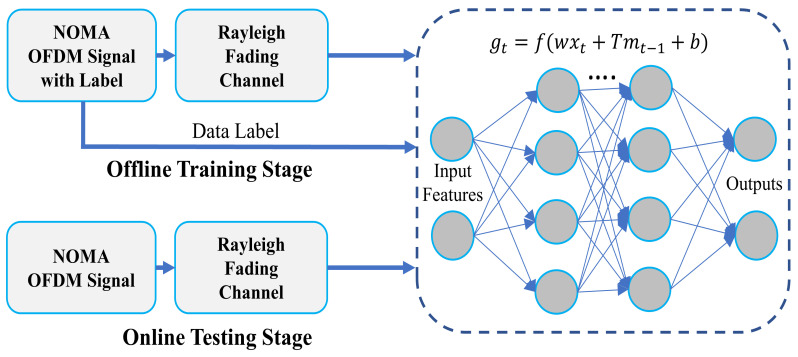
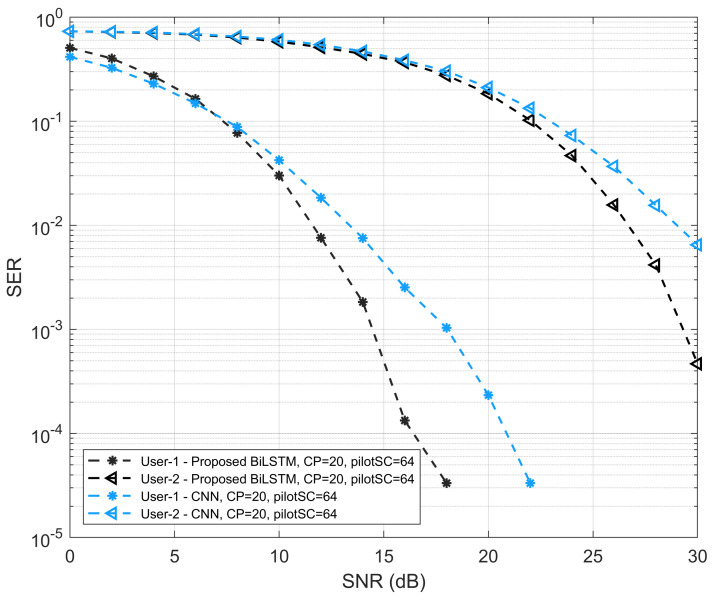
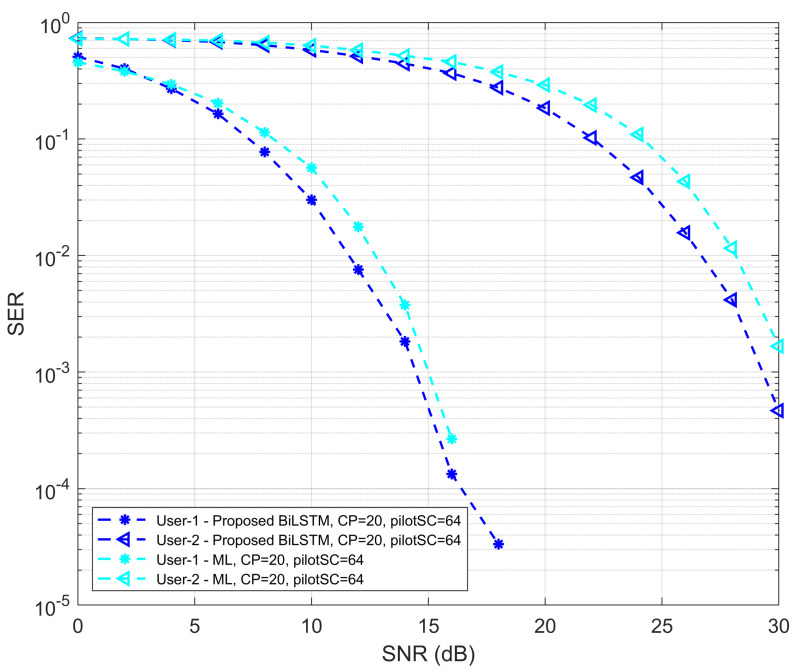
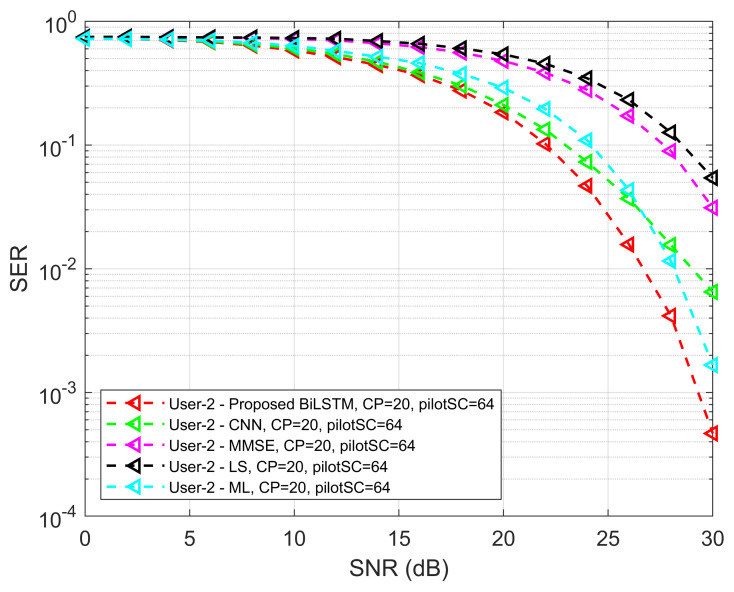
Non-orthogonal multiple access (NOMA) has great potential to implement the fifth-generation (5G) requirements of wireless communication. For a NOMA traditional detection method, successive interference cancellation (SIC) plays a vital role at the receiver side for both uplink and downlink transmission. Due to the complex multipath channel environment and prorogation of error problems, the traditional SIC method has a limited performance. To overcome the limitation of traditional detection methods, the deep-learning method has an advantage for the highly efficient tool. In this paper, a deep neural network which has bi-directional long short-term memory (Bi-LSTM) for multiuser uplink channel estimation (CE) and signal detection of the originally transmitted signal is proposed. Unlike the traditional CE schemes, the proposed Bi-LSTM model can directly recover multiuser transmission signals suffering from channel distortion. In the offline training stage, the Bi-LTSM model is trained using simulation data based on channel statistics. Then, the trained model is used to recover the transmitted symbols in the online deployment stage. In the simulation results, the performance of the proposed model is compared with the convolutional neural network model and traditional CE schemes such as MMSE and LS. It is shown that the proposed method provides feasible improvements in performance in terms of symbol-error rate and signal-to-noise ratio, making it suitable for 5G wireless communication and beyond.
非正交多址接入(NOMA)在实现无线通信的第五代(5G)要求方面具有巨大的潜力。对于 NOMA 的传统检测方法,在接收端,无论是在上行链路还是下行链路传输中,连续干扰消除(SIC)都起着至关重要的作用。由于复杂的多径信道环境和传播误差问题,传统的 SIC 方法性能有限。为了克服传统检测方法的局限性,深度学习方法对于高效工具具有优势。在本文中,提出了一种深度神经网络,该网络具有双向长短时记忆(Bi-LSTM),用于多用户上行链路信道估计(CE)和原始传输信号的信号检测。与传统的 CE 方案不同,所提出的 Bi-LSTM 模型可以直接恢复受到信道失真影响的多用户传输信号。在离线训练阶段,Bi-LSTM 模型使用基于信道统计的仿真数据进行训练。然后,在在线部署阶段,使用训练好的模型来恢复传输符号。在仿真结果中,将所提出的模型的性能与卷积神经网络模型和传统的 CE 方案(如 MMSE 和 LS)进行了比较。结果表明,所提出的方法在符号错误率和信噪比方面提供了可行的性能改进,使其适用于 5G 无线通信及以后。