Quiroga Borja, Soler María José, Ortiz Alberto, Jaravaca Mantecón Carlos Jesús, Nava Pérez Nathasha, Serra Martín Marta, Sato Yurika, Marin Franco Antonio José, Pazmiño Zambrano Diana Flor, Lucena Valverde Rafael, Ortega Diaz Mayra, Calderón González Carmen, Cazorla López Juan Manuel, Pereira Mónica, González Parra Emilio, Sánchez Horrillo Ana, Sánchez González Carmen, Toapanta Néstor, Cigarrán Guldris Secundino, Sánchez Hernández Rosa, Pizarro Sánchez Soledad, Muñiz Rincón María, Garcia-Fernández Nuria, Blanco Castro Natalia, Collantes Mateo Rocío, Quiroz Morales Manuel Augusto, Escamilla-Cabrera Beatriz, Berdud Godoy Isabel, Gil-Casares Casanova Beatriz, Leyva Alba, Rojas José, Gansevoort Ron T, de Sequera Patricia
IIS-La Princesa, Nephrology Department, Hospital Universitario de la Princesa, Madrid, Spain.
Nephrology Department, Vall d'Hebrón University Hospital, Barcelona, Spain.
Clin Kidney J. 2022 Jul 26;15(10):1856-1864. doi: 10.1093/ckj/sfac169. eCollection 2022 Oct.
Patients on hemodialysis are at high-risk for complications derived from coronavirus disease 2019 (COVID-19). The present analysis evaluated the impact of a booster vaccine dose and breakthrough severe acute respiratory syndrome coronavirus 2 (SARS-CoV-2) infections on humoral immunity 3 months after the booster dose.
This is a multicentric and prospective study assessing immunoglobulin G anti-Spike antibodies 6 and 9 months after initial SARS-CoV-2 vaccination in patients on hemodialysis that had also received a booster dose before the 6-month assessment (early booster) or between the 6- and 9-month assessments (late booster). The impact of breakthrough infections, type of vaccine, time from the booster and clinical variables were assessed.
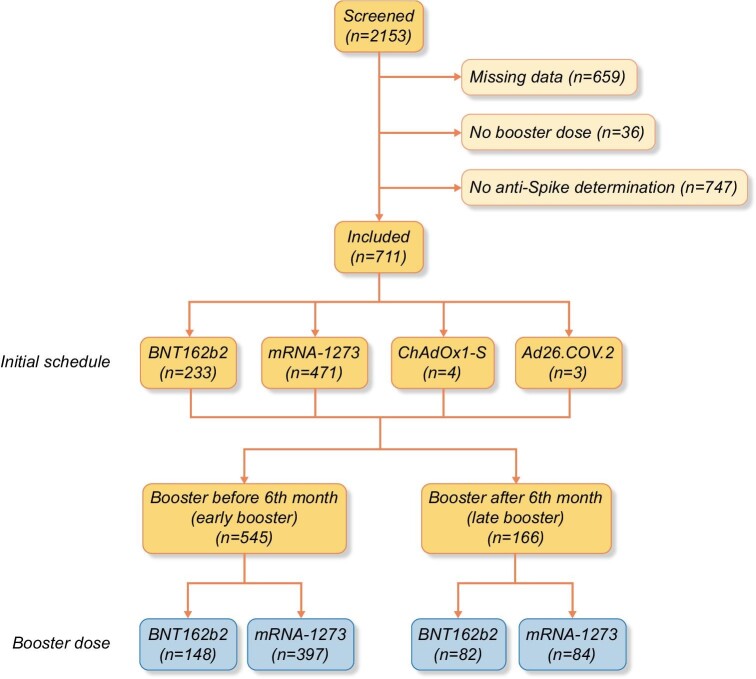
A total of 711 patients [67% male, median age (range) 67 (20-89) years] were included. Of these, 545 (77%) received an early booster and the rest a late booster. At 6 months, 64 (9%) patients had negative anti-Spike antibody titers (3% of early booster and 29% of late booster patients, = .001). At 9 months, 91% of patients with 6-month negative response had seroconverted and there were no differences in residual prevalence of negative humoral response between early and late booster patients (0.9% vs 0.6%, = .693). During follow-up, 35 patients (5%) developed breakthrough SARS-CoV-2 infection. Antibody titers at 9 months were independently associated with mRNA-1273 booster ( = .001), lower time from booster ( = .043) and past breakthrough SARS-CoV-2 infection ( < .001).
In hemodialysis patients, higher titers of anti-Spike antibodies at 9 months were associated with mRNA-1273 booster, lower time from booster and past breakthrough SARS-CoV-2 infection.
接受血液透析的患者发生2019冠状病毒病(COVID-19)相关并发症的风险很高。本分析评估了加强疫苗剂量和突破性严重急性呼吸综合征冠状病毒2(SARS-CoV-2)感染对加强剂量后3个月体液免疫的影响。
这是一项多中心前瞻性研究,评估接受血液透析的患者在初次接种SARS-CoV-2疫苗后6个月和9个月时的抗刺突免疫球蛋白G抗体,这些患者在6个月评估前(早期加强)或6至9个月评估之间(晚期加强)也接受了加强剂量。评估了突破性感染的影响、疫苗类型、距加强剂量的时间和临床变量。
共纳入711例患者[男性占67%,中位年龄(范围)67(20-89)岁]。其中,545例(77%)接受了早期加强,其余接受了晚期加强。在6个月时,64例(9%)患者的抗刺突抗体滴度为阴性(早期加强患者为3%,晚期加强患者为29%,P = 0.001)。在9个月时,6个月时反应阴性的患者中有91%发生了血清转化,早期和晚期加强患者之间体液反应阴性的残留患病率没有差异(0.9%对0.6%,P = 0.693)。在随访期间,35例患者(5%)发生了突破性SARS-CoV-2感染。9个月时的抗体滴度与mRNA-1273加强(P = 0.001)、距加强剂量时间较短(P = 0.043)和既往突破性SARS-CoV-2感染(P < 0.001)独立相关。
在血液透析患者中,9个月时较高的抗刺突抗体滴度与mRNA-1273加强、距加强剂量时间较短和既往突破性SARS-CoV-2感染相关。