Leibniz Centre for Tropical Marine Research, Bremen, Germany.
Institut Für Chemie Und Biologie Des Meeres, Carl-Von-Ossietzky Universität Oldenburg, Wilhelmshaven, Germany.
Sci Rep. 2022 Sep 24;12(1):15935. doi: 10.1038/s41598-022-19997-6.
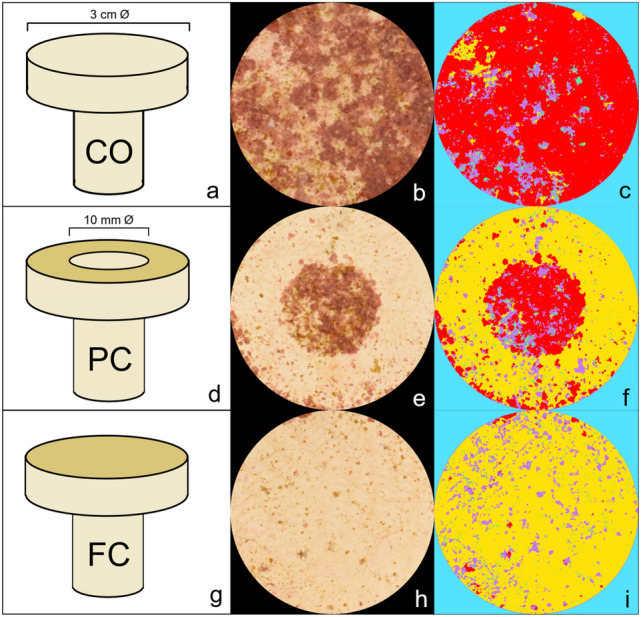
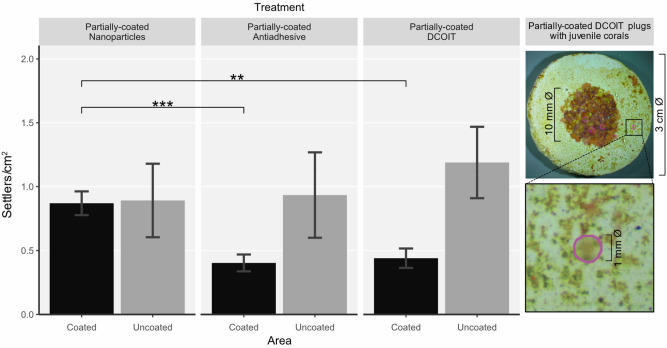
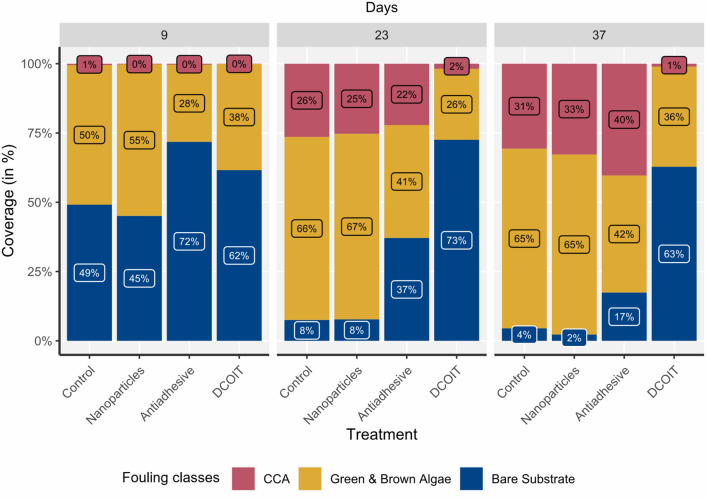
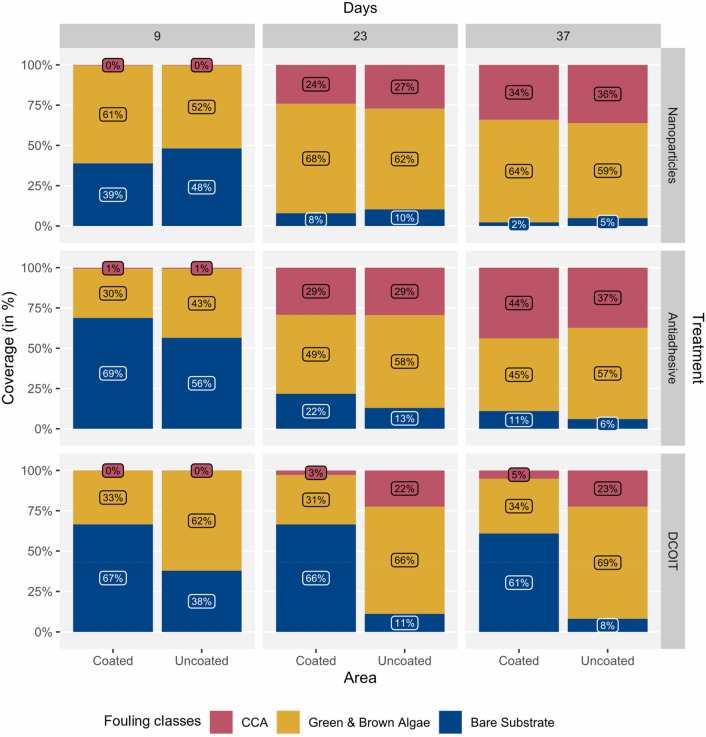
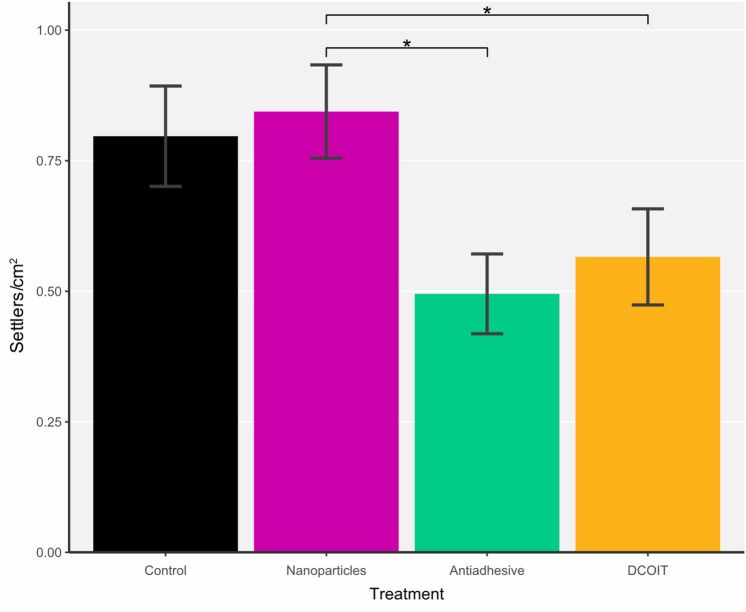
In the early stages after larval settlement, coral spat can be rapidly overgrown and outcompeted by algae, reducing overall survival for coral reef replenishment and supply for restoration programs. Here we investigated three antifouling (AF) coatings for their ability to inhibit algal fouling on coral settlement plugs, a commonly-used restoration substrate. Plugs were either fully or partially coated with the AF coatings and incubated in mesocosm systems with partial recirculation for 37 days to track fouling succession. In addition, settlement of Acropora tenuis larvae was measured to determine whether AF coatings were a settlement deterrent. Uncoated control plugs became heavily fouled, yielding only 4-8% bare substrate on upper surfaces after 37 days. During this period, an encapsulated dichlorooctylisothiazolinone (DCOIT)-coating was most effective in reducing fouling, yielding 61-63% bare substrate. Antiadhesive and cerium dioxide (CeO) nanoparticle (NP) coatings were less effective, yielding 11-17% and 2% bare substrate, respectively. Average settlement of A. tenuis larvae on the three types of AF-coated plugs did not statistically differ from settlement on uncoated controls. However, settlement on the NP-coating was generally the highest and was significantly higher than settlement found on the antiadhesive- and DCOIT-coating. Furthermore, on plugs only partially-covered with AF coatings, larval settlement on coated NP- areas was significantly higher than settlement on coated antiadhesive- and DCOIT-areas. These results demonstrate that AF coatings can reduce fouling intensity on biologically-relevant timescales while preserving robust levels of coral settlement. This represents an important step towards reducing fine-scale competition with benthic fouling organisms in coral breeding and propagation.
在幼虫定殖的早期阶段,珊瑚幼体可能会被藻类迅速覆盖和竞争,从而降低珊瑚补充和恢复计划的整体存活率。在这里,我们研究了三种防污(AF)涂料抑制珊瑚定殖塞中藻类附着的能力,珊瑚定殖塞是一种常用的恢复基质。将塞子完全或部分涂覆 AF 涂料,并在部分循环的中观系统中孵育 37 天,以跟踪附着生物的演替。此外,还测量了 Acropora tenuis 幼虫的定殖情况,以确定 AF 涂料是否对定殖有抑制作用。未涂覆的对照塞子严重受到污染,在 37 天后,上表面仅有 4-8%的裸露基质。在此期间,封装的二氯辛基异噻唑啉酮(DCOIT)涂料在减少附着方面最有效,裸露基质的比例达到 61-63%。抗附着和二氧化铈(CeO)纳米颗粒(NP)涂料的效果较差,裸露基质的比例分别为 11-17%和 2%。A. tenuis 幼虫在三种 AF 涂层塞子上的平均定殖与未涂覆对照塞子上的定殖没有统计学差异。然而,NP 涂层上的定殖通常最高,明显高于抗附着和 DCOIT 涂层上的定殖。此外,在仅部分涂覆 AF 涂料的塞子上,NP 涂层上的幼虫定殖明显高于抗附着和 DCOIT 涂层上的定殖。这些结果表明,AF 涂料可以在与生物相关的时间尺度上减少附着强度,同时保持珊瑚定殖的稳健水平。这是减少珊瑚繁殖和繁殖过程中与底栖附着生物的细尺度竞争的重要一步。