Ermine Kaylee, Yu Jian, Zhang Lin
Department of Pharmacology and Chemical Biology, University of Pittsburgh School of Medicine, Pittsburgh, PA 15213, USA.
UPMC Hillman Cancer Center, Pittsburgh, PA 15213, USA.
Genes Dis. 2021 Nov 18;9(6):1579-1593. doi: 10.1016/j.gendis.2021.10.007. eCollection 2022 Nov.
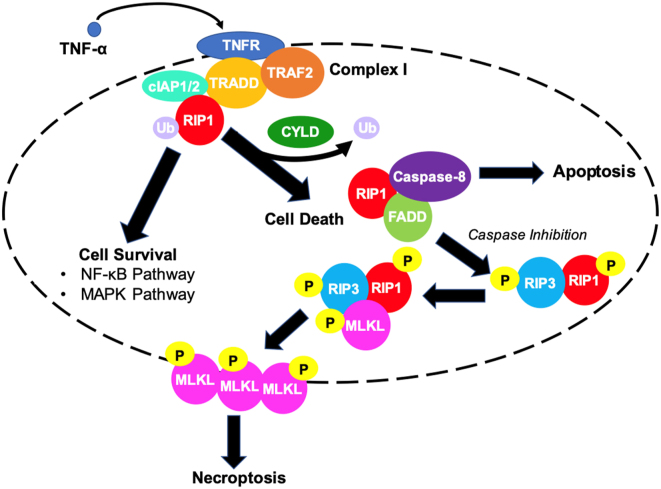
The Receptor Interacting Protein (RIP) kinase family consists of seven Serine/Threonine kinases, which plays a key signaling role in cell survival and cell death. Each RIP family member contains a conserved kinase domain and other domains that determine the specific kinase function through protein-protein interactions. RIP1 and RIP3 are best known for their critical roles in necroptosis, programmed necrosis and a non-apoptotic inflammatory cell death process. Dysregulation of RIP kinases contributes to a variety of pathogenic conditions such as inflammatory diseases, neurological diseases, and cancer. In cancer cells, alterations of RIP kinases at genetic, epigenetic and expression levels are frequently found, and suggested to promote tumor progression and metastasis, escape of antitumor immune response, and therapeutic resistance. However, RIP kinases can be either pro-tumor or anti-tumor depending on specific tumor types and cellular contexts. Therapeutic agents for targeting RIP kinases have been tested in clinical trials mainly for inflammatory diseases. Deregulated expression of these kinases in different types of cancer suggests that they represent attractive therapeutic targets. The focus of this review is to outline the role of RIP kinases in cancer, highlighting potential opportunities to manipulate these proteins in cancer treatment.
受体相互作用蛋白(RIP)激酶家族由七种丝氨酸/苏氨酸激酶组成,它们在细胞存活和细胞死亡中发挥关键的信号传导作用。每个RIP家族成员都包含一个保守的激酶结构域和其他通过蛋白质-蛋白质相互作用决定特定激酶功能的结构域。RIP1和RIP3因其在坏死性凋亡、程序性坏死和非凋亡性炎症细胞死亡过程中的关键作用而最为人所知。RIP激酶的失调会导致多种致病状况,如炎症性疾病、神经疾病和癌症。在癌细胞中,经常发现RIP激酶在基因、表观遗传和表达水平上的改变,并提示这些改变会促进肿瘤进展和转移、逃避抗肿瘤免疫反应以及产生治疗抗性。然而,根据特定的肿瘤类型和细胞环境,RIP激酶既可以是促肿瘤的,也可以是抗肿瘤的。针对RIP激酶的治疗药物主要在炎症性疾病的临床试验中进行了测试。这些激酶在不同类型癌症中的表达失调表明它们是有吸引力的治疗靶点。本综述的重点是概述RIP激酶在癌症中的作用,强调在癌症治疗中操纵这些蛋白质的潜在机会。