Osanami Arata, Tanaka Marenao, Furuhashi Masato, Ohnishi Hirofumi, Hanawa Nagisa, Yamashita Tomohisa, Moniwa Norihito, Miura Tetsuji
Department of Cardiovascular, Renal and Metabolic Medicine, Sapporo Medical University School of Medicine, Sapporo, Japan.
Department of Public Health, Sapporo Medical University School of Medicine, Sapporo, Japan.
Clin Kidney J. 2022 Apr 29;15(10):1888-1895. doi: 10.1093/ckj/sfac111. eCollection 2022 Oct.
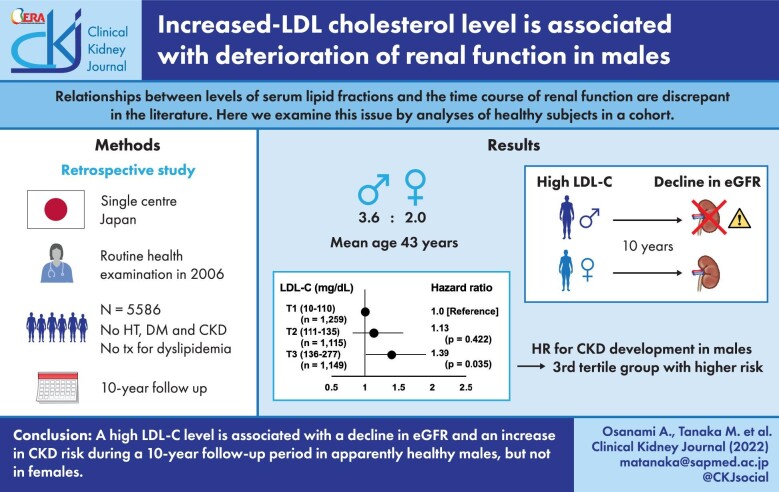
Relationships between levels of serum lipid fractions and the time course of renal function are discrepant in the literature. Here we examined this issue by analyses of healthy subjects in a cohort.
Of all subjects who received health examinations at Keijinkai Maruyama Clinic, Sapporo in 2006, subjects with hypertension, diabetes mellitus or chronic kidney disease (CKD) and those taking medication for dyslipidemia were excluded and a total of 5586 subjects (male/female: 3563/2023, mean age: 43 ± 8 years) were followed for 10 years.
Linear mixed effect models showed that baseline low-density lipoprotein-cholesterol (LDL-C) level was negatively associated with estimated glomerular filtration rate (eGFR) during the 10-year follow-up period after adjustment for confounders. Interactions between the follow-up year and baseline level of LDL-C or high-density lipoprotein-cholesterol (HDL-C) for eGFR values during the follow-up period were significant in males but not in females. There were no significant interactions for eGFR between the follow-up year and baseline levels of total cholesterol, triglycerides, or HDL-C/triglycerides ratio. During the follow-up period, 346 males and 223 females developed CKD. When male subjects were divided into subgroups according to tertiles of baseline levels of LDL-C, the adjusted risk for CKD in the third tertial group was significantly higher than that in the first tertile group as a reference [hazard ratio (95% confidence interval): 1.39 (1.02-1.90), = .035]. Such a difference was not observed for LDL-C tertiles in females or HDL-C tertiles in both sexes.
A high LDL-C level may be a risk factor for new-onset CKD in apparently healthy males.
血清脂质组分水平与肾功能时间进程之间的关系在文献中存在差异。在此,我们通过对队列中的健康受试者进行分析来研究这个问题。
在2006年于札幌京仁会丸山诊所接受健康检查的所有受试者中,排除患有高血压、糖尿病或慢性肾脏病(CKD)的受试者以及正在服用调脂药物的受试者,共有5586名受试者(男/女:3563/2023,平均年龄:43±8岁)被随访10年。
线性混合效应模型显示,在调整混杂因素后,基线低密度脂蛋白胆固醇(LDL-C)水平在10年随访期内与估计肾小球滤过率(eGFR)呈负相关。随访年份与随访期内eGFR值的LDL-C或高密度脂蛋白胆固醇(HDL-C)基线水平之间的相互作用在男性中显著,但在女性中不显著。随访年份与总胆固醇、甘油三酯或HDL-C/甘油三酯比值的基线水平之间对于eGFR没有显著的相互作用。在随访期间,346名男性和223名女性发生了CKD。当根据LDL-C基线水平的三分位数将男性受试者分为亚组时,第三三分位数组中CKD的校正风险显著高于作为参照的第一三分位数组[风险比(95%置信区间):1.39(1.02 - 1.90),P = 0.035]。在女性的LDL-C三分位数或两性的HDL-C三分位数中未观察到这种差异。
高LDL-C水平可能是明显健康男性新发CKD的一个危险因素。