Zhou Xin, Kong Lingjun, Ren Jun, Song Pengfei, Wu Zhiwei, He Tianxiang, Lv Zhizhen, Zhang Shuaipan, Sun Wuquan, Zhang Jiafu, Cai Junhao, Zhu Qingguang, Fang Min
Yueyang Hospital of Integrated Traditional Chinese and Western Medicine, Shanghai University of Traditional Chinese Medicine, Shanghai, China.
Institute of Tuina, Shanghai Institute of Traditional Chinese Medicine, Shanghai, China.
Front Neurol. 2022 Sep 6;13:952346. doi: 10.3389/fneur.2022.952346. eCollection 2022.
Herniation of the nucleus pulposus caused by disc degeneration and other reasons can cause low back pain and disability. In China, traditional Chinese exercises (TCEs) and traditional Chinese massage (TCM) are widely used to improve symptoms of pain and disability in patients with lumbar disc herniation (LDH). The safety and efficacy of combination therapy have not been studied.
To assess the effect of traditional Chinese exercise combined with massage vs. traditional Chinese massage alone on pain, disability, lumbar mobility and gait performance in patients with LDH.
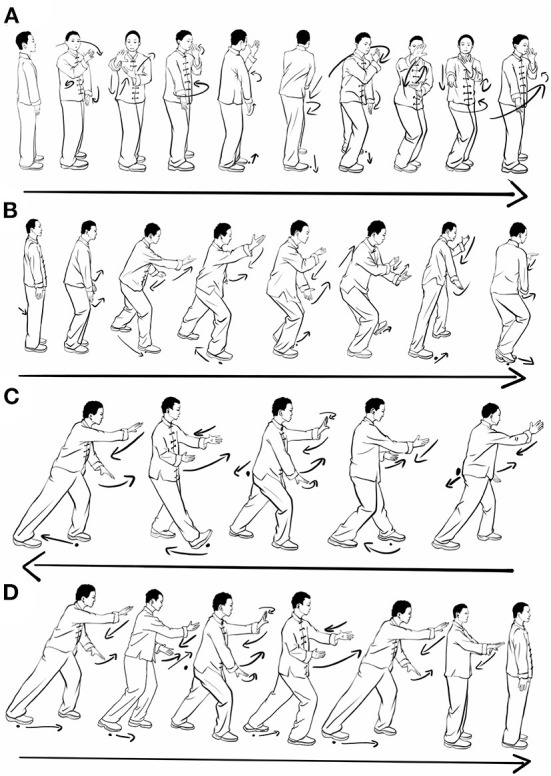
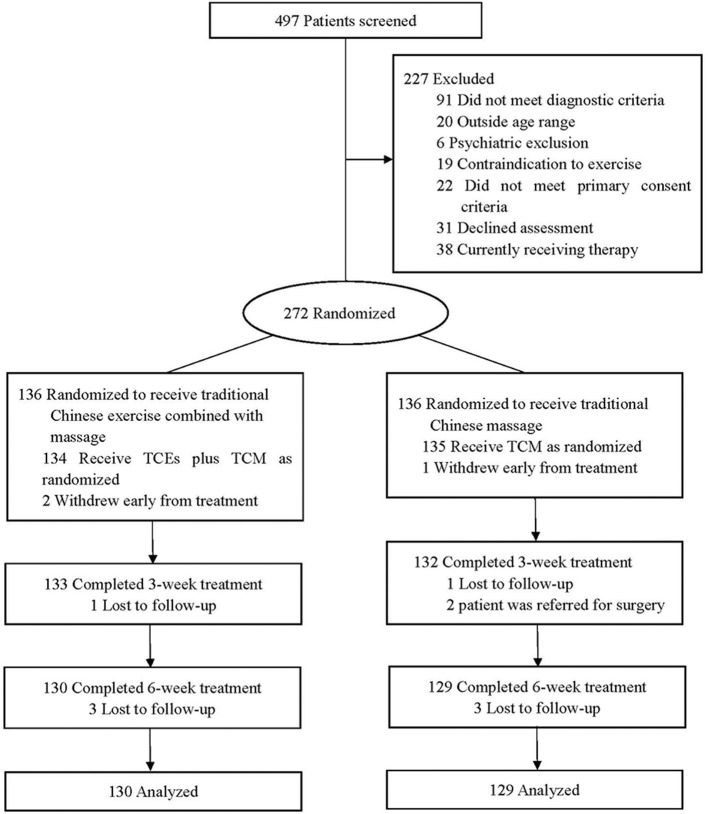
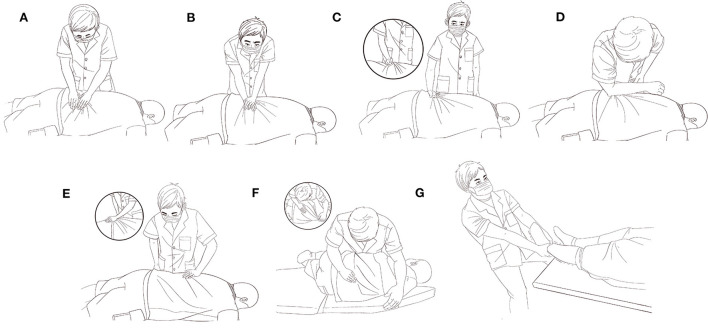
Multi-center, randomized clinical trial conducted at 4 hospitals in China and enrolling 272 patients with LDH. Participants were randomly assigned to TCEs plus TCM group or TCM alone group. The combined therapy group received 18 Tai Chi training sessions (30-min sessions 3 times a week) and regular TCM treatments over 6 weeks. The control group received TCM therapy alone and was instructed to maintain their usual daily physical activity. Outcome variables measured included Visual Analog Scale (VAS), Short Form of McGill Pain Questionnaire (SF-MPQ), Oswestry Disability Index (ODI), lumbar spine range of motion (ROM) and gait performance.
Among the 272 randomized participants, 259 completed the study. The mean VAS score was 51.77 mm at baseline in the TCEs plus TCM group, and 50.93 mm for the TCM alone group. The reduction in the VAS score at week 6 was greater in the TC group than in the TCM group with a mean difference of 4.05 (95% CI, 2.15-5.95; < 0.001), and the ODI score with between-group differences of 3.57 points (95% CI, 2.84-4.30 points; < 0.001). Similar significantly different results were observed in SF-MPQ, walking speed, cadence, and lumbar ROM. No serious adverse events were reported throughout the study period.
Compared with TCM alone, TCEs combined with TCM treatment performed better in reducing pain and improving disability. The combination therapy could be considered a valuable treatment option for LDH patients, with potential therapeutic utility for middle-aged and elderly patients with LDH.
椎间盘退变及其他原因导致的髓核突出可引起腰痛和功能障碍。在中国,传统中医运动(TCEs)和传统中医按摩(TCM)被广泛用于改善腰椎间盘突出症(LDH)患者的疼痛和功能障碍症状。联合治疗的安全性和有效性尚未得到研究。
评估传统中医运动联合按摩与单纯传统中医按摩对LDH患者疼痛、功能障碍、腰椎活动度和步态表现的影响。
在中国4家医院进行的多中心随机临床试验,纳入272例LDH患者。参与者被随机分配到TCEs加TCM组或单纯TCM组。联合治疗组接受18次太极拳训练课程(每次30分钟,每周3次),并在6周内接受常规中医治疗。对照组仅接受中医治疗,并被要求保持日常的身体活动。测量的结果变量包括视觉模拟量表(VAS)、麦吉尔疼痛问卷简表(SF-MPQ)、Oswestry功能障碍指数(ODI)、腰椎活动范围(ROM)和步态表现。
在272名随机参与者中,259人完成了研究。TCEs加TCM组基线时的平均VAS评分为51.77mm,单纯TCM组为50.93mm。第6周时,TC组的VAS评分降低幅度大于TCM组,平均差值为4.05(95%CI,2.15-5.95;P<0.001),ODI评分组间差异为3.57分(95%CI,2.84-4.30分;P<0.001)。在SF-MPQ、步行速度、步频和腰椎ROM方面也观察到了类似的显著差异结果。在整个研究期间未报告严重不良事件。
与单纯中医治疗相比,TCEs联合中医治疗在减轻疼痛和改善功能障碍方面表现更好。联合治疗可被认为是LDH患者的一种有价值的治疗选择,对中老年LDH患者具有潜在的治疗作用。