Hong Jiahui, Sun Jingqing, Zhang Liping, Tan Zhongjian, Chen Ying, Chen Qiuyi, Zhu Yupu, Liu Yuhan, Zhu Liying, Zeng Lin, Kong Yazhuo, Li Bin, Liu Lu
School of Clinical Medicine, Beijing University of Chinese Medicine, Beijing, China.
Department of Acupuncture and Moxibustion, Beijing Hospital of Traditional Chinese Medicine, Capital Medical University, Beijing Key Laboratory of Acupuncture Neuromodulation, Beijing, China.
Front Neurol. 2022 Sep 8;13:981752. doi: 10.3389/fneur.2022.981752. eCollection 2022.
Acupuncture is an effective treatment in migraine without aura (MWoA), but the neurological mechanism has not been investigated using multimodal magnetic resonance imaging (MRI). This trial will combine functional MRI, structural MRI, and diffusion tensor imaging to explore the potential neural mechanism of acupuncture on MWoA, and will use machine learning approach to predict acupuncture treatment effects.
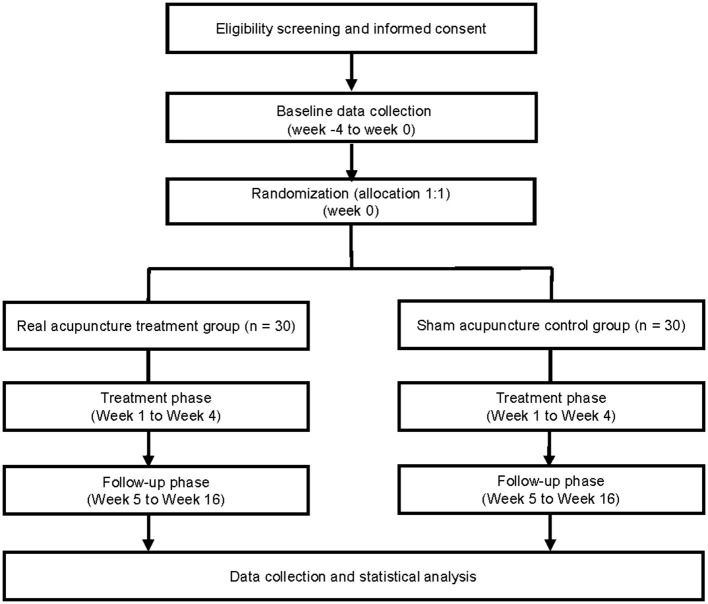
In this multimodal neuroimaging randomized controlled trial, a total of 60 MWoA participants will be randomly allocated to two groups: the real acupuncture treatment group and the sham acupuncture control group. This trial will include a 4-week baseline phase, a 4-week treatment phase, and a 12-week follow-up phase. Participants will undergo 12 acupuncture or sham acupuncture sessions during the treatment phase. The Headache Diary, Migraine-Specific Quality of Life Questionnaire, Headache Impact Test, Beck Depression Inventory-II, and Beck Anxiety Inventory will be utilized to evaluate the clinical efficacy. Multimodal MRI scans will be employed to investigate the mechanism of acupuncture at baseline, at the end of treatment, and after follow-up. Multimodal MRI data will be used to predict acupuncture treatment effects using machine learning technology.
This study hypothesized that acupuncture therapy may treat MWoA by restoring the neuropathological alterations in brain activity. Our finding should provide valuable scientific proof for the effects of acupuncture and demonstrate the usefulness of acupuncture in the treatment of MWoA. Moreover, acupuncture response prediction might decrease healthcare expenses and time lags for patients.
[ChiCTR2100044251].
针刺是无先兆偏头痛(MWoA)的一种有效治疗方法,但尚未使用多模态磁共振成像(MRI)研究其神经机制。本试验将结合功能MRI、结构MRI和扩散张量成像,以探索针刺治疗MWoA的潜在神经机制,并将使用机器学习方法预测针刺治疗效果。
在这项多模态神经影像学随机对照试验中,总共60名MWoA参与者将被随机分配到两组:真针刺治疗组和假针刺对照组。本试验将包括一个为期4周的基线期、一个为期4周的治疗期和一个为期12周的随访期。参与者将在治疗期接受12次针刺或假针刺治疗。将使用头痛日记、偏头痛特异性生活质量问卷、头痛影响测试、贝克抑郁量表第二版和贝克焦虑量表来评估临床疗效。将在基线期、治疗结束时和随访后采用多模态MRI扫描来研究针刺机制。多模态MRI数据将用于通过机器学习技术预测针刺治疗效果。
本研究假设针刺疗法可能通过恢复大脑活动中的神经病理改变来治疗MWoA。我们的发现应为针刺的效果提供有价值的科学证据,并证明针刺在治疗MWoA中的有效性。此外,针刺反应预测可能会降低患者的医疗费用和时间延迟。
[ChiCTR2100044251]