Serviço de Gastrenterologia, Centro Hospitalar Universitário de São João, Porto 4200, Portugal.
Faculty of Medicine, University of Porto, Porto 4200, Portugal.
World J Gastroenterol. 2022 Aug 21;28(31):4310-4327. doi: 10.3748/wjg.v28.i31.4310.
Individuals within specific risk groups for pancreatic ductal adenocarcinoma (PDAC) [mucinous cystic lesions (MCLs), hereditary risk (HR), and new-late onset diabetes mellitus (NLOD)] represent an opportunity for early cancer detection. Endoscopic ultrasound (EUS) is a premium image modality for PDAC screening and precursor lesion characterization. While no specific biomarker is currently clinically available for this purpose, glypican-1 (GPC1) is overexpressed in the circulating exosomes (crExos) of patients with PDAC compared with healthy subjects or those harboring benign pancreatic diseases.
To evaluate the capacity of GPC1 crExos to identify individuals at higher risk within these specific groups, all characterized by EUS.
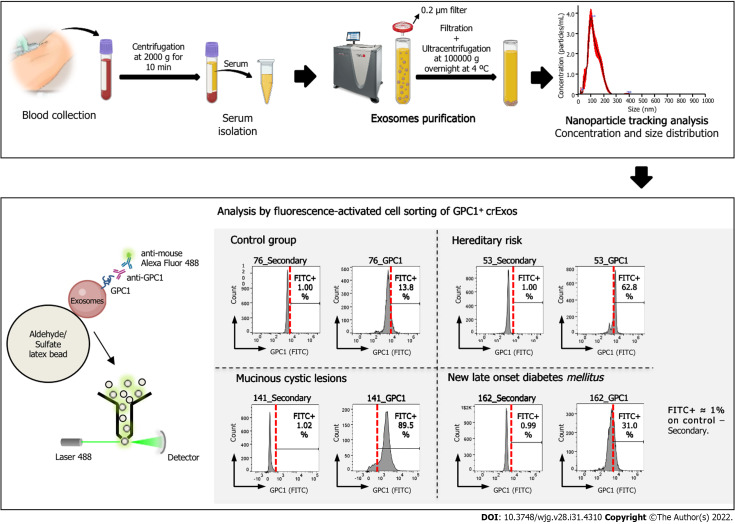
This cross-sectional study with a prospective unicentric cohort included 88 subjects: 40 patients with MCL, 20 individuals with HR, and 20 patients with NLOD. A control group (CG) was submitted to EUS for other reasons than pancreatic pathology, with normal pancreas and absence of hereditary risk factors ( = 8). The inclusion period was between October 2016 and January 2019, and the study was approved by the Ethics Committee of Centro Hospitalar Universitário de São João, Porto, Portugal. All patients provided written informed consent. EUS and blood tests for quantification of GPC1 crExos by flow cytometry and carbohydrate antigen 19-9 (CA 19-9) levels by ELISA were performed in all subjects. EUS-guided tissue acquisition was done whenever necessary. For statistical analysis, SPSS 27.0 (IBM Corp., Armonk, NY, United States) version was used. All graphs were created using GraphPad Prism 7.00 (GraphPad Software, San Diego, CA, United States).
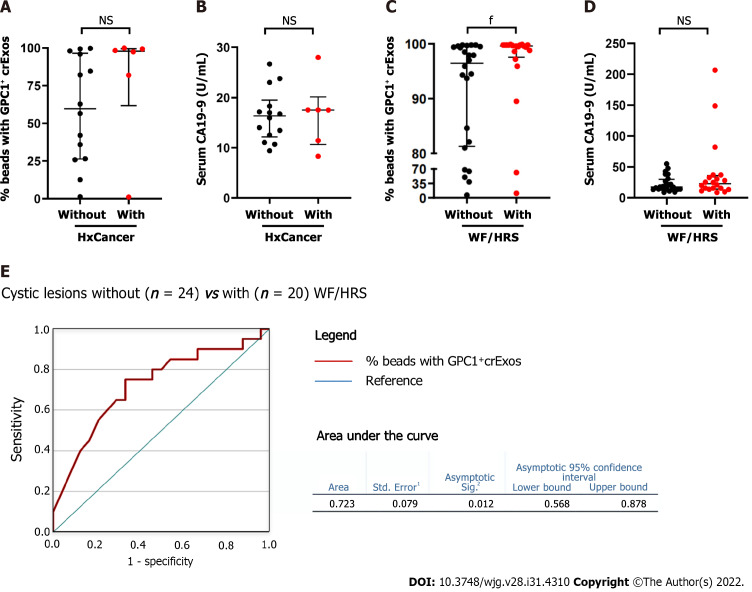
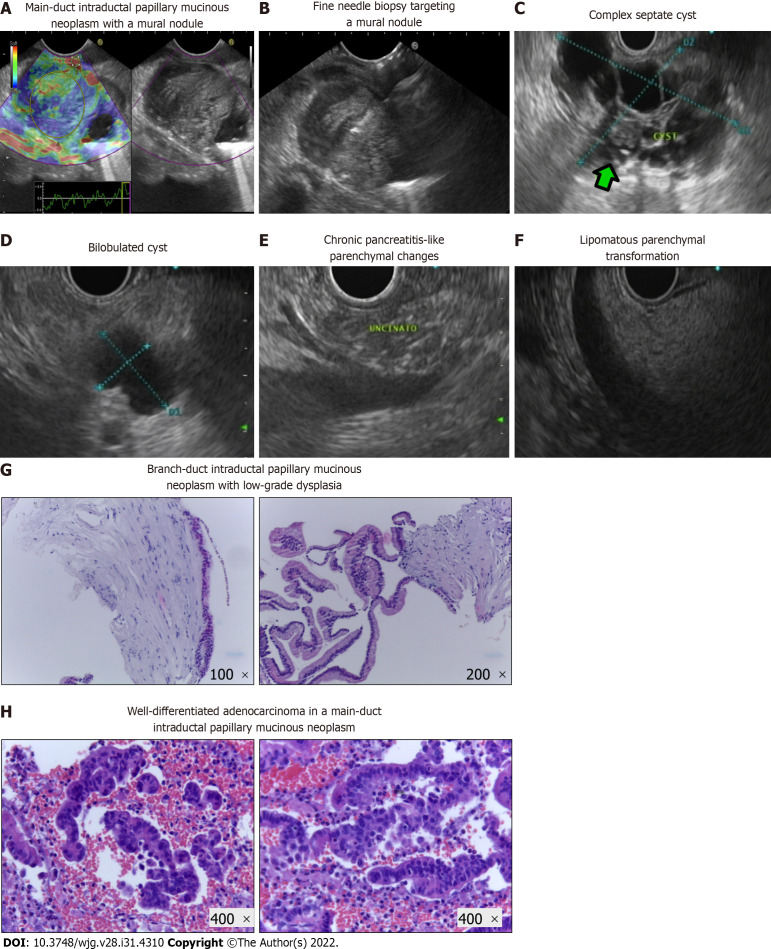
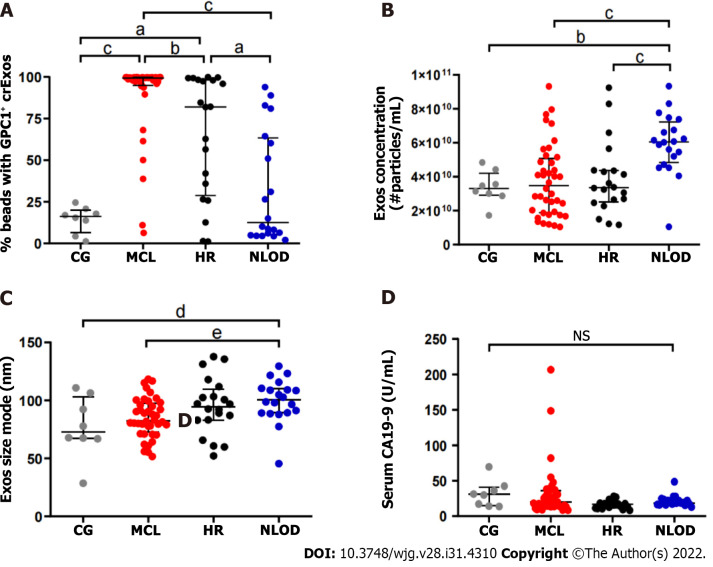
Half of MCLs harbored worrisome features (WF) or high-risk stigmata (HRS). Pancreatic abnormalities were detected by EUS in 10.0% and 35.0% in HR and NLOD individuals, respectively, all considered non-malignant and "harmless." Median levels of GPC1 crExos were statistically different: MCL [99.4%, interquartile range (IQR): 94.9%-99.8%], HR (82.0%, IQR: 28.9%-98.2%), NLOD (12.6%, IQR: 5.2%-63.4%), and CG (16.2%, IQR: 6.6%-20.1%) ( < 0.0001). Median levels of CA 19-9 were within the normal range in all groups (standard clinical cut-off of 37 U/mL). Within HR, individuals with a positive history of cancer had higher median levels of GPC1 crExos (97.9%; IQR: 61.7%-99.5%), compared to those without (59.7%; IQR: 26.3%-96.4%), despite no statistical significance ( = 0.21). Pancreatic cysts with WF/HRS were statistically associated with higher median levels of GPC1 crExos (99.6%; IQR: 97.6%-99.8%) compared to those without (96.5%; IQR: 81.3%-99.5%) ( = 0.011), presenting an area under the receiver operating characteristic curve value of 0.723 (sensitivity 75.0% and specificity 67.7%, using a cut-off of 98.5%; = 0.012).
GPC1 crExos may act as biomarker to support the diagnosis and stratification of PDAC precursor lesions, and in signaling individuals with genetic predisposition in the absence of EUS abnormalities.
在胰腺导管腺癌(PDAC)的特定风险群体中(黏液性囊性病变(MCLs)、遗传风险(HR)和新发病的晚期糖尿病(NLOD)),个体代表了早期癌症检测的机会。内镜超声(EUS)是 PDAC 筛查和前体病变特征的优质成像方式。虽然目前临床上没有特定的生物标志物用于此目的,但与健康受试者或患有良性胰腺疾病的受试者相比,GPC1 在 PDAC 患者的循环外泌体(crExos)中过表达。
评估 GPC1 crExos 识别这些特定群体中风险较高个体的能力,这些个体均通过 EUS 进行了特征描述。
这项前瞻性单中心队列的横断面研究纳入了 88 名受试者:40 名 MCL 患者、20 名 HR 个体和 20 名 NLOD 患者。对照组(CG)因胰腺病理学以外的其他原因接受了 EUS,其胰腺正常且无遗传风险因素(n=8)。纳入期为 2016 年 10 月至 2019 年 1 月,该研究得到了葡萄牙波尔图 Centro Hospitalar Universitário de São João 的伦理委员会的批准。所有患者均提供了书面知情同意书。所有患者均进行了 EUS 和通过流式细胞术定量检测 GPC1 crExos 和通过 ELISA 定量检测 CA19-9 水平的血液检测。必要时进行了 EUS 引导的组织采集。统计分析使用 SPSS 27.0(IBM 公司,美国阿蒙克)版本。所有图表均使用 GraphPad Prism 7.00(GraphPad Software,美国圣地亚哥)创建。
一半的 MCL 存在令人担忧的特征(WF)或高危标志物(HRS)。EUS 检测到 HR 和 NLOD 个体中分别有 10.0%和 35.0%存在胰腺异常,均被认为是非恶性和“无害的”。GPC1 crExos 的中位数水平存在统计学差异:MCL[99.4%,四分位距(IQR):94.9%-99.8%]、HR(82.0%,IQR:28.9%-98.2%)、NLOD(12.6%,IQR:5.2%-63.4%)和 CG(16.2%,IQR:6.6%-20.1%)(<0.0001)。所有组的 CA19-9 中位水平均在正常范围内(标准临床截止值为 37 U/mL)。在 HR 中,有癌症病史的个体 GPC1 crExos 中位数水平较高(97.9%,IQR:61.7%-99.5%),而无癌症病史的个体 GPC1 crExos 中位数水平较低(59.7%,IQR:26.3%-96.4%),尽管无统计学意义(=0.21)。具有 WF/HRS 的胰腺囊肿与 GPC1 crExos 中位数水平较高相关(99.6%,IQR:97.6%-99.8%),而无 WF/HRS 的胰腺囊肿与 GPC1 crExos 中位数水平较低相关(96.5%,IQR:81.3%-99.5%)(=0.011),其接受者操作特征曲线下面积值为 0.723(灵敏度为 75.0%,特异性为 67.7%,使用 98.5%的截断值;=0.012)。
GPC1 crExos 可作为支持 PDAC 前体病变诊断和分层的生物标志物,并在无 EUS 异常的情况下提示遗传倾向个体。