Department of Animal Ecology, Netherlands Institute of Ecology (NIOO-KNAW), Wageningen, The Netherlands.
Groningen Institute for Evolutionary Life Sciences, University of Groningen, Groningen, The Netherlands.
Mol Ecol. 2022 Nov;31(22):5795-5812. doi: 10.1111/mec.16705. Epub 2022 Oct 6.
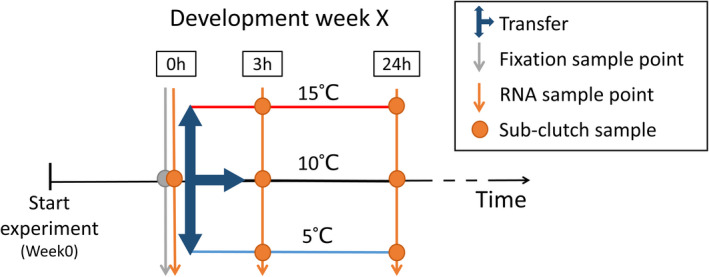
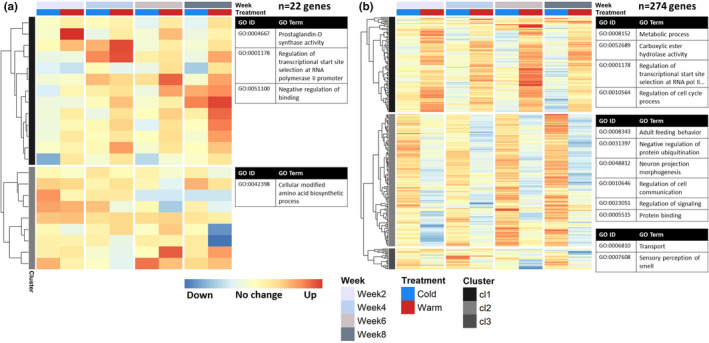
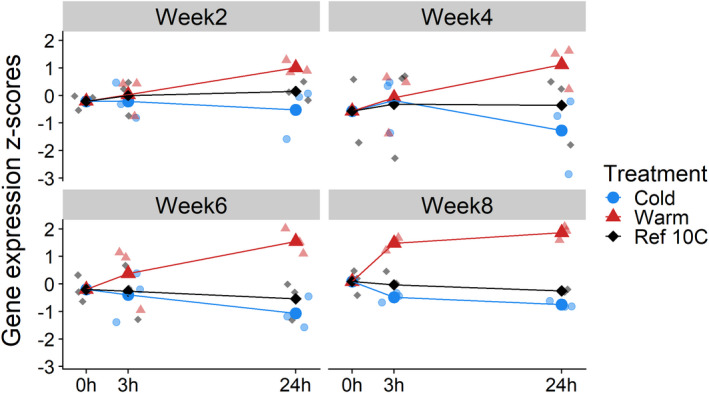
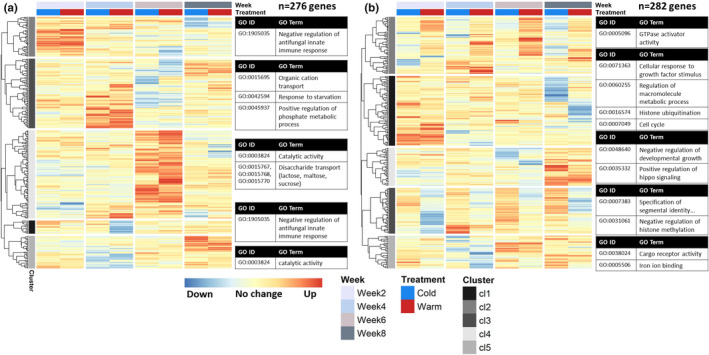
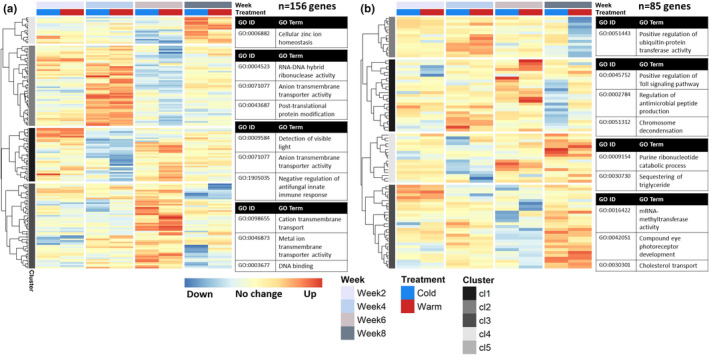
Climate change will strongly affect the developmental timing of insects, as their development rate depends largely on ambient temperature. However, we know little about the genetic mechanisms underlying the temperature sensitivity of embryonic development in insects. We investigated embryonic development rate in the winter moth (Operophtera brumata), a species with egg dormancy which has been under selection due to climate change. We used RNA sequencing to investigate which genes are involved in the regulation of winter moth embryonic development rate in response to temperature. Over the course of development, we sampled eggs before and after an experimental change in ambient temperature, including two early development weeks when the temperature sensitivity of eggs is low and two late development weeks when temperature sensitivity is high. We found temperature-responsive genes that responded in a similar way across development, as well as genes with a temperature response specific to a particular development week. Moreover, we identified genes whose temperature effect size changed around the switch in temperature sensitivity of development rate. Interesting candidate genes for regulating the temperature sensitivity of egg development rate included genes involved in histone modification, hormonal signalling, nervous system development and circadian clock genes. The diverse sets of temperature-responsive genes we found here indicate that there are many potential targets of selection to change the temperature sensitivity of embryonic development rate. Identifying for which of these genes there is genetic variation in wild insect populations will give insight into their adaptive potential in the face of climate change.
气候变化将强烈影响昆虫的发育时间,因为它们的发育速度在很大程度上取决于环境温度。然而,我们对昆虫胚胎发育对温度的敏感性的遗传机制知之甚少。我们研究了具有卵休眠特性的冬蛾(Operophtera brumata)的胚胎发育速度,由于气候变化,该物种一直受到选择的影响。我们使用 RNA 测序来研究哪些基因参与了调节冬蛾胚胎发育速度对温度的反应。在发育过程中,我们在环境温度发生实验性变化前后采集卵,包括两个早期发育周,此时卵对温度的敏感性较低,以及两个晚期发育周,此时温度敏感性较高。我们发现了在整个发育过程中以相似方式响应温度的温度响应基因,以及在特定发育周具有温度响应特异性的基因。此外,我们确定了基因的温度效应大小在发育速度的温度敏感性变化附近发生变化。调节卵发育速度温度敏感性的候选基因包括参与组蛋白修饰、激素信号、神经系统发育和生物钟基因的基因。我们在这里发现的多样化的温度响应基因表明,有许多潜在的选择目标可以改变胚胎发育速度的温度敏感性。确定在野生昆虫种群中这些基因中有哪些存在遗传变异,将深入了解它们在气候变化面前的适应潜力。