Waldvogel Ann-Marie, Feldmeyer Barbara, Rolshausen Gregor, Exposito-Alonso Moises, Rellstab Christian, Kofler Robert, Mock Thomas, Schmid Karl, Schmitt Imke, Bataillon Thomas, Savolainen Outi, Bergland Alan, Flatt Thomas, Guillaume Frederic, Pfenninger Markus
Senckenberg Biodiversity and Climate Research Centre Frankfurt am Main Germany.
Department of Plant Biology Carnegie Institution for Science Stanford California.
Evol Lett. 2020 Jan 14;4(1):4-18. doi: 10.1002/evl3.154. eCollection 2020 Feb.
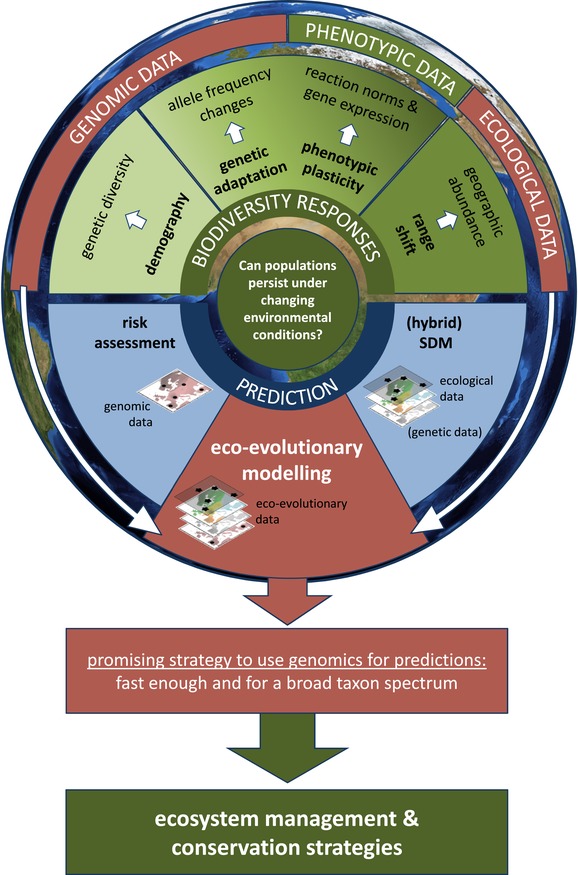
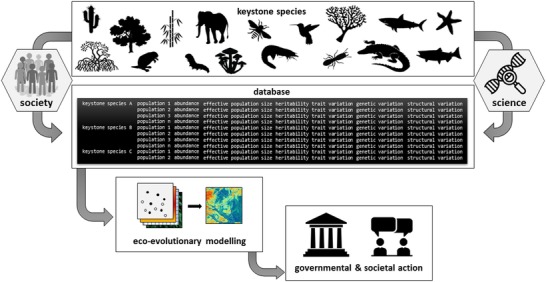
Global climate change (GCC) increasingly threatens biodiversity through the loss of species, and the transformation of entire ecosystems. Many species are challenged by the pace of GCC because they might not be able to respond fast enough to changing biotic and abiotic conditions. Species can respond either by shifting their range, or by persisting in their local habitat. If populations persist, they can tolerate climatic changes through phenotypic plasticity, or genetically adapt to changing conditions depending on their genetic variability and census population size to allow for de novo mutations. Otherwise, populations will experience demographic collapses and species may go extinct. Current approaches to predicting species responses to GCC begin to combine ecological and evolutionary information for species distribution modelling. Including an evolutionary dimension will substantially improve species distribution projections which have not accounted for key processes such as dispersal, adaptive genetic change, demography, or species interactions. However, eco-evolutionary models require new data and methods for the estimation of a species' adaptive potential, which have so far only been available for a small number of model species. To represent global biodiversity, we need to devise large-scale data collection strategies to define the ecology and evolutionary potential of a broad range of species, especially of keystone species of ecosystems. We also need standardized and replicable modelling approaches that integrate these new data to account for eco-evolutionary processes when predicting the impact of GCC on species' survival. Here, we discuss different genomic approaches that can be used to investigate and predict species responses to GCC. This can serve as guidance for researchers looking for the appropriate experimental setup for their particular system. We furthermore highlight future directions for moving forward in the field and allocating available resources more effectively, to implement mitigation measures before species go extinct and ecosystems lose important functions.
全球气候变化(GCC)正通过物种丧失和整个生态系统的转变日益威胁生物多样性。许多物种受到全球气候变化速度的挑战,因为它们可能无法足够迅速地应对不断变化的生物和非生物条件。物种可以通过转移其分布范围或在当地栖息地存续来做出反应。如果种群得以存续,它们可以通过表型可塑性来耐受气候变化,或者根据其遗传变异性和普查种群规模在基因上适应变化的条件以产生新的突变。否则,种群将经历数量崩溃,物种可能灭绝。当前预测物种对全球气候变化反应的方法开始将生态和进化信息结合起来用于物种分布建模。纳入进化维度将大幅改进尚未考虑扩散、适应性基因变化、种群统计学或物种相互作用等关键过程的物种分布预测。然而,生态进化模型需要新的数据和方法来估计物种的适应潜力,而到目前为止这些仅适用于少数模式物种。为了代表全球生物多样性,我们需要设计大规模数据收集策略来界定广泛物种,特别是生态系统关键物种的生态和进化潜力。我们还需要标准化且可重复的建模方法,在预测全球气候变化对物种生存的影响时整合这些新数据以考虑生态进化过程。在此,我们讨论可用于研究和预测物种对全球气候变化反应的不同基因组方法。这可为寻求适合其特定系统的实验设置的研究人员提供指导。我们还进一步强调了该领域未来的发展方向以及更有效地分配可用资源,以便在物种灭绝和生态系统失去重要功能之前实施缓解措施。