Department of Neurology, Beijing Tiantan Hospital, Capital Medical University, Beijing, Fengtai, China.
China National Clinical Research Center for Neurological Diseases, Beijing, China.
Stroke Vasc Neurol. 2023 Apr;8(2):127-133. doi: 10.1136/svn-2022-001612. Epub 2022 Sep 26.
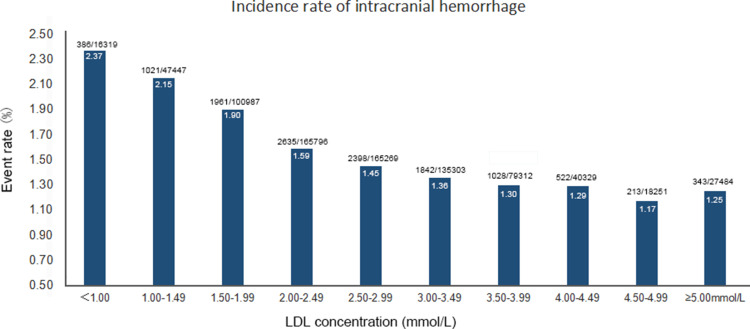
The Treat Stroke to Target trial has confirmed the benefit of targeting low-density lipoprotein cholesterol (LDL-C) of <1.8 mmol/L in patients who had an ischaemic stroke (IS). However, haemorrhagic risk brought by this target level (<1.8 mmol/L) or even lower level (<1.4 mmol/L) of LDL-C should also be concerned. In this study, we aimed to demonstrate whether low LDL-C could increase the intracranial haemorrhage risk following IS.
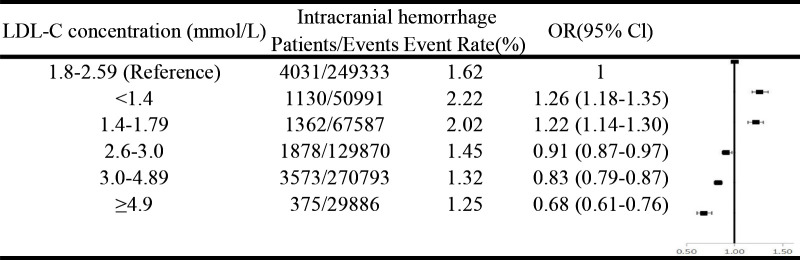
Patients who had an IS from China Stroke Center Alliance programme with complete baseline information were prospectively enrolled. 793 572 patients who had an IS were categorised into 6 groups according to LDL-C level (<1.40 mmol/L, 1.40-1.79 mmol/L, 1.80-2.59 mmol/L, 2.60-2.99 mmol/L, 3.00-4.89 mmol/L, ≥4.90 mmol/L). The study outcome was defined as intracranial haemorrhage identified during hospitalisation. Logistic regression model was used to examine the association between different LDL-C levels and risk of intracranial haemorrhage.
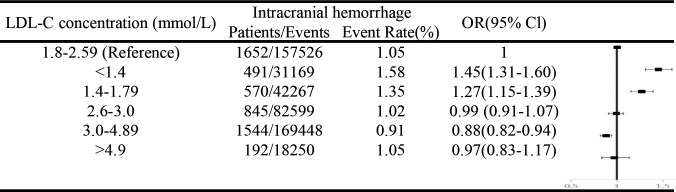
Compared with patients of LDL-C=1.80-2.59 mmol/L, both subgroups of LDL-C<1.40 mmol/L and LDL-C=1.40-1.79 mmol/L showed significantly higher risk of intracranial haemorrhage (OR=1.26, 95% CI=1.18 to 1.35; OR=1.22, 95% CI=1.14 to 1.30, respectively). Interaction effect was found to exist between the subgroups of intravenous thrombolytic therapy (p=0.04), rather than the subgroups of age, sex and body mass index. Moreover, the sensitivity analyses indicated that even patients who had an IS with minor stroke still suffered from the increased intracranial haemorrhage risk related to low LDL-C level.
Among patients who had an IS, the low LDL-C level (<1.4 mmol/L or <1.8 mmol/L) at baseline is associated with increased risk of intracranial haemorrhage during acute stage. While actively lowering LDL-C level for patients who had an IS, clinicians should also concern about the haemorrhagic risk associated with low LDL-C level.
Treat Stroke to Target 试验证实,缺血性卒中(IS)患者的低密度脂蛋白胆固醇(LDL-C)目标值<1.8mmol/L 有益。然而,人们也应该关注 LDL-C 达到这一目标水平(<1.8mmol/L)甚至更低水平(<1.4mmol/L)带来的出血风险。本研究旨在探讨低 LDL-C 是否会增加 IS 后颅内出血的风险。
前瞻性纳入中国卒中中心联盟项目中具有完整基线资料的 IS 患者。将 793572 例 IS 患者按 LDL-C 水平(<1.40mmol/L、1.40-1.79mmol/L、1.80-2.59mmol/L、2.60-2.99mmol/L、3.00-4.89mmol/L、≥4.90mmol/L)分为 6 组。研究结局为住院期间发生颅内出血。采用 logistic 回归模型探讨不同 LDL-C 水平与颅内出血风险的关系。
与 LDL-C=1.80-2.59mmol/L 相比,LDL-C<1.40mmol/L 和 LDL-C=1.40-1.79mmol/L 亚组颅内出血风险均显著增加(OR=1.26,95%CI=1.18-1.35;OR=1.22,95%CI=1.14-1.30)。亚组间静脉溶栓治疗(p=0.04)存在交互作用,而年龄、性别和体质指数亚组间无交互作用。敏感性分析表明,即使是发生小卒中的 IS 患者,也会因 LDL-C 水平较低而增加颅内出血风险。
IS 患者基线 LDL-C 水平较低(<1.4mmol/L 或<1.8mmol/L)与急性期颅内出血风险增加相关。在积极降低 IS 患者 LDL-C 水平的同时,临床医生也应关注与 LDL-C 水平降低相关的出血风险。