Moreira Helena R, Rodrigues Daniel B, Freitas-Ribeiro Sara, da Silva Lucília P, da S Morais Alain, Jarnalo Mariana, Horta Ricardo, Reis Rui L, Pirraco Rogério P, Marques Alexandra P
3B's Research Group, I3Bs - Research Institute on Biomaterials, Biodegradables and Biomimetics, University of Minho, Headquarters of the European Institute of Excellence on Tissue Engineering and Regenerative Medicine, Avepark - Zona Industrial da Gandra, Guimarães, 4805-017, Portugal.
ICVS/3B's - PT Government Associate Laboratory, Braga/Guimarães, 4805-017, Portugal.
NPJ Regen Med. 2022 Sep 27;7(1):57. doi: 10.1038/s41536-022-00253-4.
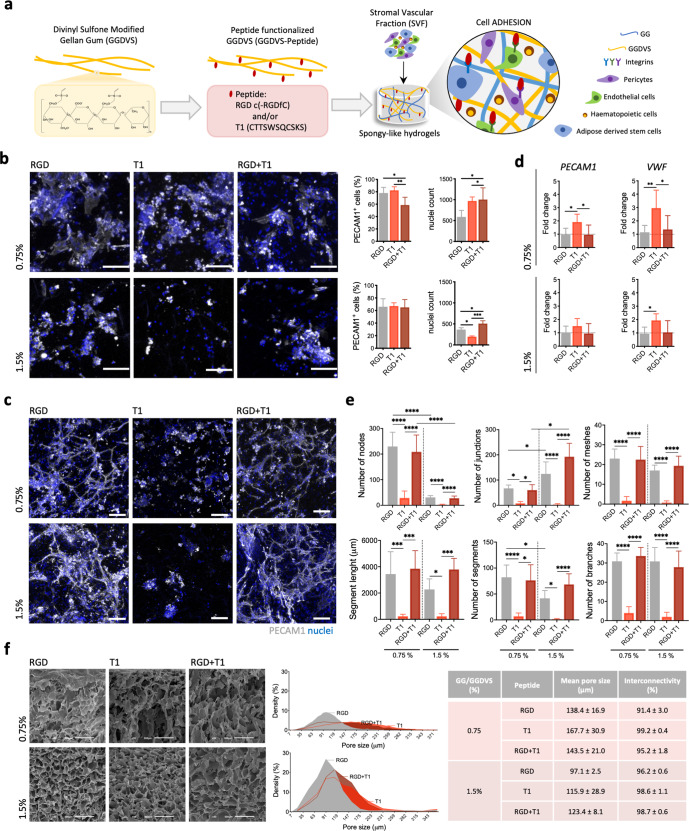
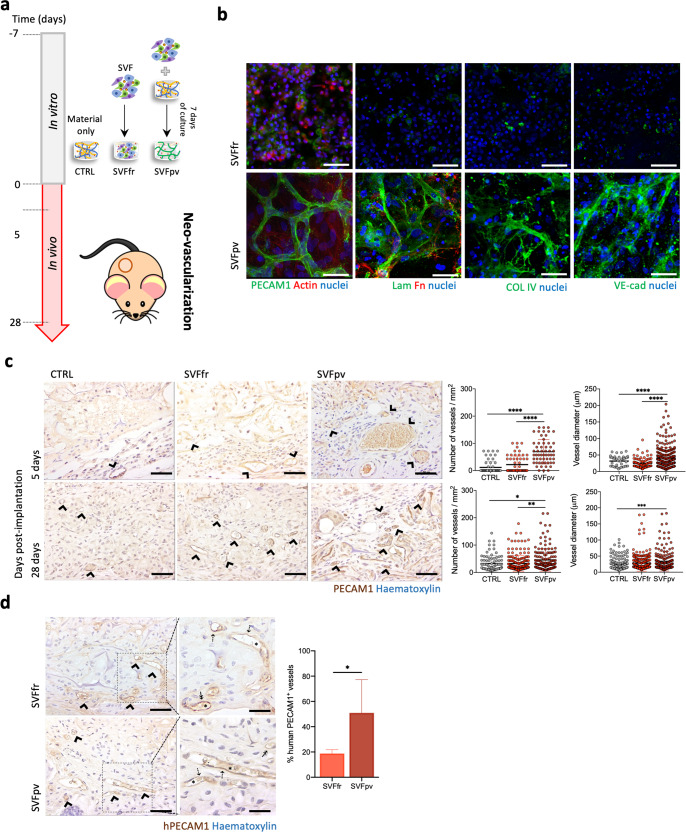
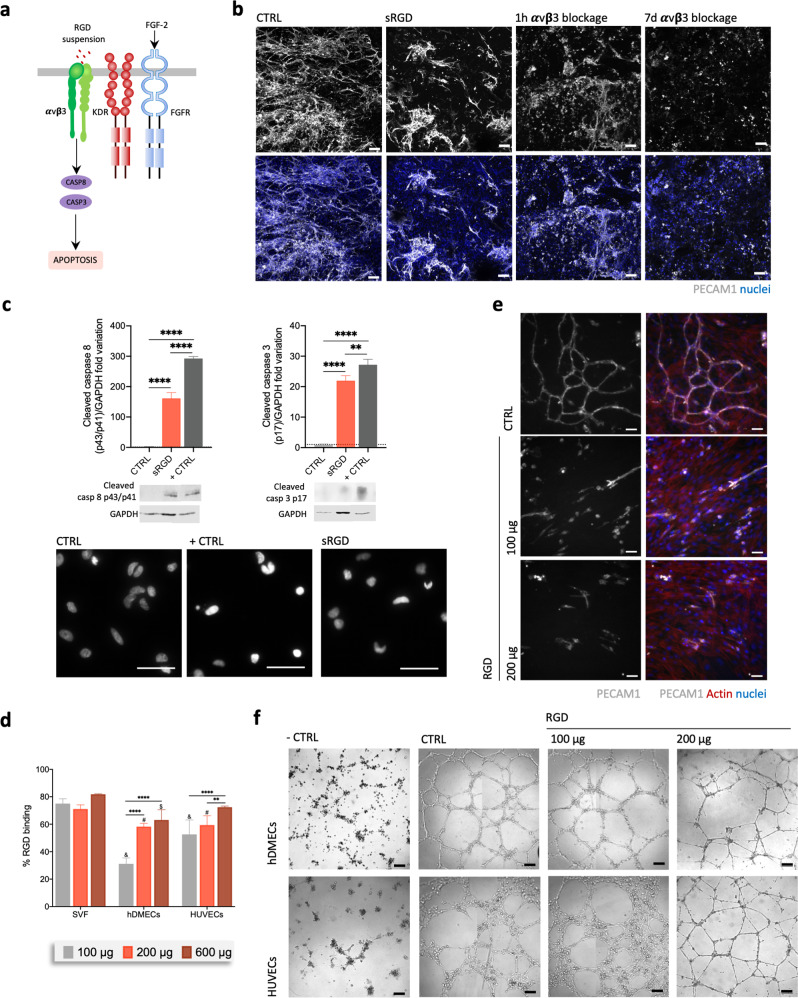
Integrin-binding biomaterials have been extensively evaluated for their capacity to enable de novo formation of capillary-like structures/vessels, ultimately supporting neovascularization in vivo. Yet, the role of integrins as vascular initiators in engineered materials is still not well understood. Here, we show that αvβ3 integrin-specific 3D matrices were able to retain PECAM1 cells from the stromal vascular fraction (SVF) of adipose tissue, triggering vasculogenesis in vitro in the absence of extrinsic growth factors. Our results suggest that αvβ3-RGD-driven signaling in the formation of capillary-like structures prevents the activation of the caspase 8 pathway and activates the FAK/paxillin pathway, both responsible for endothelial cells (ECs) survival and migration. We also show that prevascularized αvβ3 integrin-specific constructs inosculate with the host vascular system fostering in vivo neovascularization. Overall, this work demonstrates the ability of the biomaterial to trigger vasculogenesis in an integrin-specific manner, by activating essential pathways for EC survival and migration within a self-regulatory growth factor microenvironment. This strategy represents an improvement to current vascularization routes for Tissue Engineering constructs, potentially enhancing their clinical applicability.
整合素结合生物材料已被广泛评估其促成毛细血管样结构/血管新生形成的能力,最终在体内支持新生血管化。然而,整合素作为工程材料中血管引发剂的作用仍未得到充分理解。在此,我们表明,αvβ3整合素特异性三维基质能够保留来自脂肪组织基质血管成分(SVF)的PECAM1细胞,在无外源性生长因子的情况下在体外触发血管生成。我们的结果表明,在毛细血管样结构形成过程中由αvβ3-RGD驱动的信号传导可防止半胱天冬酶8途径的激活,并激活FAK/桩蛋白途径,这两者都负责内皮细胞(EC)的存活和迁移。我们还表明,预血管化的αvβ3整合素特异性构建体与宿主血管系统吻合,促进体内新生血管化。总体而言,这项工作证明了生物材料通过在自调节生长因子微环境中激活EC存活和迁移的关键途径,以整合素特异性方式触发血管生成的能力。该策略代表了对组织工程构建体当前血管化途径的改进,可能会提高其临床适用性。