Moreira Helena R, Silva Lucília P da, Reis Rui L, Marques Alexandra P
3B's Research Group, I3Bs-Research Institute on Biomaterials, Biodegradables and Biomimetics, University of Minho, Headquarters of the European Institute of Excellence on Tissue Engineering and Regenerative Medicine, 4805-017 Guimarães, Portugal.
ICVS/3B's-PT Government Associate Laboratory, 4805-017 Braga/Guimarães, Portugal.
Polymers (Basel). 2020 Feb 5;12(2):329. doi: 10.3390/polym12020329.
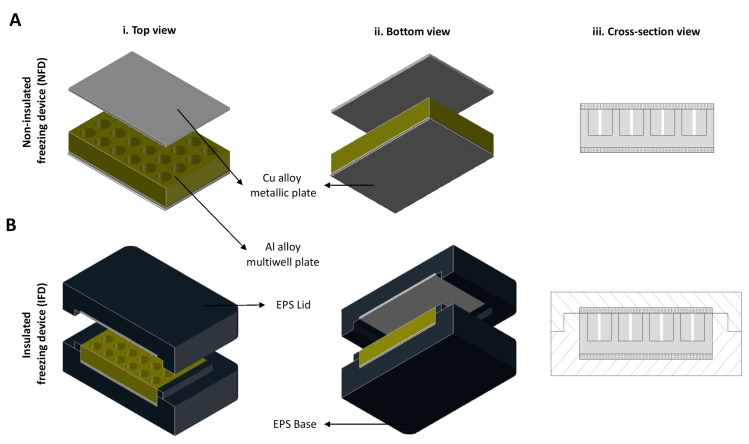
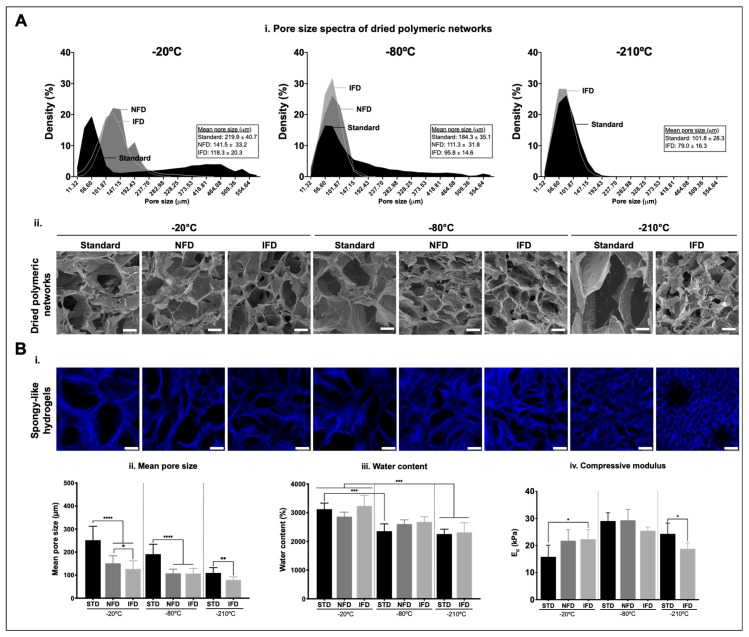
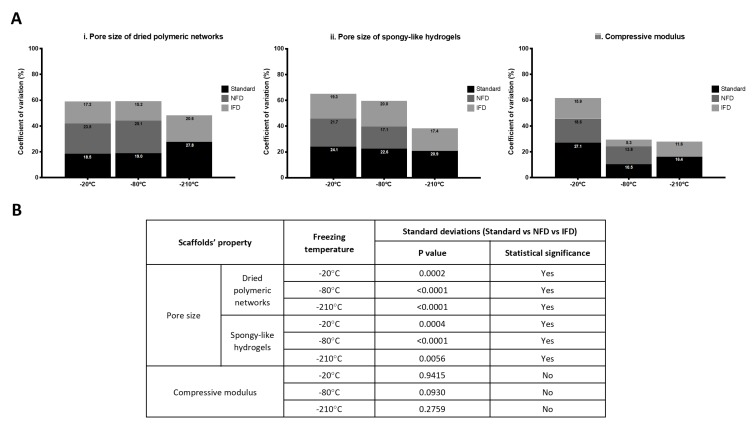
Gellan gum (GG) spongy-like hydrogels have been explored for different tissue engineering (TE) applications owing to their highly attractive hydrogel-like features, and improved mechanical resilience and cell performance. Although the whole process for the preparation of these materials is well-defined, we hypothesized that variations occurring during the freezing step lead to batch-to-batch discrepancies. Aiming to address this issue, two freezing devices were tested, to prepare GG spongy-like hydrogels in a more reproducible way. The cooling and freezing rates, the nucleation time and temperature, and the end freezing time were determined at different freezing temperatures (-20, -80, and -210 °C). The efficacy of the devices was assessed by analyzing the physicochemical, mechanical, and biological properties of different formulations. The cooling rate and freezing rate varied between 0.1 and 128 °C/min, depending on the temperature used and the device. The properties of spongy-like hydrogels prepared with the tested devices showed lower standard deviation in comparison to those prepared with the standard process, due to the slower freezing rate of the hydrogels. However, with this method, mean pore size was significantly lower than that with the standard method. Cell entrapment, adhesion, and viability were not affected as demonstrated with human dermal fibroblasts. This work confirmed that batch-to-batch variations are mostly due to the freezing step and that the tested devices allow fine tuning of the scaffolds' structure and properties.
结冷胶(GG)海绵状水凝胶因其极具吸引力的水凝胶样特性、改善的机械弹性和细胞性能,已被探索用于不同的组织工程(TE)应用。尽管制备这些材料的整个过程已明确,但我们推测冷冻步骤中出现的变化会导致批次间的差异。为了解决这个问题,测试了两种冷冻设备,以便以更可重复的方式制备GG海绵状水凝胶。在不同的冷冻温度(-20、-80和-210℃)下测定了冷却和冷冻速率、成核时间和温度以及最终冷冻时间。通过分析不同配方的物理化学、机械和生物学特性来评估设备的功效。冷却速率和冷冻速率在0.1至128℃/分钟之间变化,这取决于所使用的温度和设备。与采用标准工艺制备的海绵状水凝胶相比,用测试设备制备的海绵状水凝胶的特性显示出更低的标准差,这是由于水凝胶的冷冻速率较慢。然而,用这种方法,平均孔径明显低于标准方法。如用人皮肤成纤维细胞所证明的,细胞截留、粘附和活力不受影响。这项工作证实批次间的差异主要归因于冷冻步骤,并且测试的设备允许对支架的结构和特性进行微调。