University of Lincoln, School of Life & Environmental Sciences, Joseph Banks Laboratories, Green Lane, Lincoln, United Kingdom.
Smithsonian Tropical Research Institute, Balboa, Panama.
Elife. 2022 Sep 28;11:e77628. doi: 10.7554/eLife.77628.
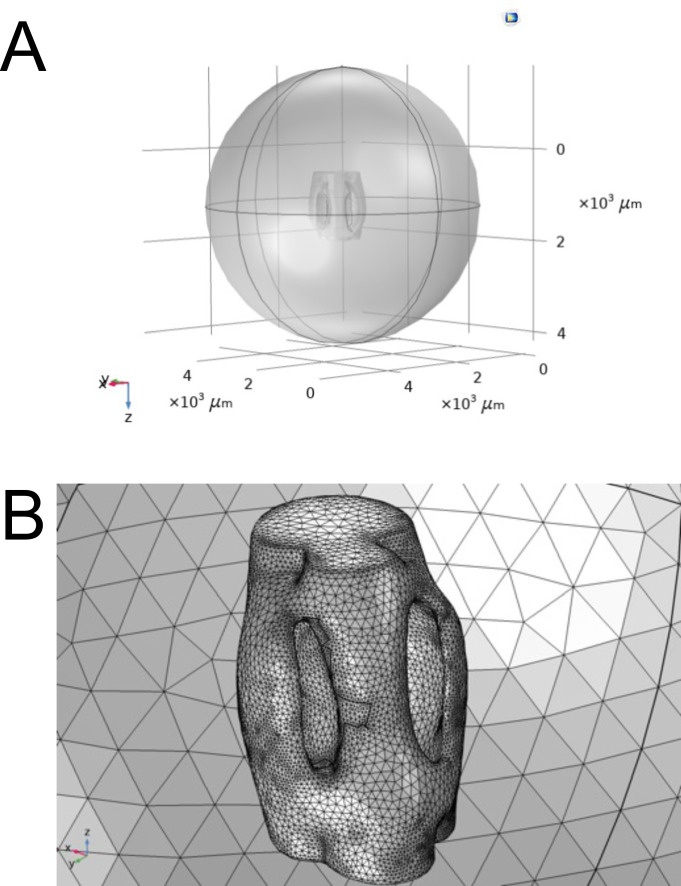
Early predator detection is a key component of the predator-prey arms race and has driven the evolution of multiple animal hearing systems. Katydids (Insecta) have sophisticated ears, each consisting of paired tympana on each foreleg that receive sound both externally, through the air, and internally via a narrowing ear canal running through the leg from an acoustic spiracle on the thorax. These ears are pressure-time difference receivers capable of sensitive and accurate directional hearing across a wide frequency range. Many katydid species have cuticular pinnae which form cavities around the outer tympanal surfaces, but their function is unknown. We investigated pinnal function in the katydid by combining experimental biophysics and numerical modelling using 3D ear geometries. We found that the pinnae in do not assist in directional hearing for conspecific call frequencies, but instead act as ultrasound detectors. Pinnae induced large sound pressure gains (20-30 dB) that enhanced sound detection at high ultrasonic frequencies (>60 kHz), matching the echolocation range of co-occurring insectivorous gleaning bats. These findings were supported by behavioural and neural audiograms and pinnal cavity resonances from live specimens, and comparisons with the pinnal mechanics of sympatric katydid species, which together suggest that katydid pinnae primarily evolved for the enhanced detection of predatory bats.
早期捕食者的探测是捕食者-猎物军备竞赛的一个关键组成部分,它推动了多种动物听觉系统的进化。螽斯(昆虫)拥有复杂的耳朵,每只前腿上都有一对鼓膜,可以通过空气从外部接收声音,也可以通过穿过腿部的狭窄耳道从胸部的声学喇叭口从内部接收声音。这些耳朵是压力-时间差接收器,能够在很宽的频率范围内进行敏感和准确的方向听觉。许多螽斯物种的外鼓膜表面周围都有角质耳突,但其功能尚不清楚。我们通过使用 3D 耳朵几何形状的实验生物物理学和数值建模相结合,研究了螽斯的耳突功能。我们发现,在 中,耳突对于同种鸣声的定向听觉没有帮助,而是充当超声波探测器。耳突引起了较大的声压增益(20-30 dB),增强了高频超声(>60 kHz)的声音检测,与同时出现的食虫性掠食蝙蝠的回声定位范围相匹配。这些发现得到了来自活体标本的行为和神经听力图以及耳突腔共振的支持,并与同域螽斯物种的耳突力学进行了比较,这些综合表明,螽斯耳突主要是为了增强对捕食性蝙蝠的探测而进化的。