Simon Business School, University of Rochester, Rochester, NY, United States of America.
McIntire School of Commerce, University of Virginia, Charlottesville, VA, United States of America.
PLoS One. 2022 Sep 28;17(9):e0273307. doi: 10.1371/journal.pone.0273307. eCollection 2022.
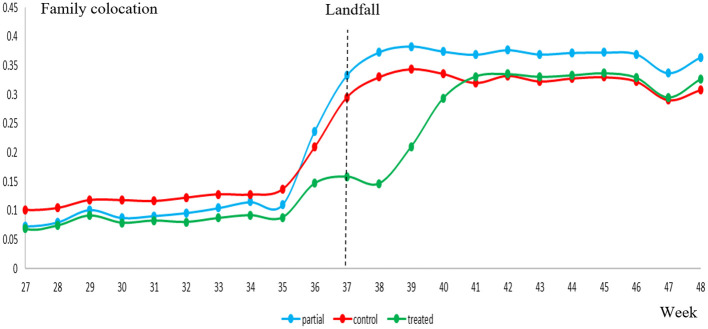
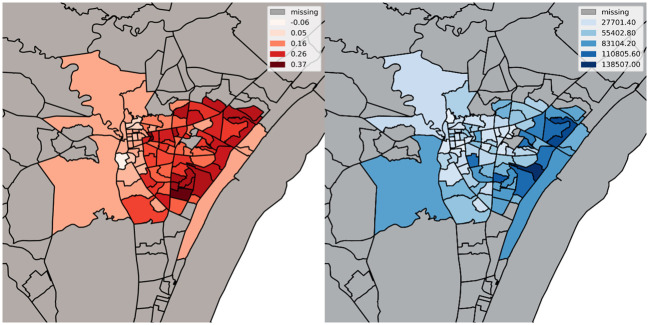
Disasters, from hurricanes to pandemics, tremendously impact human lives and behaviors. Physical closeness to family post-disaster plays a critical role in mental healing and societal sustainability. Nonetheless, little is known about whether and how family colocation alters after a disaster, a topic of immense importance to a post-disaster society. We analyze 1 billion records of population-scale, granular, individual-level mobile location data to quantify family colocation, and examine the magnitude, dynamics, and socioeconomic heterogeneity of the shift in family colocation from the pre- to post-disaster period. Leveraging Hurricane Florence as a natural experiment, and Geographic Information System (GIS), machine learning, and statistical methods to investigate the shift across the landfall (treated) city of Wilmington, three partially treated cites on the hurricane's path, and two control cities off the path, we uncover dramatic (18.9%), widespread (even among the partially treated cities), and enduring (over at least 3 months) escalations in family colocation. These findings reveal the powerful psychological and behavioral impacts of the disaster upon the broader populations, and simultaneously remarkable human resilience via behavioral adaptations during disastrous times. Importantly, the disaster created a gap across socioeconomic groups non-existent beforehand, with the disadvantaged displaying weaker lifts in family colocation. This sheds important lights on policy making and policy communication to promote sustainable family colocation, healthy coping strategies against traumatic experiences, social parity, and societal recovery.
灾害,无论是飓风还是大流行病,都会对人类的生活和行为产生巨大影响。灾难后与家人近距离接触对心理康复和社会可持续性起着至关重要的作用。然而,人们对灾难后家庭是否以及如何重新团聚知之甚少,而这对于灾后社会而言是一个极其重要的话题。我们分析了 10 亿份人口规模、粒度细化、个体层面的移动位置数据,以量化家庭团聚情况,并研究了家庭团聚在灾难前后的变化幅度、动态变化以及社会经济异质性。我们利用佛罗伦萨飓风作为自然实验,利用地理信息系统(GIS)、机器学习和统计方法,调查了在威尔明顿市(受飓风影响的城市)、飓风路径上的三个部分受影响城市以及两条不在路径上的控制城市之间的家庭团聚的转移情况。我们发现,家庭团聚的急剧增加(18.9%)、广泛(即使在部分受影响城市中也是如此)和持久(至少持续 3 个月)。这些发现揭示了灾难对更广泛人群的心理和行为产生的强大影响,同时也展现了人类在灾难时期通过行为适应所表现出的非凡韧性。重要的是,这场灾难在社会经济群体之间制造了一个前所未有的差距,弱势群体的家庭团聚程度提升较弱。这为制定和传播促进可持续家庭团聚、健康应对创伤经历、社会平等和社会恢复的政策提供了重要启示。