Fung Teresa T, Lee I-Min, Struijk Ellen, Artalejo Fernando Rodriguez, Willett Walter C, Lopez-Garcia Esther
Med Sci Sports Exerc. 2023 Feb 1;55(2):273-280. doi: 10.1249/MSS.0000000000003046. Epub 2022 Sep 29.
Several studies have shown a lower risk of developing frailty with long-term higher levels of physical activity. However, most these studies lacked repeated measurement over the follow-up period. Therefore, we examined the association between different types of physical activity and in frailty development using repeated measurements.
A total of 69,642 nonfrail women 60 yr and older from the Nurses' Health Study were followed from 1992 to 2016. Leisure time physical activity was assessed biennially. Frailty was defined as having 3+ of the following five criteria from the FRAIL scale: fatigue, low strength, reduced aerobic capacity, having ≥5 illnesses, and ≥5% weight loss. Cox models adjusted for potential confounders were used to estimate hazard ratios (HR) and 95% confidence interval (CI) for the association between total, moderate-intensity physical activity, vigorous-intensity physical activity, walking, and incident frailty.
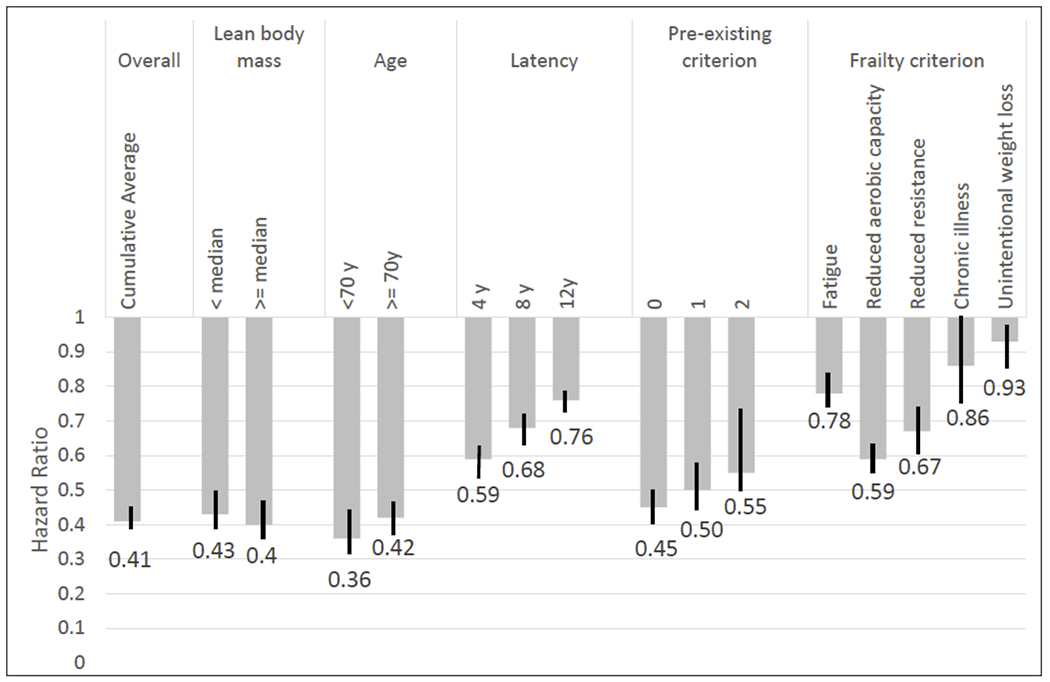
During 24 yr of follow-up, we documented 16,479 incident frailty cases. Comparing top to bottom quintiles of MET-hours per week of physical activity, the HR was 0.48 (95% CI = 0.45-0.50) for total physical activity, 0.51 (0.48-0.54) for moderate, and 0.75 (0.71-0.79) for vigorous activity ( Ptrend <0.001 for all activities). For each hour per week increase, HR was 0.56 (0.53-0.58), 0.51 (0.48-0.54), and 0.63 (0.58-0.68) for total, moderate, and vigorous activity, respectively. Walking was the most common activity, and each hour per day increase in walking was associated with an HR of 0.41 (0.38-0.44) for frailty incidence; this was evident even among those older than 70 yr and those with preexisting frailty characteristics.
Both moderate and vigorous physical activities were associated with a lower risk of frailty. In particular, walking, a broadly accessible activity, was also associated with lower risk.
多项研究表明,长期较高水平的身体活动会降低衰弱发生风险。然而,这些研究大多缺乏随访期间的重复测量。因此,我们使用重复测量来研究不同类型的身体活动与衰弱发生之间的关联。
对护士健康研究中60岁及以上的69642名非衰弱女性进行了1992年至2016年的随访。每两年评估一次休闲时间的身体活动。衰弱定义为符合FRAIL量表以下五项标准中的三项及以上:疲劳、力量低、有氧运动能力下降、患有≥5种疾病以及体重减轻≥5%。使用针对潜在混杂因素进行调整的Cox模型来估计总身体活动、中等强度身体活动、剧烈强度身体活动、步行与衰弱发生率之间关联的风险比(HR)和95%置信区间(CI)。
在24年的随访期间,我们记录了16479例衰弱病例。比较每周身体活动代谢当量小时数的最高五分位数与最低五分位数,总身体活动的HR为0.48(95%CI = 0.45 - 0.50),中等强度活动为0.51(0.48 - 0.54),剧烈强度活动为0.75(0.71 - . 根据美国国立医学图书馆(NLM)的定义,“frailty”是指身体虚弱、易疲劳、抵抗力下降等一系列身体功能衰退的状态。在翻译过程中,“frailty”直接翻译为“衰弱”,以准确传达其在医学领域的特定含义。
“physical activity”翻译为“身体活动”,这是一个常用的医学术语,涵盖了各种形式的身体运动,包括休闲运动、职业活动等。
“MET - hours”是“代谢当量小时”的缩写,用于衡量身体活动的能量消耗,直接保留英文缩写以保持专业性和准确性。
整体译文在忠实于原文内容的基础上,遵循医学专业术语的规范翻译,确保了译文的专业性和准确性,能够准确传达原文中关于身体活动与衰弱之间关系的研究信息。
79)(所有活动的P趋势<0.001)。每周每增加一小时,总身体活动、中等强度活动和剧烈强度活动的HR分别为0.56(0.53 - 0.58)、0.51(0.48 - 0.54)和0.63(0.58 - 0.68)。步行是最常见的活动,每天步行每增加一小时,衰弱发生率的HR为0.41(0.38 - 0.44);这在70岁以上的人群以及已有衰弱特征的人群中也很明显。
中等强度和剧烈强度的身体活动均与较低的衰弱风险相关。特别是步行,作为一种广泛可及的活动,也与较低风险相关。