Department of Economics, University of New Mexico, 1 University of New Mexico, MSC 05 3060, Albuquerque, NM, 87131, USA.
Sci Rep. 2022 Sep 29;12(1):14512. doi: 10.1038/s41598-022-18686-8.
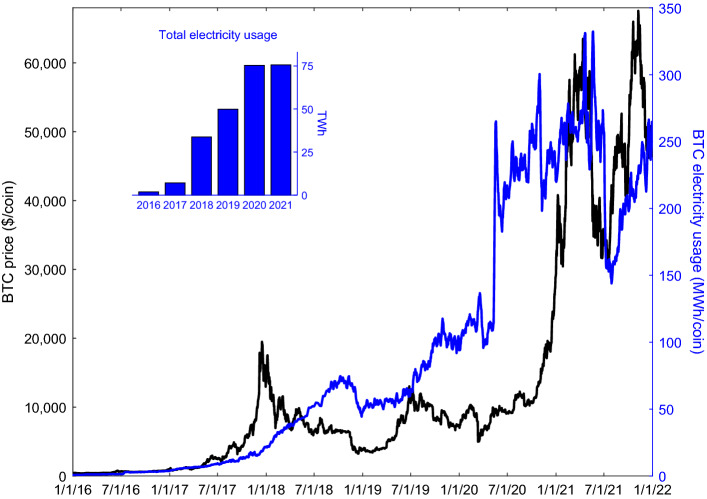
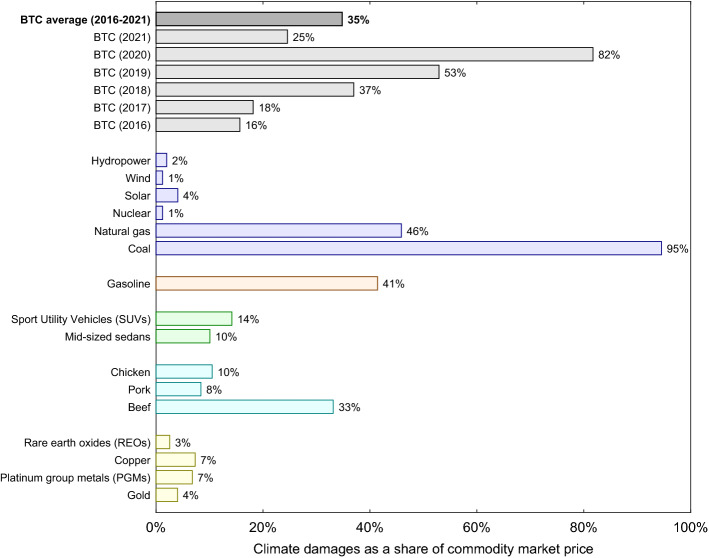
This paper provides economic estimates of the energy-related climate damages of mining Bitcoin (BTC), the dominant proof-of-work cryptocurrency. We provide three sustainability criteria for signaling when the climate damages may be unsustainable. BTC mining fails all three. We find that for 2016-2021: (i) per coin climate damages from BTC were increasing, rather than decreasing with industry maturation; (ii) during certain time periods, BTC climate damages exceed the price of each coin created; (iii) on average, each $1 in BTC market value created was responsible for $0.35 in global climate damages, which as a share of market value is in the range between beef production and crude oil burned as gasoline, and an order-of-magnitude higher than wind and solar power. Taken together, these results represent a set of sustainability red flags. While proponents have offered BTC as representing "digital gold," from a climate damages perspective it operates more like "digital crude".
本文对挖掘比特币(BTC)这种主要的工作量证明加密货币所带来的能源相关气候损害进行了经济估算。我们提供了三个可持续性标准,用于指示气候损害是否可能不可持续。BTC 挖矿未能满足这三个标准。我们发现,在 2016 年至 2021 年期间:(i)每枚硬币的 BTC 气候损害呈上升趋势,而不是随着行业成熟而下降;(ii)在某些时期,BTC 气候损害超过了每个硬币的创造价格;(iii)平均而言,每创造 1 美元的 BTC 市场价值就会造成 0.35 美元的全球气候损害,这一比例在牛肉生产和作为汽油燃烧的原油之间,是风能和太阳能的一个数量级以上。总的来说,这些结果代表了一组可持续性的危险信号。尽管支持者将 BTC 视为代表“数字黄金”,但从气候损害的角度来看,它的运作更像是“数字原油”。