National Center for Cancer Immune Therapy (CCIT-DK), Department of Oncology, Copenhagen University Hospital Herlev, Borgmester Ib Juuls Vej 25C, 5th floor, DK-2730, Herlev, Denmark.
Department of Immunology and Microbiology, University of Copenhagen, Copenhagen, Denmark.
Semin Immunopathol. 2023 Mar;45(2):253-264. doi: 10.1007/s00281-022-00966-0. Epub 2022 Sep 29.
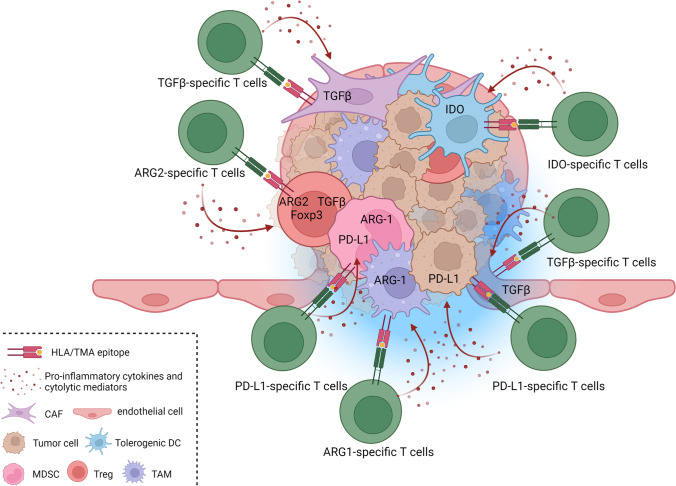
The identification and characterization of tumor antigens are central objectives in developing anti-cancer immunotherapy. Traditionally, tumor-associated antigens (TAAs) are considered relatively restricted to tumor cells (i.e., overexpressed proteins in tumor cells), whereas tumor-specific antigens (TSAs) are considered unique to tumor cells. Recent studies have focused on identifying patient-specific neoantigens, which might be highly immunogenic because they are not expressed in normal tissues. The opposite strategy has emerged with the discovery of anti-regulatory T cells (anti-Tregs) that recognize and attack many cell types in the tumor microenvironment, such as regulatory immune cells, in addition to tumor cells. The term proposed in this review is "tumor microenvironment antigens" (TMAs) to describe the antigens that draw this attack. As therapeutic targets, TMAs offer several advantages that differentiate them from more traditional tumor antigens. Targeting TMAs leads not only to a direct attack on tumor cells but also to modulation of the tumor microenvironment, rendering it immunocompetent and tumor-hostile. Of note, in contrast to TAAs and TSAs, TMAs also are expressed in non-transformed cells with consistent human leukocyte antigen (HLA) expression. Inflammation often induces HLA expression in malignant cells, so that targeting TMAs could additionally affect tumors with no or very low levels of surface HLA expression. This review defines the characteristics, differences, and advantages of TMAs compared with traditional tumor antigens and discusses the use of these antigens in immune modulatory vaccines as an attractive approach to immunotherapy. Different TMAs are expressed by different cells and could be combined in anti-cancer immunotherapies to attack tumor cells directly and modulate local immune cells to create a tumor-hostile microenvironment and inhibit tumor angiogenesis. Immune modulatory vaccines offer an approach for combinatorial therapy with additional immunotherapy including checkpoint blockade, cellular therapy, or traditional cancer vaccines. These combinations would increase the number of patients who can benefit from such therapeutic measures, which all have optimal efficiency in inflamed tumors.
鉴定和描述肿瘤抗原是开发抗癌免疫疗法的核心目标。传统上,肿瘤相关抗原(TAA)被认为相对局限于肿瘤细胞(即在肿瘤细胞中过度表达的蛋白),而肿瘤特异性抗原(TSA)则被认为是肿瘤细胞所特有的。最近的研究集中于鉴定患者特异性的新生抗原,这些抗原可能具有高度的免疫原性,因为它们在正常组织中不表达。相反的策略是发现能够识别和攻击肿瘤微环境中许多细胞类型的抗调节性 T 细胞(anti-Tregs),除了肿瘤细胞之外,还包括调节性免疫细胞。在本综述中提出的术语是“肿瘤微环境抗原”(TMA),用于描述引发这种攻击的抗原。作为治疗靶点,TMA 具有几个优势,使其与更传统的肿瘤抗原区分开来。靶向 TMA 不仅直接攻击肿瘤细胞,还能调节肿瘤微环境,使其具有免疫能力并对肿瘤产生敌意。值得注意的是,与 TAA 和 TSA 不同,TMA 也在具有一致人类白细胞抗原(HLA)表达的非转化细胞中表达。炎症通常会诱导恶性细胞中 HLA 的表达,因此靶向 TMA 还可以影响 HLA 表达水平低或无的肿瘤。本综述定义了 TMA 与传统肿瘤抗原的特征、差异和优势,并讨论了这些抗原在免疫调节疫苗中的应用,将其作为免疫疗法的一种有吸引力的方法。不同的 TMA 由不同的细胞表达,可以在抗癌免疫治疗中联合使用,直接攻击肿瘤细胞,并调节局部免疫细胞,以创造有利于肿瘤的微环境并抑制肿瘤血管生成。免疫调节疫苗为组合治疗提供了一种方法,包括检查点阻断、细胞治疗或传统癌症疫苗等额外的免疫疗法。这些组合将增加受益于这些治疗措施的患者数量,这些治疗措施在炎症肿瘤中都具有最佳的效率。