Department of Medicine, Division of Nephrology, McMaster University, The Research Institute of St. Joe's Hamilton and The Hamilton Centre for Kidney Research, Hamilton, Canada.
Department of Biology and Pathology and Molecular Medicine, McMaster University, Hamilton, Canada.
Kidney360. 2022 Apr 27;3(8):1394-1410. doi: 10.34067/KID.0007022021. eCollection 2022 Aug 25.
PCSK9 modulates the uptake of circulating lipids through a range of receptors, including the low-density lipoprotein receptor (LDLR) and CD36. In the kidney, CD36 is known to contribute to renal injury through pro-inflammatory and -fibrotic pathways. In this study, we sought to investigate the role of PCSK9 in modulating renal lipid accumulation and injury through CD36 using a high fat diet (HFD)-induced murine model.
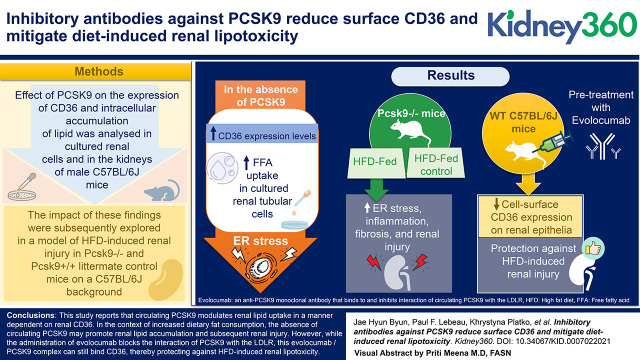
The effect of PCSK9 on the expression of CD36 and intracellular accumulation of lipid was examined in cultured renal cells and in the kidneys of male C57BL/6J mice. The effect of these findings was subsequently explored in a model of HFD-induced renal injury in and littermate control mice on a C57BL/6J background.
In the absence of PCSK9, we observed heightened CD36 expression levels, which increased free fatty acid (FFA) uptake in cultured renal tubular cells. As a result, PCSK9 deficiency was associated with an increase in long-chain saturated FFA-induced ER stress. Consistent with these observations, mice fed a HFD displayed elevated ER stress, inflammation, fibrosis, and renal injury relative to HFD-fed control mice. In contrast to mice, pretreatment of WT C57BL/6J mice with evolocumab, an anti-PCSK9 monoclonal antibody (mAb) that binds to and inhibits the function of circulating PCSK9, protected against HFD-induced renal injury in association with reducing cell surface CD36 expression on renal epithelia.
We report that circulating PCSK9 modulates renal lipid uptake in a manner dependent on renal CD36. In the context of increased dietary fat consumption, the absence of circulating PCSK9 may promote renal lipid accumulation and subsequent renal injury. However, although the administration of evolocumab blocks the interaction of PCSK9 with the LDLR, this evolocumab/PCSK9 complex can still bind CD36, thereby protecting against HFD-induced renal lipotoxicity.
PCSK9 通过一系列受体(包括低密度脂蛋白受体 [LDLR] 和 CD36)调节循环脂质的摄取。在肾脏中,CD36 通过促炎和促纤维化途径导致肾损伤。在这项研究中,我们试图通过高脂肪饮食(HFD)诱导的小鼠模型研究 PCSK9 通过 CD36 调节肾脏脂质积累和损伤的作用。
在培养的肾细胞和雄性 C57BL/6J 小鼠的肾脏中检查 PCSK9 对 CD36 表达和细胞内脂质积累的影响。随后在 C57BL/6J 背景下的 HFD 诱导的肾损伤模型中探索这些发现的作用。
在没有 PCSK9 的情况下,我们观察到 CD36 表达水平升高,这增加了培养的肾小管细胞中游离脂肪酸(FFA)的摄取。因此,PCSK9 缺乏与长链饱和 FFA 诱导的内质网应激增加有关。与这些观察结果一致,与 HFD 喂养的对照小鼠相比, 小鼠喂食 HFD 显示出升高的内质网应激、炎症、纤维化和肾损伤。与 小鼠相反,用 evolocumab(一种与循环 PCSK9 结合并抑制其功能的抗 PCSK9 单克隆抗体)预处理 WT C57BL/6J 小鼠可防止 HFD 诱导的肾损伤,同时减少肾上皮细胞表面的 CD36 表达。
我们报告循环 PCSK9 以依赖于肾脏 CD36 的方式调节肾脏脂质摄取。在饮食脂肪摄入增加的情况下,循环 PCSK9 的缺失可能会促进肾脏脂质积累和随后的肾损伤。然而,尽管 evolocumab 阻断了 PCSK9 与 LDLR 的相互作用,但这种 evolocumab/PCSK9 复合物仍能与 CD36 结合,从而防止 HFD 诱导的肾脂毒性。