Larrabee Sonderlund Anders, Charifson Mia, Ortiz Robin, Khan Maria, Schoenthaler Antoinette, Williams Natasha J
Center for Healthful Behavior Change, Institute for Excellence in Health Equity, NYU Grossman School of Medicine, USA.
Research Unit of General Practice, Department of Public Health, University of Southern Denmark, Denmark.
SSM Popul Health. 2022 Sep 8;19:101225. doi: 10.1016/j.ssmph.2022.101225. eCollection 2022 Sep.
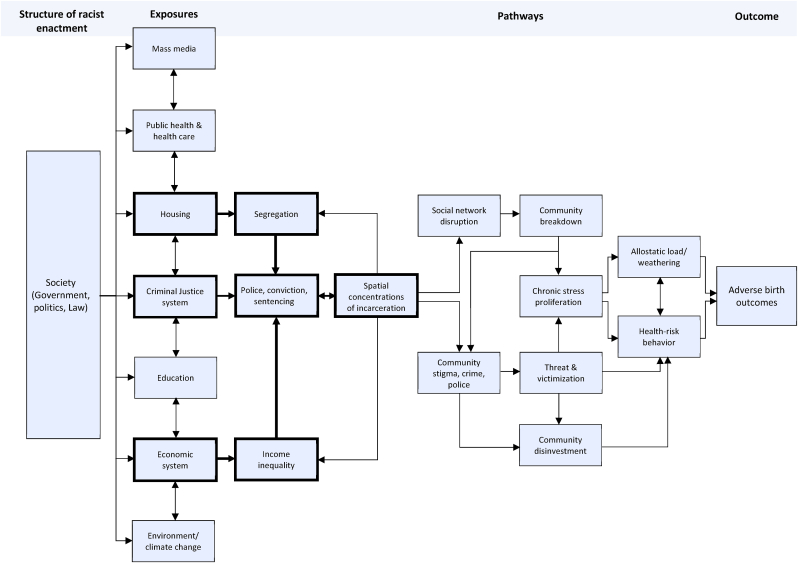
Structural racism represents a key determinant of the racial health disparities that has characterized the U.S. population throughout its existence. While this reality has recently begun to gain increasing acknowledgment and acceptance within the health sciences, there are still considerable challenges related to defining the concept of structural racism and operationalizing it in empirical study. In this paper, building on the existing evidence base, we propose a comprehensive framework that centers structural racism in terms of its historical roots and continued manifestation in most domains of society, and offer solutions for the study of this phenomenon and the pathways that connect it to population-level health disparities. We showcase our framework by applying it to the known link between spatial and racialized clustering of incarceration - a previously cited representation of structural racism - and disparities in adverse birth outcomes. Through this process we hypothesize pathways that focus on social cohesion and community-level chronic stress, community crime and police victimization, as well as infrastructural community disinvestment. First, we contextualize these mechanisms within the relevant extant literature. Then, we make recommendations for future empirical pathway analyses. Finally, we identify key areas for policy, community, and individual-level interventions that target the impact of concentrated incarceration on birth outcomes among Black people in the U.S.
结构性种族主义是美国人口自始至终存在的种族健康差异的关键决定因素。虽然这一现实最近在健康科学领域开始得到越来越多的认可和接受,但在定义结构性种族主义的概念并将其应用于实证研究方面,仍然存在相当大的挑战。在本文中,基于现有的证据基础,我们提出了一个全面的框架,该框架从其历史根源以及在社会大多数领域的持续表现方面将结构性种族主义置于中心位置,并为研究这一现象以及将其与人口层面的健康差异联系起来的途径提供解决方案。我们通过将其应用于监禁的空间和种族化聚集(结构性种族主义的一个先前引用的表现形式)与不良出生结局差异之间的已知联系来展示我们的框架。通过这个过程,我们假设了一些途径,这些途径关注社会凝聚力和社区层面的慢性压力、社区犯罪和警察侵害,以及社区基础设施投资不足。首先,我们将这些机制置于相关的现有文献背景中。然后,我们对未来的实证途径分析提出建议。最后,我们确定了政策、社区和个人层面干预的关键领域,这些干预旨在解决集中监禁对美国黑人出生结局的影响。