Division of Cancer and Genetics, School of Medicine, Cardiff University, Cardiff, United Kingdom.
Centre for Regenerative Medicine, Institute for Regeneration and Repair & Cancer Research UK Scotland Centre, University of Edinburgh, Edinburgh, United Kingdom.
Hum Gene Ther. 2022 Nov;33(21-22):1109-1120. doi: 10.1089/hum.2022.178. Epub 2022 Nov 4.
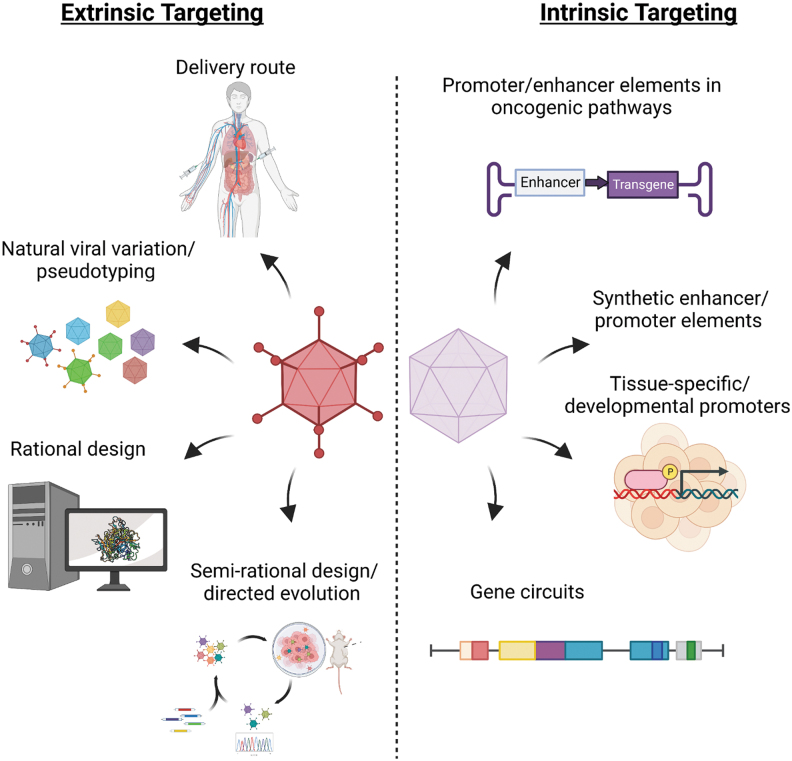
Advances in gene therapy, synthetic biology, cancer genomics, and patient-derived cancer models have expanded the repertoire of strategies for targeting human cancers using viral vectors. Novel capsids, synthetic promoters, and therapeutic payloads are being developed and assessed through approaches such as rational design, pooled library screening, and directed evolution. Ultimately, the goal is to generate precision-engineered viruses that target different facets of tumor cell biology, without compromising normal tissue and organ function. In this study, we briefly review the opportunities for engineering cancer selectivity into viral vectors at both the cell extrinsic and intrinsic level. Such stringently tumor-targeted vectors can subsequently act as platforms for the delivery of potent therapeutic transgenes, including the exciting prospect of immunotherapeutic payloads. These have the potential to eradicate nontransduced cells through stimulation of systemic anticancer immune responses, thereby side-stepping the inherent challenge of achieving gene delivery to the entire cancer cell population. We discuss the importance of using advanced primary human cellular models, such as patient-derived cultures and organoids, to enable rapid screening and triage of novel candidates using disease-relevant models. We believe this combination of improved delivery and selectivity, through novel capsids and promoters, coupled with more potent choices for the combinations of immunotherapy-based payloads seems capable of finally delivering innovative new gene therapies for oncology. Many pieces of the puzzle of how to build a virus capable of targeting human cancers appear to be falling into place.
基因治疗、合成生物学、癌症基因组学和患者来源的癌症模型的进展,扩大了使用病毒载体靶向人类癌症的策略组合。新型衣壳、合成启动子和治疗有效载荷正在通过合理设计、组合文库筛选和定向进化等方法进行开发和评估。最终目标是生成针对肿瘤细胞生物学不同方面的精密工程病毒,而不影响正常组织和器官功能。在这项研究中,我们简要回顾了在细胞外和细胞内水平上对病毒载体进行癌症选择性工程的机会。这些严格靶向肿瘤的载体随后可以作为高效治疗性转基因的传递平台,包括免疫治疗有效载荷的令人兴奋的前景。这些有效载荷有可能通过刺激全身抗癌免疫反应来消除未转导的细胞,从而避免实现对整个癌细胞群体进行基因传递的固有挑战。我们讨论了使用先进的原发性人类细胞模型(如患者来源的培养物和类器官)的重要性,以便使用与疾病相关的模型快速筛选和分类新型候选物。我们相信,通过新型衣壳和启动子来提高递送和选择性,再加上基于免疫治疗的有效载荷的更有效选择,似乎能够最终为肿瘤学提供创新的新型基因疗法。如何构建一种能够靶向人类癌症的病毒的拼图的许多部分似乎正在到位。