Tahita Marc Christian, Sondo Paul, Kabore Berenger, Ilboudo Hamidou, Rouamba Toussaint, Sanou Hyacinthe, Ouédraogo Kadija, Compaoré Adélaïde, Lompo Palpouguini, Ouedraogo Florence, Sawadogo Seydou, Derra Karim, Sawadogo Yabré Edmond, Somé Athanase M, Nana Macaire, Sorgho Hermann, Traore-Coulibaly Maminata, Bassat Quique, Tinto Halidou
, Clinical Research Unit of Nanoro (CRUN)/Institut de Recherche en Sciences de la Santé (IRSS-DRCO), Nanoro, Burkina Faso.
Sanitary Health District of Nanoro, Ministry of Health, Nanoro, Burkina Faso.
Pilot Feasibility Stud. 2022 Oct 1;8(1):221. doi: 10.1186/s40814-022-01181-2.
Malaria infection during pregnancy (MIP) is not only deleterious to the woman, but it also puts her fetus at increased risk of adverse outcomes, such as preterm delivery, low birth weight, and intrauterine growth retardation. Additionally, all-cause mortality during the first year of life in babies born to women with malaria during pregnancy is also increased. Many interventions such as IPTp-SP and long-lasting insecticidal nets have proven to be efficient at reducing malaria in pregnancy burden but adherence to recommended policies remains poor. In sub-Saharan Africa, malaria in pregnancy is often asymptomatic and many malaria infections may be missed due to the inadequate performance of the current rapid diagnostic test to detect low-level parasitemias. Therefore, additional strategies such as intermittent screening with ultrasensitive rapid diagnostic tests and treatment with an effective artemisinin-based combination therapy in addition to IPTp-SP could reduce placental malaria, peripheral malaria infection at delivery, and low birth weight.
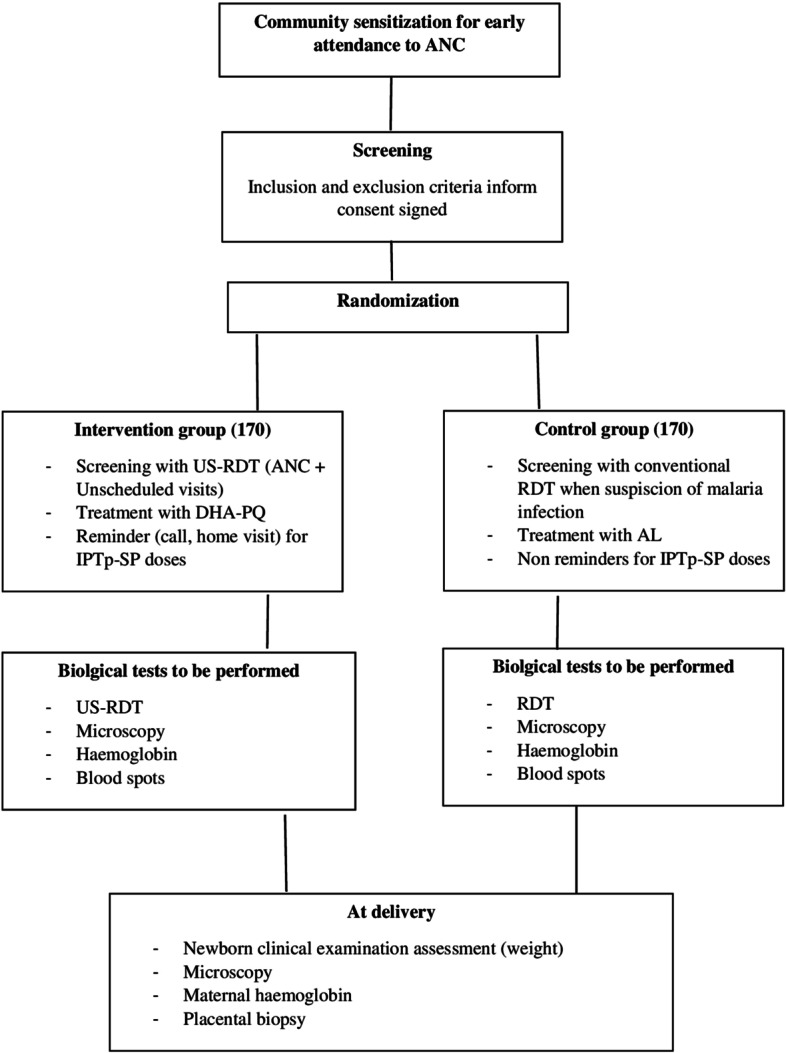
This pilot 2-group randomized open trial with a nested qualitative social behavioral will be carried out in Nanoro district in which 340 pregnant women will be recruited. Pregnant women will be randomized into two groups and followed on a monthly basis until delivery. In the intervention group, monthly screening using ultrasensitive rapid diagnostic tests and treatment of those found to be infected with dihydroartemisinin-piperaquine will be performed. In addition, a reminder will be sent to increase the uptake of IPTp-SP doses per woman. During scheduled and unscheduled visits, malaria infection, hemoglobin level, and other clinical outcomes will be assessed and compared by the group. The primary feasibility outcome will evaluate the study site's capacity to enroll participants and the women's perception and acceptability of the intervention. The primary clinical outcome will be the prevalence of placental malaria at delivery.
The present protocol aims to evaluate the feasibility on a large-scale and also to demonstrate the impact and the operational feasibility of additional screening with ultrasensitive rapid diagnostic tests and treatment with DHA-PQ on placental malaria, low birth weight, and peripheral malaria infection at delivery in a high-burden setting in Burkina Faso.
ClinicalTrials.gov , ID: NCT04147546 (14 October 2019).
孕期疟疾感染(MIP)不仅对孕妇有害,还会使其胎儿面临更高的不良结局风险,如早产、低出生体重和宫内生长受限。此外,孕期感染疟疾的女性所生婴儿在出生后第一年的全因死亡率也会增加。许多干预措施,如孕期间歇性预防治疗(IPTp-SP)和长效驱虫蚊帐,已被证明在减轻孕期疟疾负担方面有效,但对推荐政策的依从性仍然很差。在撒哈拉以南非洲,孕期疟疾通常没有症状,而且由于目前用于检测低水平疟原虫血症的快速诊断测试性能不足,许多疟疾感染可能会被漏诊。因此,除IPTp-SP外,采用超灵敏快速诊断测试进行间歇性筛查以及使用有效的青蒿素联合疗法进行治疗等额外策略,可能会减少胎盘疟疾、分娩时的外周疟疾感染和低出生体重。
这项具有嵌套定性社会行为研究的2组随机开放试验将在纳诺罗区开展,将招募340名孕妇。孕妇将被随机分为两组,并每月随访直至分娩。在干预组中,将使用超灵敏快速诊断测试进行每月筛查,并对检测出感染的孕妇使用双氢青蒿素哌喹进行治疗。此外,还将发送提醒信息,以提高每位女性接受IPTp-SP剂量的比例。在定期和不定期访视期间,将对两组的疟疾感染情况、血红蛋白水平和其他临床结局进行评估和比较。主要可行性结局将评估研究地点招募参与者的能力以及女性对干预措施的认知和接受程度。主要临床结局将是分娩时胎盘疟疾的患病率。
本方案旨在评估大规模实施的可行性,并证明在布基纳法索的高负担环境中,使用超灵敏快速诊断测试进行额外筛查以及使用双氢青蒿素哌喹进行治疗对胎盘疟疾、低出生体重和分娩时外周疟疾感染的影响及操作可行性。
ClinicalTrials.gov,标识符:NCT04147546(2019年10月14日)。