London School of Hygiene and Tropical Medicine, London, United Kingdom.
Imperial College London, London, United Kindom.
Am J Trop Med Hyg. 2018 Feb;98(2):534-542. doi: 10.4269/ajtmh.17-0620. Epub 2017 Nov 30.
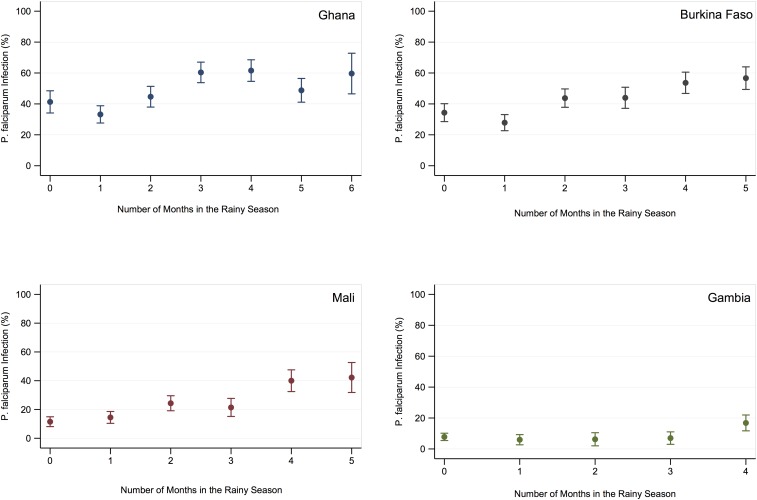
In malaria-endemic areas, prevalence is often high in young women because of 1) low use of insecticide-treated nets before their first pregnancy and 2) acquired immunity, meaning infections are asymptomatic and thus untreated. Consequently, a common source of malaria in pregnancy (MiP) may be infected women becoming pregnant, rather than pregnant women becoming infected. In this study, prevalence of infection was determined by microscopy at first antenatal care (ANC) visit in primigravidae and secundigravidae in Ghana, Burkina Faso, Mali, and The Gambia, four countries with strong seasonal variations in transmission. Duration of pregnancy spent in the rainy season and other risk factors for infection were evaluated using multivariable Poisson regression. We found that the overall prevalence of malaria at first ANC was generally high and increased with time spent pregnant during the rainy season: prevalence among those with the longest exposure was 59.7% in Ghana, 56.7% in Burkina Faso, 42.2% in Mali, and 16.8% in Gambia. However, the prevalence was substantial even among women whose entire pregnancy before first ANC had occurred in the dry season: 41.3%, 34.4%, 11.5%, and 7.8%, respectively, in the four countries. In multivariable analysis, risk of infection was also higher among primigravidae, younger women, and those of lower socioeconomic status, independent of seasonality. High prevalence among women without exposure to high transmission during their pregnancy suggests that part of the MiP burden results from long-duration infections, including those acquired preconception. Prevention of malaria before pregnancy is needed to reduce the MiP burden.
在疟疾流行地区,年轻女性的患病率通常较高,原因有以下两点:1)在首次怀孕前,她们很少使用经杀虫剂处理的蚊帐;2)获得性免疫,即感染无症状,因而未经治疗。因此,妊娠相关疟疾(MiP)的常见来源可能是感染的女性怀孕,而不是孕妇感染。在这项研究中,加纳、布基纳法索、马里和冈比亚四个国家疟疾传播具有明显季节性,研究人员在初产妇和经产妇首次产前护理就诊时通过显微镜检查来确定感染率。利用多变量泊松回归评估了妊娠期间雨季时长和其他感染风险因素。结果发现,首次产前护理时疟疾的总体感染率通常较高,且随着雨季妊娠时间的延长而增加:在加纳,雨季妊娠时间最长的孕妇感染率为 59.7%,在布基纳法索为 56.7%,在马里为 42.2%,在冈比亚为 16.8%。然而,即使在首次产前护理前整个孕期都在旱季的女性中,感染率也相当高:四个国家分别为 41.3%、34.4%、11.5%和 7.8%。在多变量分析中,初产妇、年轻女性和社会经济地位较低的女性感染风险也更高,这与季节性无关。在孕期未暴露于高传播环境的女性中,感染率也很高,这表明 MiP 负担的一部分是由包括孕前感染在内的长期感染引起的。需要在怀孕前预防疟疾,以降低 MiP 负担。