Ge Shuai-Shuai, Liu Song-Bai, Xue Sheng-Li
National Clinical Research Center for Hematologic Diseases, Jiangsu Institute of Hematology, The First Affiliated Hospital of Soochow University, Suzhou, China.
Institute of Blood and Marrow Transplantation, Collaborative Innovation Center of Hematology, Soochow University, Suzhou, China.
Front Oncol. 2022 Sep 14;12:996438. doi: 10.3389/fonc.2022.996438. eCollection 2022.
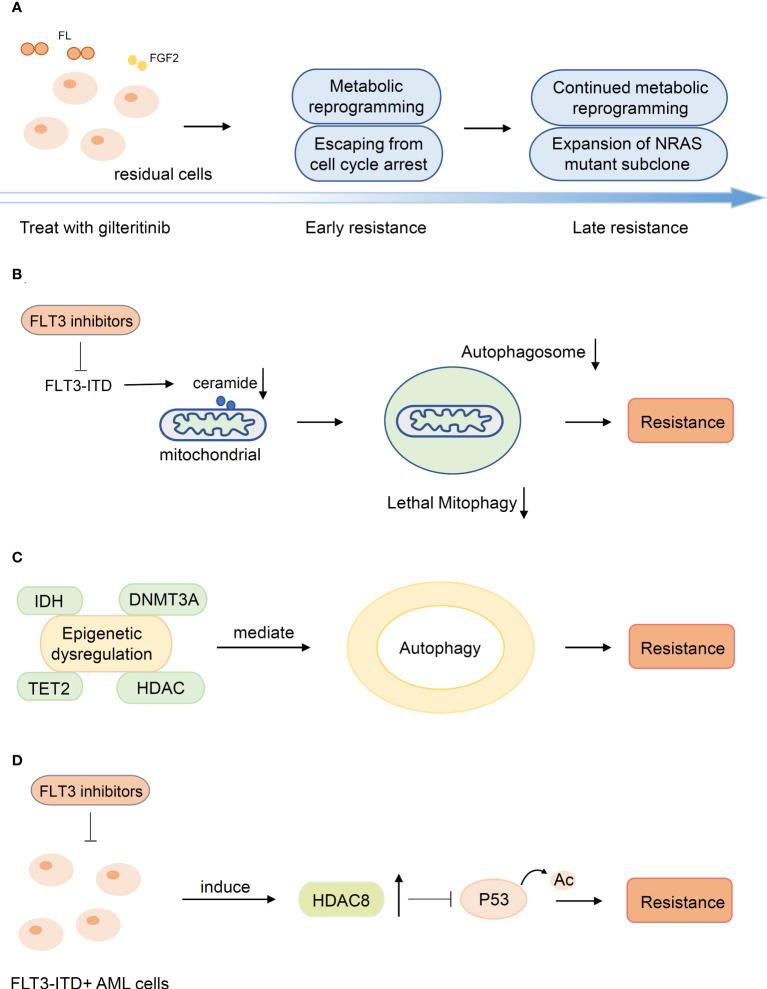
FLT3 mutations are one of the most common genetic alterations in acute myeloid leukemia (AML) and are identified in approximately one-third of newly diagnosed patients. Aberrant FLT3 receptor signaling has important implications for the biology and clinical management of AML. In recent years, targeting FLT3 has been a part of every course of treatment in FLT3-ITD/TKD-mutated AML and contributes to substantially prolonged survival. At the same time, wide application of next-generation sequencing (NGS) technology has revealed a series of non-canonical FLT3 mutations, including point mutations and small insertions/deletions. Some of these mutations may be able to influence downstream phosphorylation and sensitivity to FLT3 inhibitors, while the correlation with clinical outcomes remains unclear. Exploration of FLT3-targeted therapy has made substantial progress, but resistance to FLT3 inhibitors has become a pressing issue. The mechanisms underlying FLT3 inhibitor tolerance can be roughly divided into primary resistance and secondary resistance. Primary resistance is related to abnormalities in signaling factors, such as FL, CXCL12, and FGF2, and secondary resistance mainly involves on-target mutations and off-target aberrations. To overcome this problem, novel agents such as FF-10101 have shown promising potential. Multitarget strategies directed at FLT3 and anomalous signaling factors simultaneously are in active clinical development and show promising results.
FLT3突变是急性髓系白血病(AML)中最常见的基因改变之一,约三分之一的新诊断患者存在该突变。异常的FLT3受体信号传导对AML的生物学特性和临床管理具有重要意义。近年来,针对FLT3的治疗已成为FLT3-ITD/TKD突变型AML每一疗程治疗的一部分,并显著延长了生存期。与此同时,下一代测序(NGS)技术的广泛应用揭示了一系列非典型FLT3突变,包括点突变和小的插入/缺失。其中一些突变可能会影响下游磷酸化以及对FLT3抑制剂的敏感性,但其与临床结局的相关性仍不明确。FLT3靶向治疗已取得重大进展,但对FLT3抑制剂的耐药性已成为一个紧迫问题。FLT3抑制剂耐受的机制大致可分为原发性耐药和继发性耐药。原发性耐药与信号因子异常有关,如FL、CXCL12和FGF2,继发性耐药主要涉及靶向突变和非靶向畸变。为克服这一问题,新型药物如FF-10101已显示出有前景的潜力。同时针对FLT3和异常信号因子的多靶点策略正在积极进行临床开发,并显示出有前景的结果。