
内镜超声在评估胆总管结石漏诊患者中的作用。
Role of endoscopic ultrasound in evaluation of patients with missed common bile duct stones.
作者信息
Eissa Mohamed, Okasha Hussein Hassan, Abbasy Mohamed, Khamis Ahmed Kamal, Abdellatef Abeer, Rady Mohamed Akl
机构信息
Department of Hepatology and Gastroenterology, National Liver Institute, Menoufia University, Menoufia 32951, Egypt.
Department of Internal Medicine, Hepatogastroenterology Division, Kasr AL-Ainy School of Medicine, Cairo University, Cairo 11451, Egypt.
出版信息
World J Gastrointest Endosc. 2022 Sep 16;14(9):564-574. doi: 10.4253/wjge.v14.i9.564.
BACKGROUND
Choledocholithiasis develops in up to 20% of patients with gall bladder stones. The challenge in diagnosis usually occurs with small stones that may be missed by magnetic resonance cholangiopancreatography (MRCP). Endoscopic ultrasound (EUS) is accurate in detecting common bile duct (CBD) stones missed by MRCP, especially the small ones or those impacted at the distal CBD or the papillary region.
AIM
To evaluate the accuracy of EUS in detecting CBD stones missed by MRCP.
METHODS
Patients with an intermediate likelihood of choledocholithiasis according to ESGE guidelines and those with acute pancreatitis of undetermined cause were included. The presence of choledocholithiasis was evaluated by MRCP and EUS, and then results were confirmed by endoscopic retrograde cholangiopancreatography (ERCP). The sensitivity and specificity of EUS and MRCP were compared regarding the presence of stones, the size, and the number of detected stones.
RESULTS
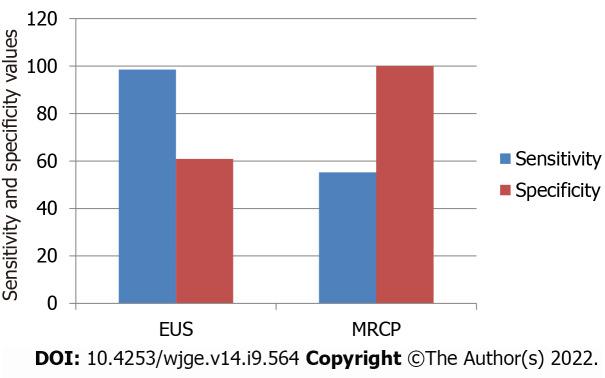
Ninety out of 100 involved patients had choledocholithiasis, while ten patients were excluded as they had pancreatic or gall bladder masses during EUS examination. In choledocholithiasis patients, the mean age was 52.37 ± 14.64 years, and 52.2% were males. Most patients had biliary obstruction (74.4%), while only 23 (25.6%) patients had unexplained pancreatitis. The overall prevalence of choledocholithiasis was 83.3% by EUS, 41.1% by MRCP, and 74.4% by ERCP. Also, the number and size of CBD stones could be detected accurately in 78.2% and 75.6% by EUS and 41.1% and 70.3% by MRCP, respectively. The sensitivity of EUS was higher than that of MRCP (98.51% 55.22%), and their predictive value was statistically different ( 0.001). Combination of both tools raised the sensitivity to 97.22% and specificity to 100%.
CONCLUSION
EUS could be a useful tool in assessing patients with suspected choledocholithiasis especially if combined with MRCP. However, its usefulness depends on its availability and the experience of the local centers.
背景
高达20%的胆囊结石患者会并发胆总管结石。诊断的挑战通常在于小结石,磁共振胰胆管造影(MRCP)可能会漏诊这些小结石。内镜超声(EUS)在检测MRCP漏诊的胆总管(CBD)结石方面很准确,尤其是小结石或嵌顿于胆总管远端或乳头区域的结石。
目的
评估EUS检测MRCP漏诊的CBD结石的准确性。
方法
纳入根据欧洲胃肠内镜学会(ESGE)指南具有胆总管结石中度可能性的患者以及病因不明的急性胰腺炎患者。通过MRCP和EUS评估胆总管结石的存在情况,然后通过内镜逆行胰胆管造影(ERCP)确认结果。比较EUS和MRCP在结石存在情况、大小及检测到的结石数量方面的敏感性和特异性。
结果
100例参与研究的患者中有90例患有胆总管结石,10例患者因在EUS检查期间发现胰腺或胆囊肿块而被排除。在胆总管结石患者中,平均年龄为52.37±14.64岁,男性占52.2%。大多数患者有胆道梗阻(74.4%),而只有23例(25.6%)患者有不明原因的胰腺炎。EUS检测胆总管结石的总体患病率为83.3%,MRCP为41.1%,ERCP为74.4%。此外,EUS分别能准确检测出78.2%的CBD结石数量和75.6%的结石大小,MRCP分别为41.1%和70.3%。EUS的敏感性高于MRCP(98.51%对55.22%),其预测价值在统计学上有差异(P<0.001)。两种检查手段联合使用可将敏感性提高到97.22%,特异性提高到100%。
结论
EUS可能是评估疑似胆总管结石患者的有用工具,特别是与MRCP联合使用时。然而,其效用取决于其可用性和当地中心的经验。




 Zotero 插件