• 文献检索
  • 文档翻译
  • 深度研究
  • 学术资讯
  • Suppr Zotero 插件Zotero 插件
  • 邀请有礼
  • 套餐&价格
  • 历史记录
应用&插件
Suppr Zotero 插件Zotero 插件浏览器插件Mac 客户端Windows 客户端微信小程序
定价
高级版会员购买积分包购买API积分包
服务
文献检索文档翻译深度研究API 文档MCP 服务
关于我们
关于 Suppr公司介绍联系我们用户协议隐私条款
关注我们

Suppr 超能文献

核心技术专利:CN118964589B侵权必究
粤ICP备2023148730 号-1Suppr @ 2026

文献检索

告别复杂PubMed语法,用中文像聊天一样搜索,搜遍4000万医学文献。AI智能推荐,让科研检索更轻松。

立即免费搜索

文件翻译

保留排版,准确专业,支持PDF/Word/PPT等文件格式,支持 12+语言互译。

免费翻译文档

深度研究

AI帮你快速写综述,25分钟生成高质量综述,智能提取关键信息,辅助科研写作。

立即免费体验

基于截至 2022 年 3 月 1 日中国所有本地疫情的发病数据,比较不同 COVID-19 株的流行病学特征和传播性。

Comparison of epidemiological characteristics and transmissibility of different strains of COVID-19 based on the incidence data of all local outbreaks in China as of March 1, 2022.

机构信息

Public Health Emergency Center, Chinese Center for Disease Control and Prevention, Beijing, China.

State Key Laboratory of Molecular Vaccinology and Molecular Diagnostics, School of Public Health, Xiamen University, Fujian, China.

出版信息

Front Public Health. 2022 Sep 15;10:949594. doi: 10.3389/fpubh.2022.949594. eCollection 2022.

DOI:10.3389/fpubh.2022.949594
PMID:36187650
原文链接:https://pmc.ncbi.nlm.nih.gov/articles/PMC9521362/
Abstract

BACKGROUND

The epidemiological characteristics and transmissibility of Coronavirus Disease 2019 (COVID-19) may undergo changes due to the mutation of Severe Acute Respiratory Syndrome Coronavirus 2 (SARS-CoV-2) strains. The purpose of this study is to compare the differences in the outbreaks of the different strains with regards to aspects such as epidemiological characteristics, transmissibility, and difficulties in prevention and control.

METHODS

COVID-19 data from outbreaks of pre-Delta strains, the Delta variant and Omicron variant, were obtained from the Chinese Center for Disease Control and Prevention (CDC). Case data were collected from China's direct-reporting system, and the data concerning outbreaks were collected by on-site epidemiological investigators and collated by the authors of this paper. Indicators such as the effective reproduction number ( ), time-dependent reproduction number ( ), rate of decrease in transmissibility (), and duration from the illness onset date to the diagnosed date ( )/reported date ( ) were used to compare differences in transmissibility between pre-Delta strains, Delta variants and Omicron variants. Non-parametric tests (namely the Kruskal-Wallis H and Mean-Whitney U tests) were used to compare differences in epidemiological characteristics and transmissibility between outbreaks of different strains. < 0.05 indicated that the difference was statistically significant.

RESULTS

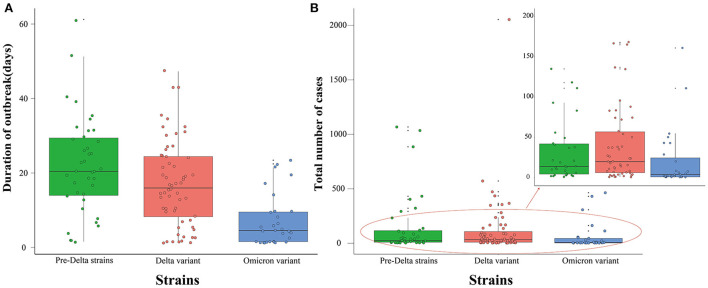
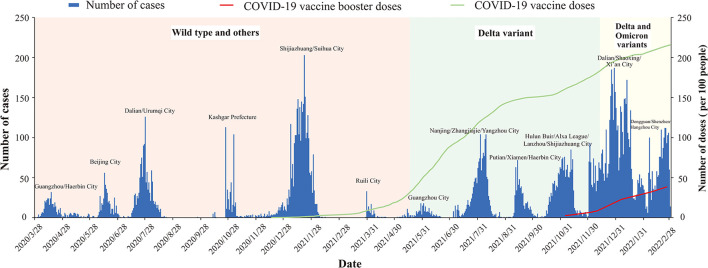
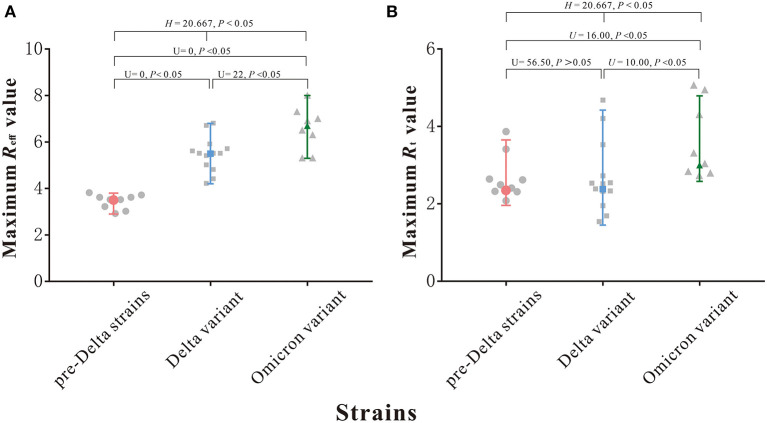
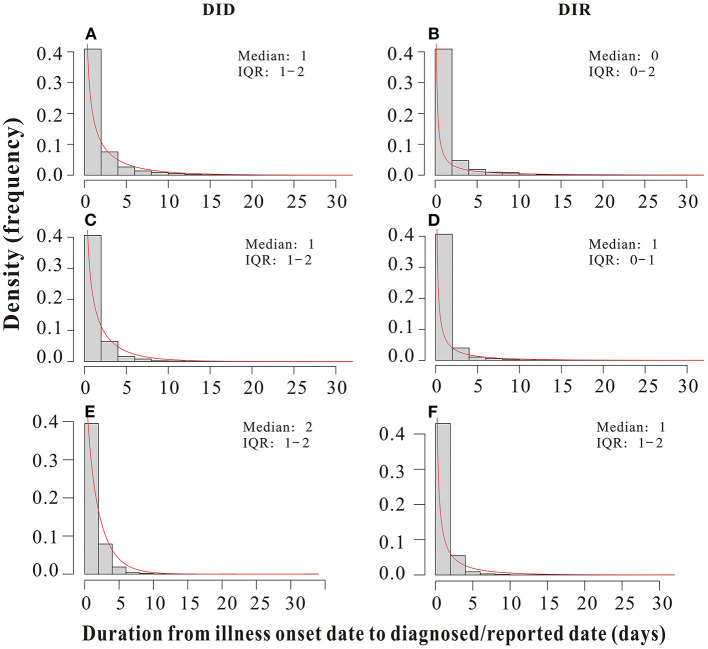
Mainland China has maintained a "dynamic zero-out strategy" since the first case was reported, and clusters of outbreaks have occurred intermittently. The strains causing outbreaks in mainland China have gone through three stages: the outbreak of pre-Delta strains, the outbreak of the Delta variant, and outbreaks involving the superposition of Delta and Omicron variant strains. Each outbreak of pre-Delta strains went through two stages: a rising stage and a falling stage, Each outbreak of the Delta variant and Omicron variant went through three stages: a rising stage, a platform stage and a falling stage. The maximum value of Omicron variant outbreaks was highest (median: 6.7; ranged from 5.3 to 8.0) and the differences were statistically significant. The value of outbreaks involving pre-Delta strains was smallest (median: 91.4%; [IQR]: 87.30-94.27%), and the differences were statistically significant. The and for all strains was mostly in a range of 0-2 days, with more than 75%. The range of duration for outbreaks of pre-Delta strains was the largest (median: 20 days, ranging from 1 to 61 days), and the differences were statistically significant.

CONCLUSION

With the evolution of the virus, the transmissibility of the variants has increased. The transmissibility of the Omicron variant is higher than that of both the pre-Delta strains and the Delta variant, and is more difficult to suppress. These findings provide us with get a more clear and precise picture of the transmissibility of the different variants in the real world, in accordance with the findings of previous studies. is more suitable than for assessing the transmissibility of the disease during an epidemic outbreak.

摘要

背景

严重急性呼吸系统综合症冠状病毒 2 型(SARS-CoV-2)株的突变可能导致 2019 年冠状病毒病(COVID-19)的流行病学特征和传染性发生变化。本研究旨在比较不同株系爆发的差异,包括流行病学特征、传染性和防控难度等方面。

方法

从中国疾病预防控制中心(CDC)获得了前三角洲株、三角洲变异株和奥密克戎变异株爆发的 COVID-19 数据。病例数据来自中国的直接报告系统,爆发数据由现场流行病学调查员收集,并由本文作者整理。使用有效繁殖数()、时变繁殖数()、传染性下降率()和从发病日期到确诊日期()/报告日期()的时间()等指标比较前三角洲株、三角洲变异株和奥密克戎变异株之间的传染性差异。采用非参数检验(即 Kruskal-Wallis H 和 Mean-Whitney U 检验)比较不同株系爆发的流行病学特征和传染性差异。<0.05 表示差异具有统计学意义。

结果

中国大陆自首例报告以来一直采取“动态清零策略”,间歇性发生聚集性疫情。中国大陆引起疫情的毒株经历了三个阶段:前三角洲株爆发、三角洲变异株爆发和三角洲与奥密克戎变异株叠加爆发。每次前三角洲株爆发都经历了两个阶段:上升阶段和下降阶段,每次三角洲变异株和奥密克戎变异株爆发都经历了三个阶段:上升阶段、平台阶段和下降阶段。奥密克戎变异株爆发的最大 值最高(中位数:6.7;范围为 5.3 至 8.0),差异具有统计学意义。前三角洲株爆发的 值最小(中位数:91.4%;[IQR]:87.30-94.27%),差异具有统计学意义。所有菌株的 值主要在 0-2 天范围内,超过 75%。前三角洲株爆发的持续时间范围最大(中位数:20 天,范围为 1 至 61 天),差异具有统计学意义。

结论

随着病毒的进化,变异株的传染性增强。奥密克戎变异株的传染性高于前三角洲株和三角洲变异株,更难抑制。这些发现与之前的研究结果一致,更清晰、更准确地了解了不同变异株在现实世界中的传播能力。在疫情爆发期间, 使用 来评估疾病的传染性比使用 更合适。
https://cdn.ncbi.nlm.nih.gov/pmc/blobs/6c93/9521362/174068f685e9/fpubh-10-949594-g0005.jpg
https://cdn.ncbi.nlm.nih.gov/pmc/blobs/6c93/9521362/f14d4209a6db/fpubh-10-949594-g0001.jpg
https://cdn.ncbi.nlm.nih.gov/pmc/blobs/6c93/9521362/adf7dc3bea9a/fpubh-10-949594-g0002.jpg
https://cdn.ncbi.nlm.nih.gov/pmc/blobs/6c93/9521362/0576567bfdc5/fpubh-10-949594-g0003.jpg
https://cdn.ncbi.nlm.nih.gov/pmc/blobs/6c93/9521362/9079b8404506/fpubh-10-949594-g0004.jpg
https://cdn.ncbi.nlm.nih.gov/pmc/blobs/6c93/9521362/174068f685e9/fpubh-10-949594-g0005.jpg
https://cdn.ncbi.nlm.nih.gov/pmc/blobs/6c93/9521362/f14d4209a6db/fpubh-10-949594-g0001.jpg
https://cdn.ncbi.nlm.nih.gov/pmc/blobs/6c93/9521362/adf7dc3bea9a/fpubh-10-949594-g0002.jpg
https://cdn.ncbi.nlm.nih.gov/pmc/blobs/6c93/9521362/0576567bfdc5/fpubh-10-949594-g0003.jpg
https://cdn.ncbi.nlm.nih.gov/pmc/blobs/6c93/9521362/9079b8404506/fpubh-10-949594-g0004.jpg
https://cdn.ncbi.nlm.nih.gov/pmc/blobs/6c93/9521362/174068f685e9/fpubh-10-949594-g0005.jpg

相似文献

1
Comparison of epidemiological characteristics and transmissibility of different strains of COVID-19 based on the incidence data of all local outbreaks in China as of March 1, 2022.基于截至 2022 年 3 月 1 日中国所有本地疫情的发病数据,比较不同 COVID-19 株的流行病学特征和传播性。
Front Public Health. 2022 Sep 15;10:949594. doi: 10.3389/fpubh.2022.949594. eCollection 2022.
2
A comparative study on epidemiological characteristics, transmissibility, and pathogenicity of three COVID-19 outbreaks caused by different variants.三种不同变异株引起的 COVID-19 疫情流行病学特征、传染性和致病性的比较研究。
Int J Infect Dis. 2023 Sep;134:78-87. doi: 10.1016/j.ijid.2023.01.039. Epub 2023 Feb 1.
3
Epidemiological characteristics and transmission dynamics of the outbreak caused by the SARS-CoV-2 Omicron variant in Shanghai, China: a descriptive study.中国上海新型冠状病毒奥密克戎变异株引发疫情的流行病学特征及传播动力学:一项描述性研究
medRxiv. 2022 Jun 18:2022.06.11.22276273. doi: 10.1101/2022.06.11.22276273.
4
The rapid and efficient strategy for SARS-CoV-2 Omicron transmission control: analysis of outbreaks at the city level.SARS-CoV-2 奥密克戎传播控制的快速高效策略:城市级疫情分析。
Infect Dis Poverty. 2022 Nov 24;11(1):114. doi: 10.1186/s40249-022-01043-2.
5
Epidemiological Characteristics and Transmissibility for SARS-CoV-2 of Population Level and Cluster Level in a Chinese City.中国城市人群水平和集群水平的 SARS-CoV-2 的流行病学特征和传播性。
Front Public Health. 2022 Jan 18;9:799536. doi: 10.3389/fpubh.2021.799536. eCollection 2021.
6
Comparative epidemiology of outbreaks caused by SARS-CoV-2 Delta and Omicron variants in China.中国由 SARS-CoV-2 德尔塔和奥密克戎变异株引起的暴发的比较流行病学研究。
Epidemiol Infect. 2024 Mar 19;152:e43. doi: 10.1017/S0950268824000360.
7
Is the SARS CoV-2 Omicron Variant Deadlier and More Transmissible Than Delta Variant?奥密克戎变异株比德尔塔变异株更致命且更具传染性吗?
Int J Environ Res Public Health. 2022 Apr 11;19(8):4586. doi: 10.3390/ijerph19084586.
8
Coronavirus disease 2019 transmission and symptoms in young children during the severe acute respiratory syndrome coronavirus 2 Delta variant and Omicron variant outbreaks.2019 年冠状病毒病在严重急性呼吸综合征冠状病毒 2 德尔塔变异株和奥密克戎变异株流行期间在幼儿中的传播和症状。
J Int Med Res. 2022 May;50(5):3000605221102079. doi: 10.1177/03000605221102079.
9
Overlapping Delta and Omicron Outbreaks During the COVID-19 Pandemic: Dynamic Panel Data Estimates.新冠大流行期间 Delta 和奥密克戎变异株的叠加流行:动态面板数据估计。
JMIR Public Health Surveill. 2022 Jun 3;8(6):e37377. doi: 10.2196/37377.
10
Mathematical modeling of SARS-CoV-2 variant substitutions in European countries: transmission dynamics and epidemiological insights.SARS-CoV-2 变异株在欧洲国家中的替代数学建模:传播动力学和流行病学见解。
Front Public Health. 2024 May 15;12:1339267. doi: 10.3389/fpubh.2024.1339267. eCollection 2024.

引用本文的文献

1
Opportunities and challenges encountered in managing cervical cancer during the coronavirus disease 2019 pandemic.2019冠状病毒病大流行期间宫颈癌管理中遇到的机遇与挑战。
Infect Agent Cancer. 2024 Aug 29;19(1):41. doi: 10.1186/s13027-024-00594-3.
2
Hybrid Immunity and the Incidence of SARS-CoV-2 Reinfections during the Omicron Era in Frontline Healthcare Workers.一线医护人员在奥密克戎时代的混合免疫与新冠病毒再次感染发生率
Vaccines (Basel). 2024 Jun 19;12(6):682. doi: 10.3390/vaccines12060682.
3
The evolution of SARS-CoV-2 seroprevalence in Canada: a time-series study, 2020-2023.

本文引用的文献

1
COVID-19 pandemic dynamics in South Africa and epidemiological characteristics of three variants of concern (Beta, Delta, and Omicron).南非的 COVID-19 疫情动态及三种关注变异株(Beta、Delta 和 Omicron)的流行病学特征。
Elife. 2022 Aug 9;11:e78933. doi: 10.7554/eLife.78933.
2
Shorter serial intervals in SARS-CoV-2 cases with Omicron BA.1 variant compared with Delta variant, the Netherlands, 13 to 26 December 2021.与德尔塔变异株相比,奥密克戎 BA.1 变异株引起的 SARS-CoV-2 病例的连续间隔时间更短,荷兰,2021 年 12 月 13 日至 26 日。
Euro Surveill. 2022 Feb;27(6). doi: 10.2807/1560-7917.ES.2022.27.6.2200042.
3
Serial Intervals and Household Transmission of SARS-CoV-2 Omicron Variant, South Korea, 2021.
SARS-CoV-2 血清流行率在加拿大的演变:2020-2023 年的时间序列研究。
CMAJ. 2023 Aug 14;195(31):E1030-E1037. doi: 10.1503/cmaj.230249.
2021 年韩国,奥密克戎变异株的连续间隔时间和家庭传播。
Emerg Infect Dis. 2022 Mar;28(3):756-759. doi: 10.3201/eid2803.212607. Epub 2022 Feb 2.
4
Relative Reproduction Number of SARS-CoV-2 Omicron (B.1.1.529) Compared with Delta Variant in South Africa.南非新冠病毒奥密克戎变异株(B.1.1.529)与德尔塔变异株相比的相对繁殖数
J Clin Med. 2021 Dec 23;11(1):30. doi: 10.3390/jcm11010030.
5
Transmission and containment of the SARS-CoV-2 Delta variant of concern in Guangzhou, China: A population-based study.在中国广州,关注的 SARS-CoV-2 德尔塔变异株的传播和控制:一项基于人群的研究。
PLoS Negl Trop Dis. 2022 Jan 5;16(1):e0010048. doi: 10.1371/journal.pntd.0010048. eCollection 2022 Jan.
6
Importation and Transmission of SARS-CoV-2 B.1.1.529 (Omicron) Variant of Concern in Korea, November 2021.2021 年 11 月韩国输入和传播的 SARS-CoV-2 B.1.1.529(奥密克戎)关切变异株
J Korean Med Sci. 2021 Dec 27;36(50):e346. doi: 10.3346/jkms.2021.36.e346.
7
Omicron variant and booster COVID-19 vaccines.奥密克戎变种与新冠病毒加强疫苗
Lancet Respir Med. 2022 Feb;10(2):e17. doi: 10.1016/S2213-2600(21)00559-2. Epub 2021 Dec 17.
8
The omicron variant of SARS-CoV-2: Understanding the known and living with unknowns.奥密克戎变异株:了解已知与未知并存。
Clin Transl Med. 2021 Dec;11(12):e685. doi: 10.1002/ctm2.685.
9
Serial Interval and Transmission Dynamics during SARS-CoV-2 Delta Variant Predominance, South Korea.在韩国,SARS-CoV-2 德尔塔变异株占主导地位期间的连续间隔和传播动力学。
Emerg Infect Dis. 2022 Feb;28(2):407-410. doi: 10.3201/eid2802.211774. Epub 2021 Dec 14.
10
Omicron SARS-CoV-2 variant: a new chapter in the COVID-19 pandemic.奥密克戎新冠病毒变体:新冠疫情的新篇章。
Lancet. 2021 Dec 11;398(10317):2126-2128. doi: 10.1016/S0140-6736(21)02758-6. Epub 2021 Dec 3.