Department of Education and Support for Regional Medicine, Tohoku University Hospital, Sendai, Japan.
J Int Med Res. 2022 May;50(5):3000605221102079. doi: 10.1177/03000605221102079.
Little is known about the transmission of coronavirus disease 2019 (COVID-19) in young children. This study aimed to clarify the risk of COVID-19 transmission among this population.
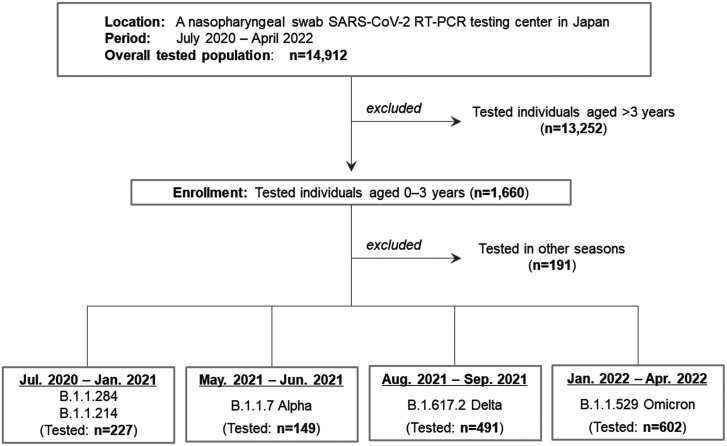
Between July 2020 and April 2022, 1660 0 to 3-year-old children underwent a nasopharyngeal swab for later reverse transcription-polymerase chain reaction testing at a mass screening test center in Japan. Their disease transmission rate and clinical symptoms were evaluated according to the predominant variant strains of that season.
The secondary transmission rate after close contact of the Delta B.1.617.2 (17.4%) and Omicron B.1.1.529 (39.2%) variants was significantly higher than that of the conventional strains (B.1.1.284 and B.1.1.214; 4.5%) during the pandemic. The increased transmissibility with the Delta and Omicron variants was independent of close contact or location. The prevalence rates of cough, fatigability, and fever were similar in young children infected by the Delta and Omicron variants.
COVID-19 transmission in children aged 0 to 3 years increased by 3 to 4 fold during the Delta outbreak and by 8 to 10 fold during the Omicron outbreak compared with the conventional strain outbreak. The symptoms in young children were not different between the Delta and Omicron variants.
关于新冠病毒疾病 2019(COVID-19)在幼儿中的传播情况知之甚少。本研究旨在阐明该人群中 COVID-19 传播的风险。
在 2020 年 7 月至 2022 年 4 月期间,在日本的一个大规模筛查检测中心,对 1660 名 0 至 3 岁的儿童进行了鼻咽拭子检测,以便以后进行逆转录-聚合酶链反应检测。根据该季节的主要变异株评估了他们的疾病传播率和临床症状。
Delta B.1.617.2(17.4%)和奥密克戎 B.1.1.529(39.2%)变异株密切接触后的二次传播率明显高于大流行期间的常规株(B.1.1.284 和 B.1.1.214;4.5%)。Delta 和奥密克戎变异株的传染性增加与密切接触或地点无关。Delta 和奥密克戎变异株感染的幼儿咳嗽、乏力和发热的患病率相似。
与常规株流行相比,Delta 爆发期间 0 至 3 岁儿童的 COVID-19 传播增加了 3 至 4 倍,Omicron 爆发期间增加了 8 至 10 倍。Delta 和奥密克戎变异株在幼儿中的症状并无差异。