Wang Sheng, Wan Lijun, Ren Hongyu, Xie Zhixun, Xie Liji, Huang Jiaoling, Deng Xianwen, Xie Zhiqin, Luo Sisi, Li Meng, Zeng Tingting, Zhang Yanfang, Zhang Minxiu
Guangxi Key Laboratory of Veterinary Biotechnology, Guangxi Veterinary Research Institute, Nanning, China.
Front Microbiol. 2022 Sep 15;13:998505. doi: 10.3389/fmicb.2022.998505. eCollection 2022.
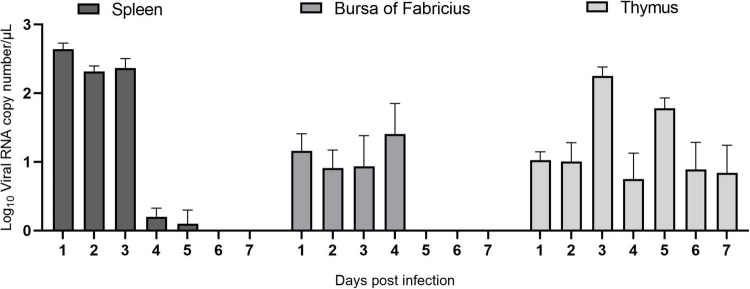
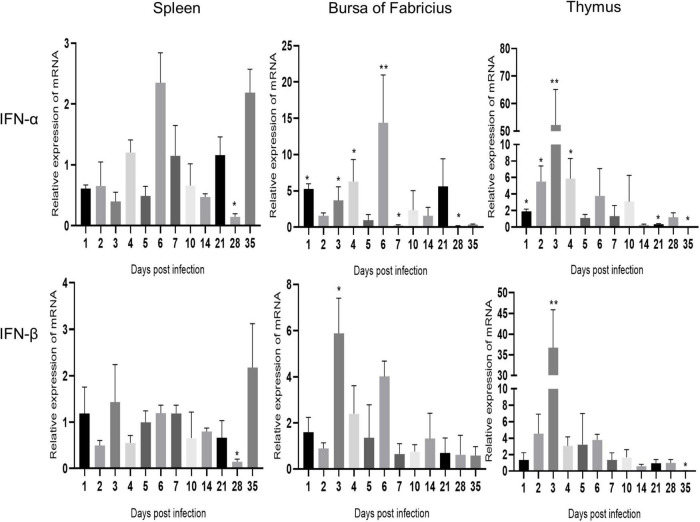
Avian reovirus (ARV) infection can lead to severe immunosuppression, complications, and secondary diseases, causing immense economic losses to the poultry industry. In-depth study of the mechanism by which the innate immune system combats ARV infection, especially the antiviral effect mediated by interferon, is needed to prevent and contain ARV infection. In this study, ARV strain S1133 was used to artificially infect 7-day-old specific pathogen-free chickens. The results indicated that ARV rapidly proliferated in the immune organs, including the spleen, bursa of Fabricius, and thymus. The viral load peaked early in the infection and led to varying degrees of pathological damage to tissues and organs. Real-time quantitative PCR revealed that the mRNA levels of interferon and multiple interferon-stimulated genes (ISGs) in the spleen, bursa of Fabricius, and thymus were upregulated to varying degrees in the early stage of infection. Among the ISGs, IFIT5, and Mx were the most upregulated in various tissues and organs, suggesting that they are important ISGs for host resistance to ARV infection. Further investigation of the role of IFIT5 in ARV infection showed that overexpression of the IFIT5 gene inhibited ARV replication, whereas inhibition of the endogenously expressed IFIT5 gene by siRNA promoted ARV replication. IFIT5 may be a positive feedback regulator of the innate immune signaling pathways during ARV infection and may induce IFN-α production by promoting the expression of MAD5 and MAVS to exert its antiviral effect. The results of this study help explain the innate immune regulatory mechanism of ARV infection and reveal the important role of IFIT5 in inhibiting ARV replication, which has important theoretical significance and practical application value for the prevention and control of ARV infection.
禽呼肠孤病毒(ARV)感染可导致严重的免疫抑制、并发症和继发性疾病,给家禽业造成巨大经济损失。需要深入研究天然免疫系统对抗ARV感染的机制,尤其是干扰素介导的抗病毒作用,以预防和控制ARV感染。在本研究中,使用ARV毒株S1133人工感染7日龄特定病原体-free鸡。结果表明,ARV在包括脾脏、法氏囊和胸腺在内的免疫器官中迅速增殖。病毒载量在感染早期达到峰值,并导致组织和器官不同程度的病理损伤。实时定量PCR显示,感染早期脾脏、法氏囊和胸腺中干扰素和多个干扰素刺激基因(ISGs)的mRNA水平不同程度上调。在ISGs中,IFIT5和Mx在各种组织和器官中上调最为明显,表明它们是宿主抵抗ARV感染的重要ISGs。进一步研究IFIT5在ARV感染中的作用表明,IFIT5基因的过表达抑制了ARV复制,而通过siRNA抑制内源性表达的IFIT5基因则促进了ARV复制。IFIT5可能是ARV感染期间天然免疫信号通路的正反馈调节因子,可能通过促进MAD5和MAVS的表达诱导IFN-α产生,从而发挥其抗病毒作用。本研究结果有助于解释ARV感染的天然免疫调节机制,揭示IFIT5在抑制ARV复制中的重要作用,对ARV感染的防控具有重要的理论意义和实际应用价值。