Public Health Research Institute, New Jersey Medical School, Rutgers University, Newark, New Jersey.
Center for Vascular Biology Research, Beth Israel Deaconess Medical Center, Harvard Medical School, Boston, Massachusetts.
Am J Physiol Cell Physiol. 2022 Nov 1;323(5):C1444-C1474. doi: 10.1152/ajpcell.00246.2022. Epub 2022 Oct 3.
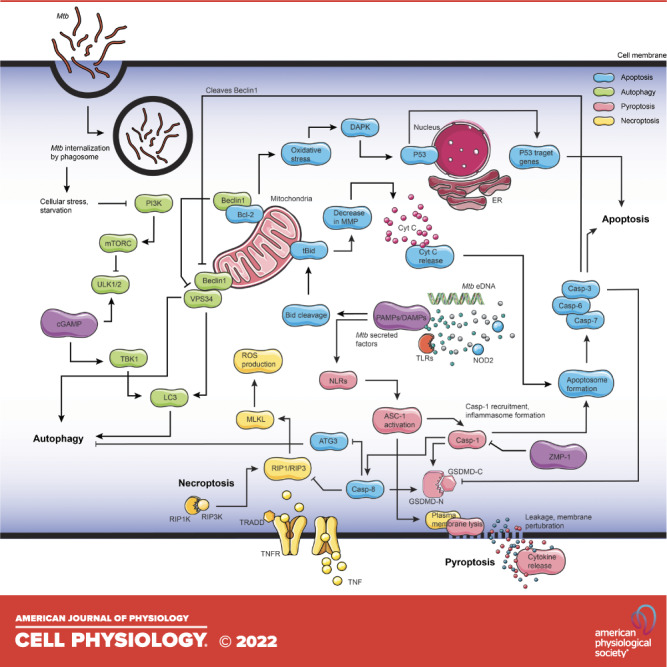
() is the pathogen that causes tuberculosis (TB), a leading infectious disease of humans worldwide. One of the main histopathological hallmarks of TB is the formation of granulomas comprised of elaborately organized aggregates of immune cells containing the pathogen. Dissemination of from infected cells in the granulomas due to host and mycobacterial factors induces multiple cell death modalities in infected cells. Based on molecular mechanism, morphological characteristics, and signal dependency, there are two main categories of cell death: programmed and nonprogrammed. Programmed cell death (PCD), such as apoptosis and autophagy, is associated with a protective response to by keeping the bacteria encased within dead macrophages that can be readily phagocytosed by arriving in uninfected or neighboring cells. In contrast, non-PCD necrotic cell death favors the pathogen, resulting in bacterial release into the extracellular environment. Multiple types of cell death in the PCD category, including pyroptosis, necroptosis, ferroptosis, ETosis, parthanatos, and PANoptosis, may be involved in infection. Since PCD pathways are essential for host immunity to , therapeutic compounds targeting cell death signaling pathways have been experimentally tested for TB treatment. This review summarizes different modalities of -mediated host cell deaths, the molecular mechanisms underpinning host cell death during infection, and its potential implications for host immunity. In addition, targeting host cell death pathways as potential therapeutic and preventive approaches against infection is also discussed.
结核分枝杆菌()是引起结核病(TB)的病原体,是全球人类主要的传染病病原体之一。TB 的主要组织病理学特征之一是形成肉芽肿,由精心组织的免疫细胞聚集物组成,其中包含病原体。由于宿主和分枝杆菌因素,从肉芽肿中的受感染细胞中传播 ,会在受感染细胞中诱导多种细胞死亡方式。基于分子机制、形态特征和信号依赖性,有两种主要的细胞死亡类别:程序性和非程序性。程序性细胞死亡(PCD),如细胞凋亡和自噬,与通过将细菌包裹在死亡的巨噬细胞中从而对 做出保护反应有关,这些巨噬细胞可以被未感染或邻近细胞中的吞噬细胞轻易吞噬。相比之下,非 PCD 坏死性细胞死亡有利于病原体,导致细菌释放到细胞外环境中。PCD 类别中的多种细胞死亡类型,包括细胞焦亡、坏死性凋亡、铁死亡、ETosis、parthanatos 和 PANoptosis,可能与 感染有关。由于 PCD 途径对于宿主免疫至关重要,因此针对细胞死亡信号通路的治疗化合物已在实验中进行了结核病治疗的测试。本综述总结了宿主细胞死亡的不同方式,以及在 感染期间宿主细胞死亡的分子机制,及其对宿主免疫的潜在影响。此外,还讨论了作为针对 感染的潜在治疗和预防方法的靶向宿主细胞死亡途径。