Cell Biology and Biophysics, European Molecular Biology Laboratory; Collaboration for joint PhD degree between EMBL and Heidelberg University, Faculty of Biosciences.
EMBL Imaging Centre, European Molecular Biology Laboratory.
J Vis Exp. 2022 Sep 13(187). doi: 10.3791/64363.
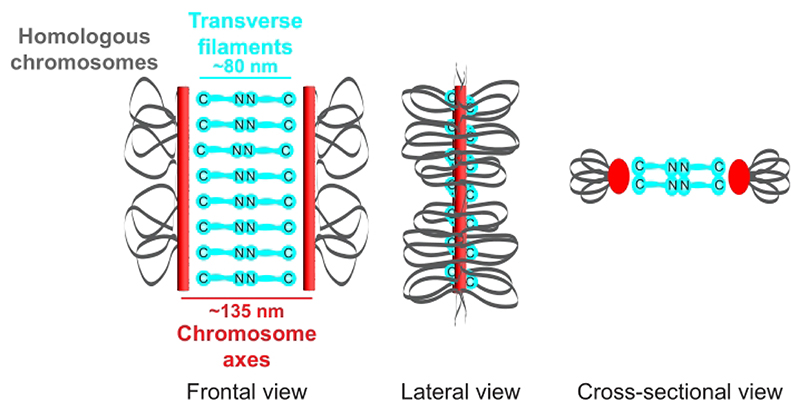
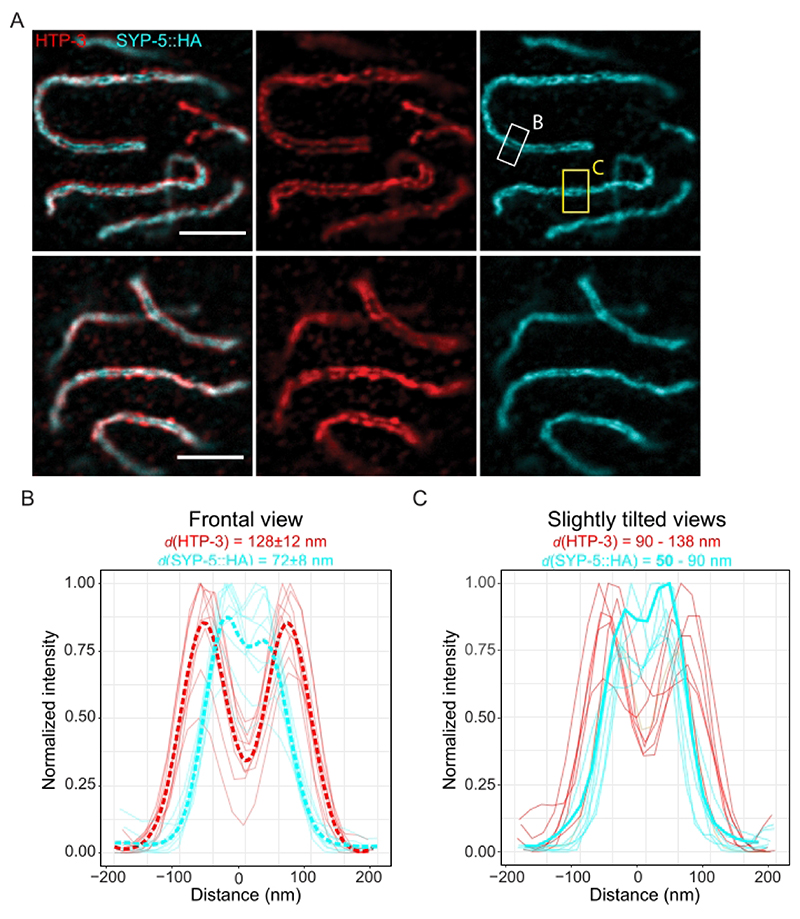
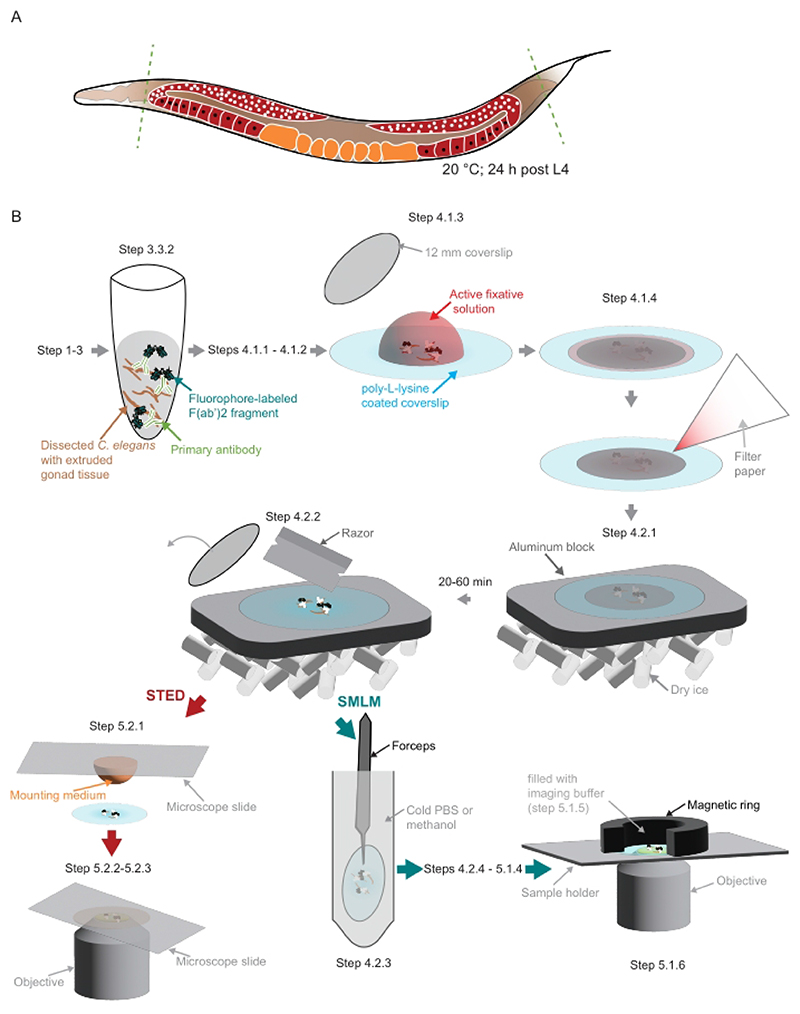
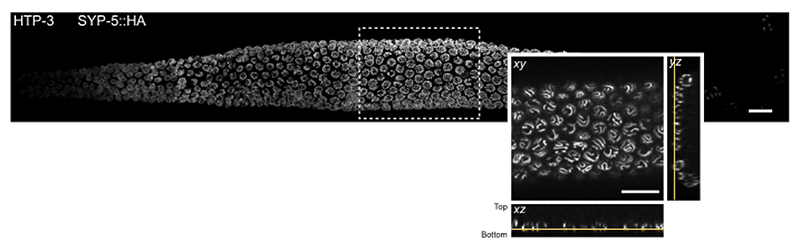
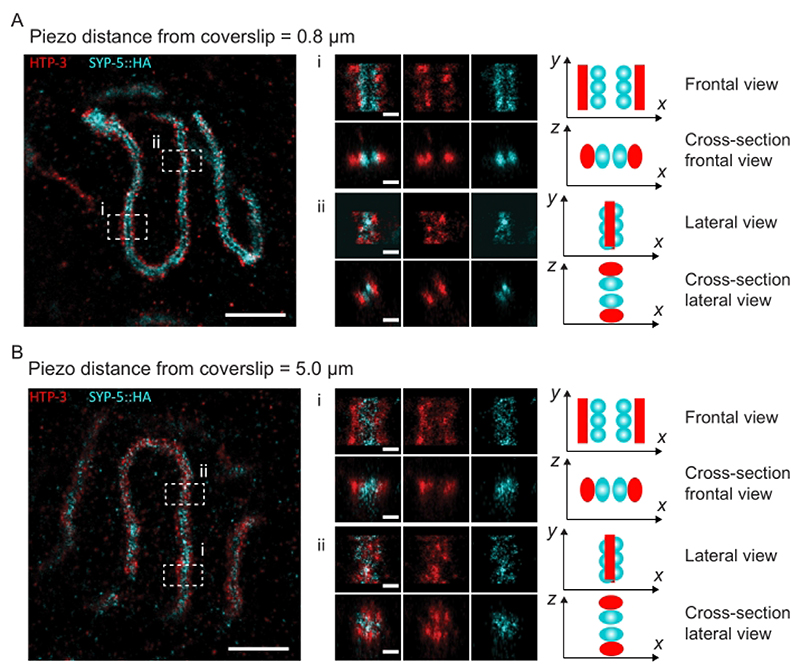
During meiosis, homologous chromosomes must recognize and adhere to one another to allow for their correct segregation. One of the key events that secures the interaction of homologous chromosomes is the assembly of the synaptonemal complex (SC) in meiotic prophase I. Even though there is little sequence homology between protein components within the SC among different species, the general structure of the SC has been highly conserved during evolution. In electron micrographs, the SC appears as a tripartite, ladder-like structure composed of lateral elements or axes, transverse filaments, and a central element. However, precisely identifying the localization of individual components within the complex by electron microscopy to determine the molecular structure of the SC remains challenging. By contrast, fluorescence microscopy allows for the identification of individual protein components within the complex. However, since the SC is only ~100 nm wide, its substructure cannot be resolved by diffraction-limited conventional fluorescence microscopy. Thus, determining the molecular architecture of the SC requires super-resolution light microscopy techniques such as structured illumination microscopy (SIM), stimulated-emission depletion (STED) microscopy, or single-molecule localization microscopy (SMLM). To maintain the structure and interactions of individual components within the SC, it is important to observe the complex in an environment that is close to its native environment in the germ cells. Therefore, we demonstrate an immunohistochemistry and imaging protocol that enables the study of the substructure of the SC in intact, extruded Caenorhabditis elegans germline tissue with SMLM and STED microscopy. Directly fixing the tissue to the coverslip reduces the movement of the samples during imaging and minimizes aberrations in the sample to achieve the high resolution necessary to visualize the substructure of the SC in its biological context.
在减数分裂过程中,同源染色体必须相互识别并结合,才能确保正确分离。确保同源染色体相互作用的一个关键事件是联会复合体 (SC) 在减数分裂前期 I 的组装。尽管不同物种的 SC 蛋白成分之间几乎没有序列同源性,但 SC 的一般结构在进化过程中高度保守。在电子显微镜下,SC 呈现出三部分、梯状结构,由侧元件或轴、横向细丝和中央元件组成。然而,通过电子显微镜精确识别复合物中各个组件的定位以确定 SC 的分子结构仍然具有挑战性。相比之下,荧光显微镜可以识别复合物中的各个蛋白成分。然而,由于 SC 只有约 100nm 宽,其亚结构无法通过传统的衍射受限荧光显微镜来解析。因此,确定 SC 的分子结构需要超分辨率光显微镜技术,如结构光照明显微镜 (SIM)、受激发射损耗 (STED) 显微镜或单分子定位显微镜 (SMLM)。为了保持 SC 中各个组件的结构和相互作用,重要的是在接近生殖细胞中其天然环境的环境中观察复合物。因此,我们展示了一种免疫组织化学和成像方案,该方案允许使用 SMLM 和 STED 显微镜研究完整的、挤出的秀丽隐杆线虫生殖系组织中 SC 的亚结构。直接将组织固定在载玻片上可以减少样品在成像过程中的运动,并最大限度地减少样品中的像差,以实现在生物背景下可视化 SC 亚结构所需的高分辨率。