
阿片类药物剂量轨迹与死亡率、阿片类药物使用障碍、持续阿片类药物治疗和健康计划退保的关联。
Opioid Dose Trajectories and Associations With Mortality, Opioid Use Disorder, Continued Opioid Therapy, and Health Plan Disenrollment.
机构信息
Institute for Health Research, Kaiser Permanente Colorado, Aurora.
Chemical Dependency Treatment Services, Colorado Permanente Medical Group, Aurora.
出版信息
JAMA Netw Open. 2022 Oct 3;5(10):e2234671. doi: 10.1001/jamanetworkopen.2022.34671.
IMPORTANCE
Uncertainty remains about the longer-term benefits and harms of different opioid management strategies, such as tapering and dose escalation. For instance, opioid tapering could help patients reduce opioid exposure to prevent opioid use disorder, but patients may also seek care elsewhere and engage in nonprescribed opioid use.
OBJECTIVE
To evaluate the association between opioid dose trajectories observed in practice and patient outcomes.
DESIGN, SETTING, AND PARTICIPANTS: This retrospective cohort study was conducted in 3 health systems in Colorado and Wisconsin. The study population included patients receiving long-term opioid therapy between 50 and 200 morphine milligram equivalents between August 1, 2014, and July 31, 2017. Follow-up ended on December 31, 2019. Data were analyzed from January 2020 to August 2022.
EXPOSURES
Group-based trajectory modeling identified 5 dosing trajectories over 1 year: 1 decreasing, 1 high-dose increasing, and 3 stable.
MAIN OUTCOMES AND MEASURES
Primary outcomes assessed after the trajectory period were 1-year all-cause mortality, incident opioid use disorder, continued opioid therapy at 1 year, and health plan disenrollment. Associations were tested using Cox proportional hazards regression and log-binomial models, adjusting for baseline covariates.
RESULTS
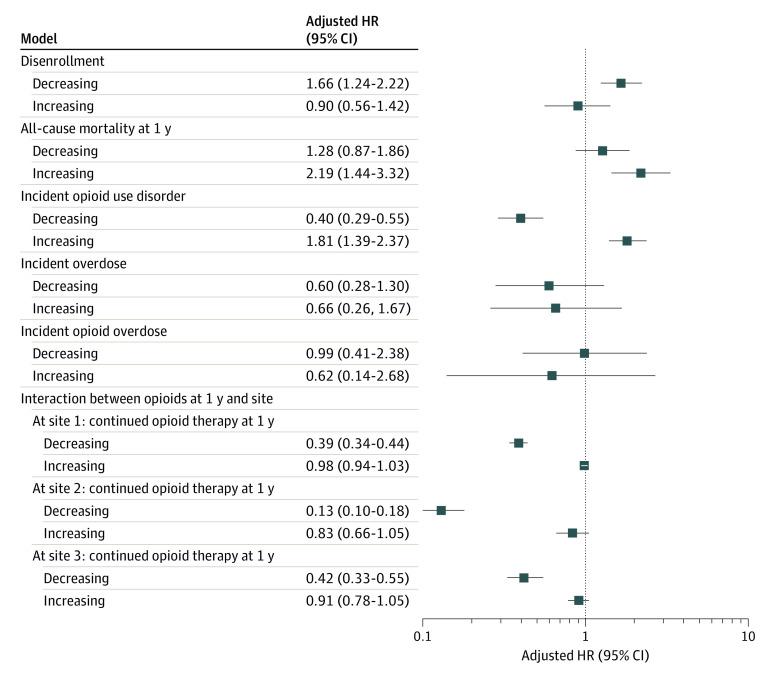
A total of 3913 patients (mean [SD] age, 59.2 [14.4] years; 2767 White non-Hispanic [70.7%]; 2237 female patients [57.2%]) were included in the study. Compared with stable trajectories, the decreasing dose trajectory was negatively associated with opioid use disorder (adjusted hazard ratio [aHR], 0.40; 95% CI, 0.29-0.55) and continued opioid therapy (site 1: adjusted relative risk [aRR], 0.39; 95% CI, 0.34-0.44), but was positively associated with health plan disenrollment (aHR, 1.66; 95% CI, 1.24-2.22). The decreasing trajectory was not associated with mortality (aHR, 1.28; 95% CI, 0.87-1.86). In contrast, the high-dose increasing trajectory was positively associated with mortality (aHR, 2.19; 95% CI, 1.44-3.32) and opioid use disorder (aHR, 1.81; 95% CI, 1.39-2.37) but was not associated with disenrollment (aHR, 0.90; 95% CI, 0.56-1.42) or continued opioid therapy (site 1: aRR, 0.98; 95% CI, 0.94-1.03).
CONCLUSIONS AND RELEVANCE
In this cohort study, decreasing opioid dose was associated with reduced risk of opioid use disorder and continued opioid therapy but increased risk of disenrollment compared with stable dosing, whereas the high-dose increasing trajectory was associated with an increased risk of mortality and opioid use disorder. These findings can inform opioid management decision-making.
重要性
不同阿片类药物管理策略的长期获益和危害仍存在不确定性,例如逐渐减少剂量和增加剂量。例如,逐渐减少阿片类药物的剂量有助于患者减少阿片类药物的暴露,以预防阿片类药物使用障碍,但患者也可能到其他地方寻求治疗,并使用未经处方的阿片类药物。
目的
评估在实践中观察到的阿片类药物剂量轨迹与患者结局之间的关联。
设计、地点和参与者:这项回顾性队列研究在科罗拉多州和威斯康星州的 3 个医疗系统中进行。研究人群包括 2014 年 8 月 1 日至 2017 年 7 月 31 日期间接受 50 至 200 吗啡毫克当量之间的长期阿片类药物治疗的患者。随访于 2019 年 12 月 31 日结束。数据分析于 2020 年 1 月至 2022 年 8 月进行。
暴露情况
基于群组的轨迹建模确定了 1 年内 5 种剂量轨迹:1 种剂量减少、1 种高剂量增加和 3 种稳定。
主要结果和措施
轨迹期后评估的主要结局包括 1 年全因死亡率、新发阿片类药物使用障碍、1 年内持续接受阿片类药物治疗和健康计划退保。使用 Cox 比例风险回归和对数二项式模型进行关联检验,调整了基线协变量。
结果
共纳入 3913 名患者(平均[标准差]年龄,59.2[14.4]岁;2767 名白人非西班牙裔[70.7%];2237 名女性患者[57.2%])。与稳定轨迹相比,剂量逐渐减少的轨迹与阿片类药物使用障碍呈负相关(调整后的危险比[aHR],0.40;95%CI,0.29-0.55)和持续接受阿片类药物治疗(地点 1:调整后的相对风险[aRR],0.39;95%CI,0.34-0.44),但与健康计划退保呈正相关(aHR,1.66;95%CI,1.24-2.22)。该轨迹与死亡率无关(aHR,1.28;95%CI,0.87-1.86)。相比之下,高剂量增加的轨迹与死亡率呈正相关(aHR,2.19;95%CI,1.44-3.32)和阿片类药物使用障碍呈正相关(aHR,1.81;95%CI,1.39-2.37),但与退保无关(aHR,0.90;95%CI,0.56-1.42)或持续接受阿片类药物治疗(地点 1:aRR,0.98;95%CI,0.94-1.03)。
结论和相关性
在这项队列研究中,与稳定剂量相比,逐渐减少阿片类药物剂量与阿片类药物使用障碍和持续接受阿片类药物治疗的风险降低相关,但与退保的风险增加相关,而高剂量增加的轨迹与死亡率和阿片类药物使用障碍的风险增加相关。这些发现可以为阿片类药物管理决策提供信息。

 Zotero 插件