School of Computer Science, Qufu Normal University, 276826, Rizhao, China.
BMC Genomics. 2022 Oct 5;23(1):686. doi: 10.1186/s12864-022-08908-8.
MicroRNAs (miRNAs) have been confirmed to be inextricably linked to the emergence of human complex diseases. The identification of the disease-related miRNAs has gradually become a routine way to unveil the genetic mechanisms of examined disorders.
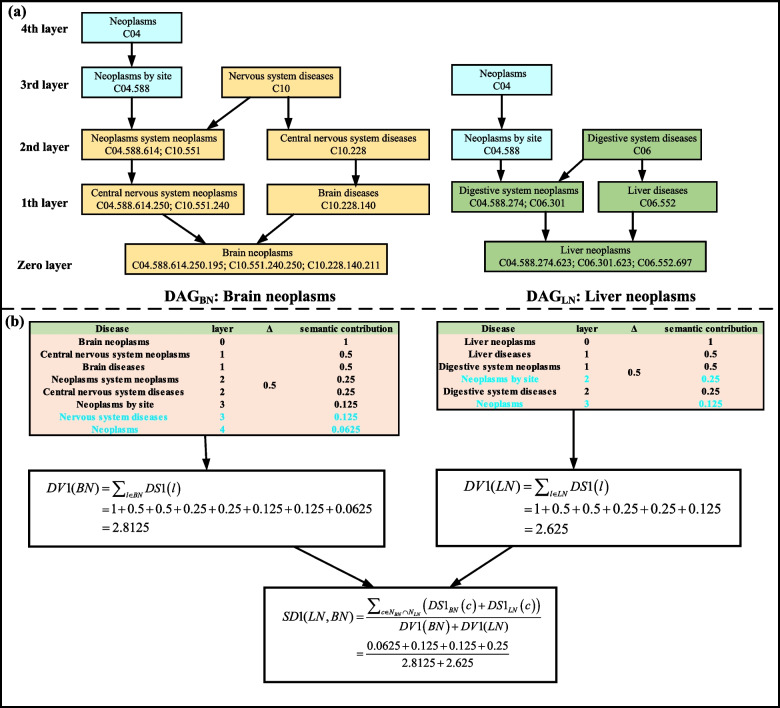
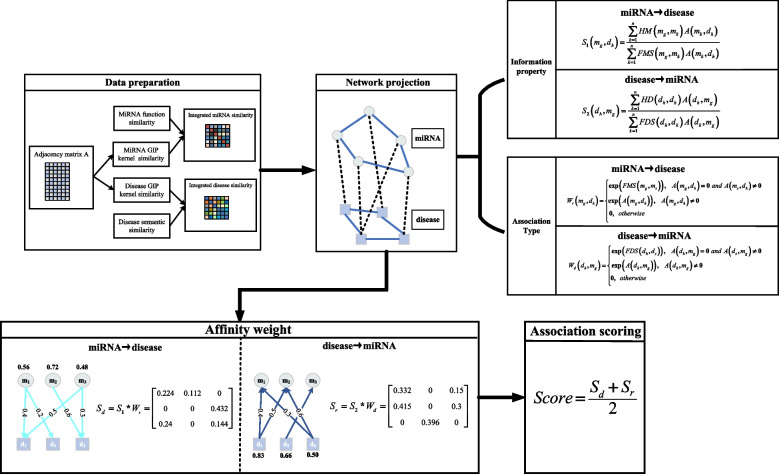
In this study, a method BLNIMDA based on a weighted bi-level network was proposed for predicting hidden associations between miRNAs and diseases. For this purpose, the known associations between miRNAs and diseases as well as integrated similarities between miRNAs and diseases are mapped into a bi-level network. Based on the developed bi-level network, the miRNA-disease associations (MDAs) are defined as strong associations, potential associations and no associations. Then, each miRNA-disease pair (MDP) is assigned two information properties according to the bidirectional information distribution strategy, i.e., associations of miRNA towards disease and vice-versa. Finally, two affinity weights for each MDP obtained from the information properties and the association type are then averaged as the final association score of the MDP. Highlights of the BLNIMDA lie in the definition of MDA types, and the introduction of affinity weights evaluation from the bidirectional information distribution strategy and defined association types, which ensure the comprehensiveness and accuracy of the final prediction score of MDAs.
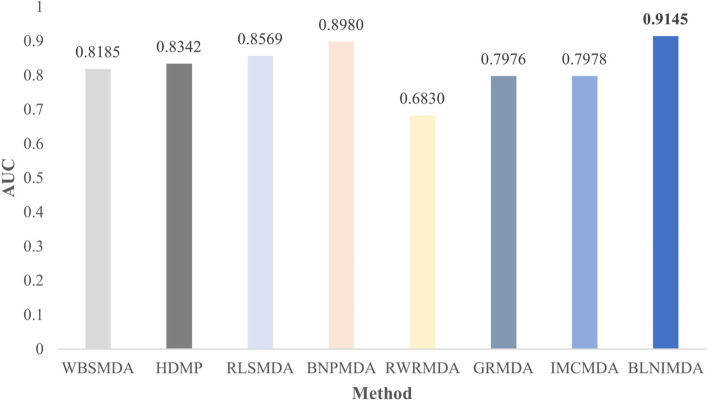
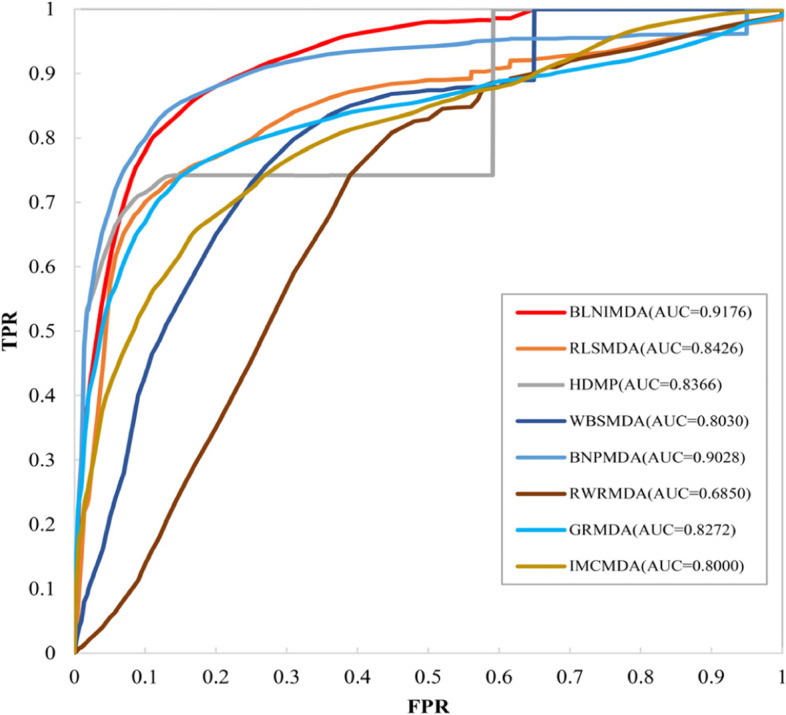
Five-fold cross-validation and leave-one-out cross-validation are used to evaluate the performance of the BLNIMDA. The results of the Area Under Curve show that the BLNIMDA has many advantages over the other seven selected computational methods. Furthermore, the case studies based on four common diseases and miRNAs prove that the BLNIMDA has good predictive performance.
Therefore, the BLNIMDA is an effective method for predicting hidden MDAs.
微小 RNA(miRNA)已被证实与人类复杂疾病的发生有着千丝万缕的联系。鉴定与疾病相关的 miRNA 已逐渐成为揭示所研究疾病遗传机制的常规方法。
在本研究中,提出了一种基于加权双层网络的 BLNIMDA 方法,用于预测 miRNA 和疾病之间隐藏的关联。为此,将 miRNA 和疾病之间的已知关联以及 miRNA 和疾病之间的综合相似性映射到双层网络中。基于开发的双层网络,将 miRNA-疾病关联(MDA)定义为强关联、潜在关联和无关联。然后,根据双向信息分配策略,为每个 miRNA-疾病对(MDP)分配两个信息属性,即 miRNA 对疾病的关联和反之亦然。最后,从信息属性和关联类型中获得的每个 MDP 的两个亲和权重然后平均作为 MDP 的最终关联得分。BLNIMDA 的亮点在于 MDA 类型的定义,以及从双向信息分配策略和定义的关联类型引入亲和权重评估,这确保了 MDA 最终预测得分的全面性和准确性。
使用五重交叉验证和留一法交叉验证来评估 BLNIMDA 的性能。曲线下面积的结果表明,BLNIMDA 优于其他七种选定的计算方法。此外,基于四种常见疾病和 miRNA 的案例研究证明了 BLNIMDA 具有良好的预测性能。
因此,BLNIMDA 是一种预测隐藏 MDA 的有效方法。